

How tokenized real-world assets are addressing the counterparty dilemma in cryptocurrency.
Modern derivatives and digital asset markets are continually hindered by operational friction. A recent survey by Nasdaq indicates that 70% of global companies encounter daily settlement failures. This systemic inefficiency compels institutions to hold excessive overnight collateral buffers, which locks up capital that could otherwise earn returns.
The challenge of mobilizing assets instantly across varied systems consistently undermines institutional performance. In their efforts to optimize balance sheets, market participants are turning to tokenized collateral as a viable solution to alleviate these execution frictions. By representing traditional assets on distributed ledgers, institutions can mitigate counterparty risk and enhance the flow of their capital across trading platforms.
**The Counterparty Risk Challenge in Digital Assets**
Traditional cryptocurrency market structures pose a significant obstacle for institutional investors. Historically, these platforms required participants to pre-fund their accounts before executing trades, leading to idle capital on trading venues and exposing users to centralized counterparty risk. Traditional financial market infrastructures intentionally separate custody, execution, and clearing to distribute risk. Aligning digital asset markets with these established standards has become a key focus.
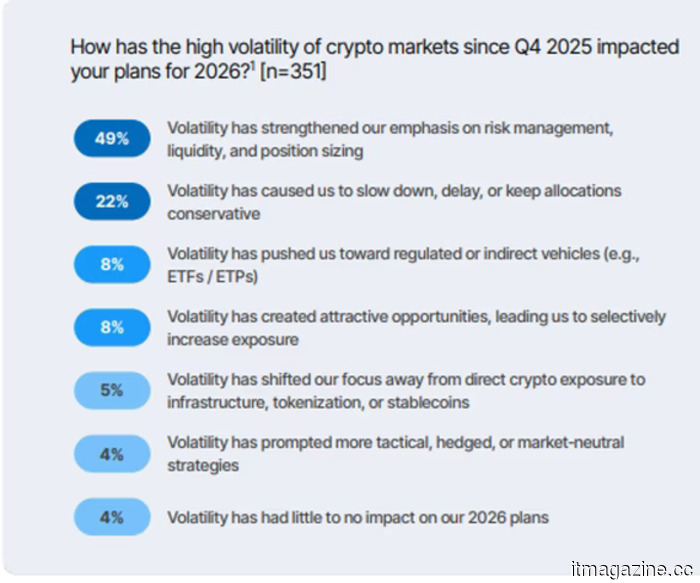
A recent EY-Parthenon survey of institutional investors reveals that 49% of participants have heightened their focus on risk management, liquidity, and position sizing in light of recent market fluctuations. Institutions need frameworks that minimize exposure while ensuring access to ample liquidity.
**Tokenized Money Market Funds as a Yield-Generating Bridge**
Exchanges are evolving their infrastructure to close this gap. Catherine Chen, Head of VIP and Institutional at Binance, points out that conforming to traditional standards drives current structural changes. She explains that “Binance was the first in the industry to introduce what we call banking tri-party.” This setup aims to enable traditional finance-type institutional investors to engage in activities on Binance in a manner that they find more familiar, allowing them to trade in an environment that feels comfortable and effectively separating asset storage from trade execution.
The core mechanics of this structural change revolve around off-exchange collateral solutions. In this framework, institutions can use yield-bearing assets through a regulated custodian to access trading margins. Participants can utilize tokenized money market fund shares, such as those from Franklin Templeton's Benji platform, keeping the underlying assets securely deposited with a partner like Ceffu. The custodian then mirrors the asset value for trading on Binance, completely eliminating the need to transfer the actual assets onto the exchange order book. This allows institutions to allocate capital efficiently without violating compliance requirements.
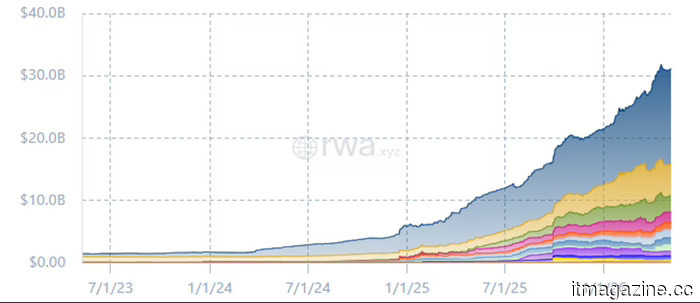
Using real-world assets in this way is gaining noticeable momentum. Recent figures from RWA.xyz show that the total distributed value in this sector has reached $31.12 billion, marking a 45% increase year-to-date.
Transferring these assets on-chain addresses specific execution challenges. The same Nasdaq research on market friction indicates that tokenizing collateral can prevent 1 in 8 failed trades and decrease overall operational costs by 12%.
By utilizing tokenized money market funds as trading collateral, Binance and Franklin Templeton provide a system that aligns with institutional risk frameworks without requiring traditional firms to conform to native cryptocurrency settlement practices.
**24/7 Capital Efficiency with TradFi Protections**
The financial advantages of this architecture specifically enhance capital efficiency. Traditional fiat or standard stablecoins on an exchange do not yield returns, acting as a drag on a firm’s balance sheet during low trading activity periods. Tokenized money market funds change this dynamic by allowing deployed capital to generate returns while simultaneously serving as margin in an always-open digital asset market.
This dual function reflects a broader shift in how corporate treasuries manage digital assets. According to PwC's Global Crypto Regulation Report 2026, institutional engagement has reached a “point of no return.” The consulting firm notes that digital assets are becoming integral to treasury operations and corporate balance-sheet management, moving well beyond mere speculation.
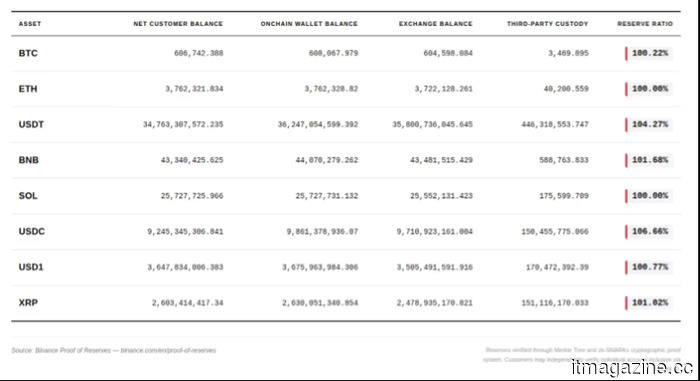
As institutional capital delves deeper into digital asset infrastructures, treasury teams are also seeking higher standards for collateral transparency and reserve verification. For instance, Binance recently revealed over $240 billion in net customer assets through its Proof of Reserves system, maintaining reserve ratios exceeding 100% across major assets like BTC, ETH, USDT, and USDC. This type of publicly verifiable reserve reporting is increasingly vital for firms assessing whether digital asset infrastructure can effectively support treasury-scale liquidity management while upholding institutional risk controls.
Firms are implementing blockchain technologies to manage funds behind the scenes, integrating these systems into their core financial operations. Off-exchange collateral structures facilitate this integration by preserving traditional financial safeguards without sacrificing the continuous liquidity characteristic of cryptocurrency markets.
**An Enhanced Infrastructure for Contemporary Markets**
Employing off-exchange collateral and tokenized real-world assets successfully aligns digital asset execution with conventional financial risk standards. Institutions are no longer forced to accept centralized exchange risk merely to access market liquidity. By retaining tokenized shares in regulated custody and mirroring their value for trading, market participants achieve a necessary division of responsibilities.
This operational enhancement addresses the capital inefficiencies historically penalizing firms for enforcing stringent risk controls. The digital asset ecosystem is
Other articles
 Apple should apply the Neo approach to its soon-to-be-released iPhone 18e, and I would definitely be interested.
Apple ought to reshape the iPhone 18e into a vibrant, compact, and personality-focused "Neo" device rather than producing yet another simplified version of its flagship series.
Apple should apply the Neo approach to its soon-to-be-released iPhone 18e, and I would definitely be interested.
Apple ought to reshape the iPhone 18e into a vibrant, compact, and personality-focused "Neo" device rather than producing yet another simplified version of its flagship series.
 Bolt collaborates with China's Dongfeng to introduce an electric vehicle ride-hailing fleet in South Africa.
Bolt, asserting a market share of over 50% in South Africa following a $180 million investment, will provide riders in Cape Town with Dongfeng's Box and 007 electric vehicles in response to increasing fuel prices.
Bolt collaborates with China's Dongfeng to introduce an electric vehicle ride-hailing fleet in South Africa.
Bolt, asserting a market share of over 50% in South Africa following a $180 million investment, will provide riders in Cape Town with Dongfeng's Box and 007 electric vehicles in response to increasing fuel prices.
 AI-driven cryptocurrency hacks siphon off $600 million from DeFi as North Korea takes advantage of the increase.
Two hacks in April resulted in North Korea-affiliated groups securing $600 million from Drift Protocol and Kelp DAO. Analysts indicate that AI played a role in hastening the attacks. Aave experienced a loss of $9 billion in deposits over the course of two days.
AI-driven cryptocurrency hacks siphon off $600 million from DeFi as North Korea takes advantage of the increase.
Two hacks in April resulted in North Korea-affiliated groups securing $600 million from Drift Protocol and Kelp DAO. Analysts indicate that AI played a role in hastening the attacks. Aave experienced a loss of $9 billion in deposits over the course of two days.
 AI-driven cryptocurrency hacks siphon off $600 million from DeFi, with North Korea taking advantage of the increase.
In April, two hacks associated with North Korea-related groups resulted in the theft of $600 million from Drift Protocol and Kelp DAO. Analysts claim that AI played a role in speeding up the attacks. Aave experienced a $9 billion drop in deposits within just two days.
AI-driven cryptocurrency hacks siphon off $600 million from DeFi, with North Korea taking advantage of the increase.
In April, two hacks associated with North Korea-related groups resulted in the theft of $600 million from Drift Protocol and Kelp DAO. Analysts claim that AI played a role in speeding up the attacks. Aave experienced a $9 billion drop in deposits within just two days.
 The Winklevoss twins invested 2.5 times the share price to get Gemini up and running.
Shares of Gemini Space Station saw a rise in premarket trading following Winklevoss Capital's purchase of 7.1 million new Class A shares for $100 million in bitcoin, priced at 2.5 times the market rate, in addition to a strong performance in Q1.
The Winklevoss twins invested 2.5 times the share price to get Gemini up and running.
Shares of Gemini Space Station saw a rise in premarket trading following Winklevoss Capital's purchase of 7.1 million new Class A shares for $100 million in bitcoin, priced at 2.5 times the market rate, in addition to a strong performance in Q1.
 Musk’s X has pledged to the UK regulator regarding hate speech, while the Grok investigation remains ongoing.
X has reached an agreement with Ofcom to assess illegal hate and terrorism content within an average of 24 hours and provide quarterly reports. An ongoing investigation in the UK concerning X, which includes Grok, is still active.
Musk’s X has pledged to the UK regulator regarding hate speech, while the Grok investigation remains ongoing.
X has reached an agreement with Ofcom to assess illegal hate and terrorism content within an average of 24 hours and provide quarterly reports. An ongoing investigation in the UK concerning X, which includes Grok, is still active.
How tokenized real-world assets are addressing the counterparty dilemma in cryptocurrency.
Tokenized money market funds are transforming institutional crypto trading by separating custody from execution, reducing settlement failures, and ensuring that capital remains yield-bearing at all times.