

The six biggest banks on Wall Street eliminated 15,000 positions and reported $47 billion in earnings. The CEOs ceased their pretenses.
The six largest banks in the United States eliminated 15,000 jobs in the first quarter of 2026 while collectively earning $47 billion in profits, a rise of 18 percent from the previous year. CEOs are openly attributing these job cuts to AI advancements. JPMorgan, Citi, Goldman Sachs, Bank of America, and Wells Fargo are now providing detailed AI productivity metrics during their earnings calls, indicating a shift from speculation to documented financial evidence regarding AI-driven workforce reductions.
The six major American banks saw a reduction of 15,000 employees in Q1 2026, generating a total profit of $47 billion. CEOs have stopped being cautious in their statements. Jamie Dimon noted that AI will lead to job eliminations, urging people to acknowledge this reality. Wells Fargo's Charlie Scharf remarked that anyone denying the impact of AI on employment is either uninformed or dishonest. Goldman Sachs sent an internal memo about impending job cuts and a hiring freeze under the OneGS 3.0 initiative. Citigroup's workforce decreased by 2,000 in just one quarter, while Bank of America's Brian Moynihan cited AI as a direct factor in job cuts just four months after reassuring employees about job security.
The uncertainty is gone. The earnings reports present the facts.
In detail, JPMorgan Chase plans to invest $19.8 billion in technology in 2026, an increase of $2 billion compared to the previous year. The bank has reported a 6 percent productivity rise in AI-utilizing divisions, twice the pre-AI rate. Operational roles have seen a 4 percent reduction, while support functions have decreased by 2 percent, contrasting with a 4 percent increase in positions related to client engagement and revenue generation. Dimon referred to this as a significant redeployment, noting that while headcount remains around 318,500, the makeup has changed, shifting from processing roles to sales roles.
Bank of America's AI assistant, Erica, is now saving the equivalent of 11,000 full-time jobs. Almost 90 percent of the bank’s 213,000 employees utilize the Erica for Employees tool. The bank has also incorporated AI to cut down 30 percent of workload in its coding process, which Moynihan estimated saves about 2,000 engineering jobs. The bank's quarterly profit reached $8.6 billion, surpassing the previous year’s by $1.6 billion, with part of the increase attributed to job cuts and automation.
Citigroup is undergoing the most extensive restructuring among the group, planning to eliminate around 20,000 jobs by the end of 2026, which is about 8 percent of its global workforce. When accounting for the segregation of its Banamex branch in Mexico, total job reductions may reach approximately 60,000, bringing the total workforce down to about 180,000. CEO Jane Fraser informed staff that the organization is not measured by effort, and that AI and automation will enable it to manage operational functions with fewer employees. Citi's AI tools now serve 182,000 employees across 84 countries, with over 70 percent adoption.
Goldman Sachs initiated OneGS 3.0 in late 2025, an AI-led reorganization of its operations aimed at areas such as client onboarding and regulatory reporting. Scheduled staffing reductions have been moved to the second quarter, targeting a cut of 3 to 5 percent. CEO David Solomon has anticipated that Goldman may have more employees in the long run, but internal communications suggest immediate job cuts.
Wells Fargo has decreased its workforce from 275,000 employees when Scharf joined in 2019 to over 210,000 by late 2025. AI-enhanced coding tools have made engineering teams 30 to 35 percent more efficient. Scharf indicated that while the number of coders has not been reduced, the output has significantly increased with the same workforce. Plans for 2026 have already factored in a smaller workforce. AI is now producing instant reports on borrower creditworthiness and pitchbooks for mergers, tasks historically done by mid-level investment bankers with six-figure salaries.
The overarching trend among all five banks is clear: profits are rising while headcounts are declining or being restructured. AI productivity increases are measurable and concrete. After previously reassuring employees that AI would assist rather than displace them, CEOs are now publicly recognizing that job replacement is occurring.
Oracle is planning to cut up to 30,000 employees to finance AI data centers, a restructuring expected to release an estimated $8 to $10 billion in annual cash flow for infrastructure development. The banks are engaging in a similar strategy, investing heavily in AI technology while recouping their investments by reducing workforces made redundant by the technology. However, unlike Oracle, which is constructing data centers, the banks are merely purchasing software that diminishes the need for personnel in existing operations.
The productivity gains are concentrated in specific sectors. Tasks involving code generation, document processing, credit analysis
Other articles
 JBL's latest Live 4 earbuds are available in three designs and feature a more advanced case with an integrated display.
JBL has refreshed its Live earbuds, offering three fit options, enhanced ANC, Hi-Res Audio, and a more intelligent touchscreen case that allows for additional controls directly from the case.
JBL's latest Live 4 earbuds are available in three designs and feature a more advanced case with an integrated display.
JBL has refreshed its Live earbuds, offering three fit options, enhanced ANC, Hi-Res Audio, and a more intelligent touchscreen case that allows for additional controls directly from the case.
 Jumia is reducing its workforce by an additional 10%. The focus is on AI, with profitability as the target.
Jumia is reducing its workforce by an additional 10%, attributing the decision to AI workflows. Since 2022, the company has eliminated over half of its employees. The deadline for achieving profitability in Q4 is approaching.
Jumia is reducing its workforce by an additional 10%. The focus is on AI, with profitability as the target.
Jumia is reducing its workforce by an additional 10%, attributing the decision to AI workflows. Since 2022, the company has eliminated over half of its employees. The deadline for achieving profitability in Q4 is approaching.
 The six largest banks on Wall Street eliminated 15,000 positions and reported $47 billion in profits. The CEOs ceased their pretense.
In the first quarter of 2026, the six largest banks in the U.S. eliminated 15,000 positions while earning $47 billion in profits. The CEOs acknowledged that AI played a significant role in these job cuts. JPMorgan, Citi, Goldman Sachs, Bank of America, and Wells Fargo are now sharing this information.
The six largest banks on Wall Street eliminated 15,000 positions and reported $47 billion in profits. The CEOs ceased their pretense.
In the first quarter of 2026, the six largest banks in the U.S. eliminated 15,000 positions while earning $47 billion in profits. The CEOs acknowledged that AI played a significant role in these job cuts. JPMorgan, Citi, Goldman Sachs, Bank of America, and Wells Fargo are now sharing this information.
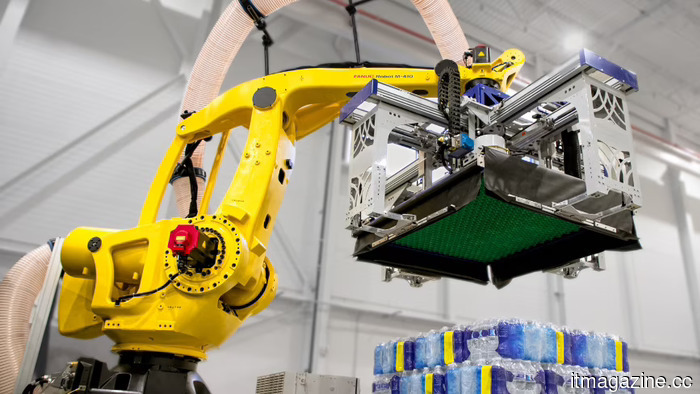 Fanuc collaborates with Google to integrate Gemini AI and the Intrinsic platform into 1.1 million industrial robots.
Fanuc's stock reached an all-time high following its collaboration with Google to incorporate Gemini Enterprise and the Intrinsic robotics platform into its global industrial robot systems.
Fanuc collaborates with Google to integrate Gemini AI and the Intrinsic platform into 1.1 million industrial robots.
Fanuc's stock reached an all-time high following its collaboration with Google to incorporate Gemini Enterprise and the Intrinsic robotics platform into its global industrial robot systems.
 Reasons why international companies are transitioning to cryptocurrency for mass payments.
Large-scale cryptocurrency payouts are transforming the global payment system. Discover how crypto payouts to various recipients provide gig platforms with a scalable, quicker, and more dependable option compared to conventional payment methods.
Reasons why international companies are transitioning to cryptocurrency for mass payments.
Large-scale cryptocurrency payouts are transforming the global payment system. Discover how crypto payouts to various recipients provide gig platforms with a scalable, quicker, and more dependable option compared to conventional payment methods.
 AMD introduces Zen 5 and 3D V-Cache to the Ryzen Pro 9000 series workstation processors.
3D V-Cache was originally seen as a gimmick for gaming. However, AMD has now made a significant entry into the workstation market with six new Ryzen PRO 9000 processors, including two featuring X3D stacking. The top model boasts 128MB of L3 cache and operates at 170W.
AMD introduces Zen 5 and 3D V-Cache to the Ryzen Pro 9000 series workstation processors.
3D V-Cache was originally seen as a gimmick for gaming. However, AMD has now made a significant entry into the workstation market with six new Ryzen PRO 9000 processors, including two featuring X3D stacking. The top model boasts 128MB of L3 cache and operates at 170W.
The six biggest banks on Wall Street eliminated 15,000 positions and reported $47 billion in earnings. The CEOs ceased their pretenses.
Summary: In the first quarter of 2026, the six largest banks in the US eliminated 15,000 positions while reporting profits of $47 billion. CEOs have directly attributed the job cuts to the use of AI. JPMorgan, Citi, Goldman Sachs, Bank of America, and Wells Fargo are now providing disclosures regarding this.