

Research shows that EV batteries can receive a significant 23% increase in lifespan with just a little encouragement from AI.
Charging rapidly and maintaining battery life had always seemed contradictory, but a new AI advancement suggests otherwise.
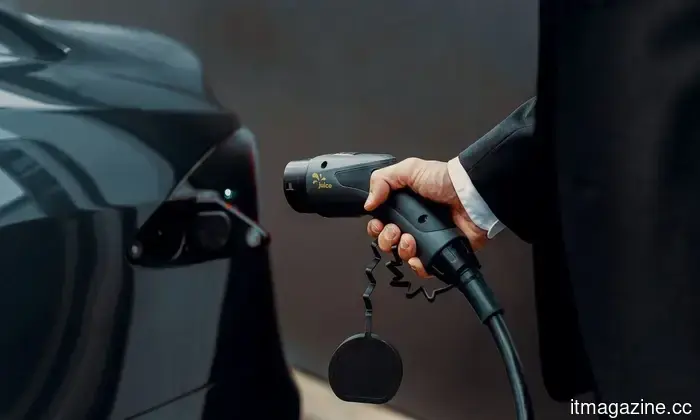
Electric vehicle (EV) battery charging technology has constantly sought to balance charging speed with battery durability. When charging is done too quickly, it can damage the battery, while excessively slow charging does not satisfy consumers.
Researchers Meng Yuan from Victoria University of Wellington and Changfu Zou from Chalmers University of Technology in Sweden may have found a solution to this enduring issue using an AI technique known as deep reinforcement learning, yielding promising results.
Their research, published in IEEE Transactions on Transportation Electrification, presents a novel AI charging system that learns to charge a battery quickly while simultaneously safeguarding its long-term well-being.
What distinguishes this new AI-driven charging system?
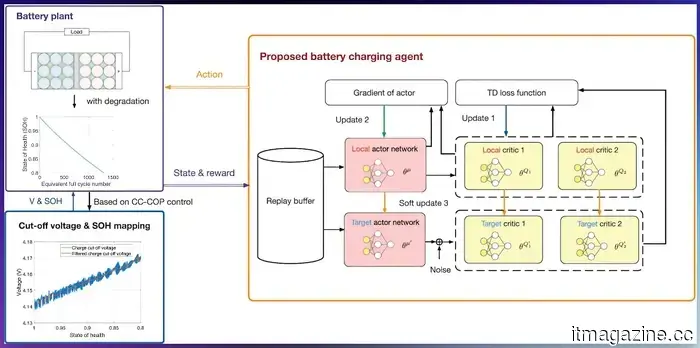
The system employs a machine learning technique called TD3, implying that the AI learns through trial and error over thousands of simulated charging experiences. Its uniqueness lies in its ability to adjust its charging strategy based on the battery's existing level of degradation.
In contrast, most conventional chargers follow a predetermined routine. They initiate charging at full power and gradually reduce it as the battery nears completion. The issue with this approach is that it does not differentiate between a new battery and one that has undergone numerous charging cycles.
The innovative AI charging approach circumvents this limitation by learning the correlation between the battery's health and the maximum safe charging voltage, enabling it to make more intelligent decisions in real time.
Does this method prolong battery lifespan?
Simulations that utilized a real-world battery model demonstrated that the proposed technique enhanced battery longevity by nearly 23% compared to standard charging practices, achieving 703 equivalent full cycles, in contrast to just 572 with traditional methods. Charging time also maintained competitiveness, with an 80% charge taking roughly 24 minutes.
The research team trained the entire framework on a consumer-grade desktop featuring an Intel i5 processor and an NVIDIA RTX 3060 GPU. As the researchers highlight, this "shows that the proposed framework can be effectively trained on commonly accessible hardware without requiring special high-performance computing clusters."
While it is still in the early stages and requires validation beyond simulations, if this method proves effective, intelligent charging may discreetly become one of the most significant enhancements for your upcoming EV.
Rachit is a veteran tech journalist with over seven years of experience in the consumer technology sector.
Alexa for Shopping is a talkative new AI assistant equipped with features to streamline your spending on Amazon.
After years of utilizing Alexa for inquiries, managing smart homes, playing music, and performing daily tasks, Amazon has identified a more straightforward role for it. Alexa is evolving into your personal shopper, designed to help you locate your desired items more swiftly and minimize hesitations before making a purchase.
Amazon is introducing Alexa for Shopping to U.S. customers across the Amazon Shopping app, Amazon.com, and Echo Show devices. It merges the existing Rufus shopping chatbot with Alexa+ personalization, allowing the assistant to enhance recommendations using product expertise, shopping history, browsing activities, past purchases, preferences, and conversations with Alexa. The service is available at no cost to signed-in Amazon customers and does not necessitate a Prime membership, an Echo device, or the Alexa app.
For individuals with hearing loss, sign language is not merely a means of communication; it is their primary language. Unfortunately, sign language is not commonly taught to those with normal hearing, creating a significant communication barrier. A research team in South Korea may have discovered an unexpectedly effective resolution to this longstanding challenge.
A recent study published in Science Advances reveals that a system named WRSLT (wirelessly connected, ring-type sign language translator) can accurately recognize and translate both American Sign Language and International Sign Language words with approximately 88% accuracy—and it functions in real time.
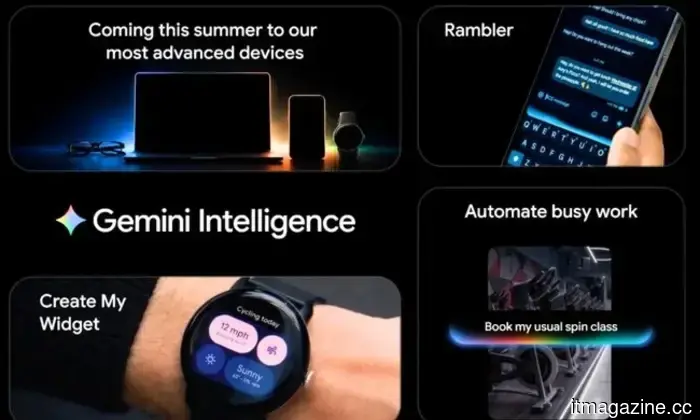
Google showcased Gemini Intelligence, Googlebooks, Android 17 updates, and other innovations during The Android Show 2026.
Google revealed an impressive lineup at its pre-I/O event, which serves as a lead-up to the main conference still a week away.
Every year, Google makes Android-related announcements in a pre-show prior to its annual I/O event. This year was no different, as The Android Show: I/O Edition proved to be anything but a mere teaser.
Google arrived well-prepared, unveiling a variety of software updates and a significant hardware surprise. Let’s delve into all the highlights, including a comprehensive AI overhaul, a much-needed security enhancement, an Android Auto redesign that appears tailored for 2026, and the introduction of a brand-new laptop category.



Other articles
 More advertisements are being introduced on Netflix, even though there are already 250 million subscribers paying to watch content that includes ads.
Netflix's ad-supported plan now attracts 250 million active viewers each month. If you're subscribed to the lower-cost option, your experience with ads on Netflix is set to change in some notable ways.
More advertisements are being introduced on Netflix, even though there are already 250 million subscribers paying to watch content that includes ads.
Netflix's ad-supported plan now attracts 250 million active viewers each month. If you're subscribed to the lower-cost option, your experience with ads on Netflix is set to change in some notable ways.
 Microsoft introduces tab intelligence to the Edge browser, and I genuinely hope Apple incorporates it into Safari.
Microsoft has enhanced Edge by allowing Copilot to reason across all of your open tabs. This feature is truly beneficial, and it makes me hope that Apple will introduce something similar for Safari.
Microsoft introduces tab intelligence to the Edge browser, and I genuinely hope Apple incorporates it into Safari.
Microsoft has enhanced Edge by allowing Copilot to reason across all of your open tabs. This feature is truly beneficial, and it makes me hope that Apple will introduce something similar for Safari.
 Tarot card readers are incorporating ChatGPT into their divination practices, and I am completely taken aback by this shift towards AI.
Tarot card readers are utilizing ChatGPT to interpret their spreads, illustrating the transition of AI from aspects of productivity to areas involving grief, faith, and the search for meaning, where assured responses can diminish human uncertainty.
Tarot card readers are incorporating ChatGPT into their divination practices, and I am completely taken aback by this shift towards AI.
Tarot card readers are utilizing ChatGPT to interpret their spreads, illustrating the transition of AI from aspects of productivity to areas involving grief, faith, and the search for meaning, where assured responses can diminish human uncertainty.
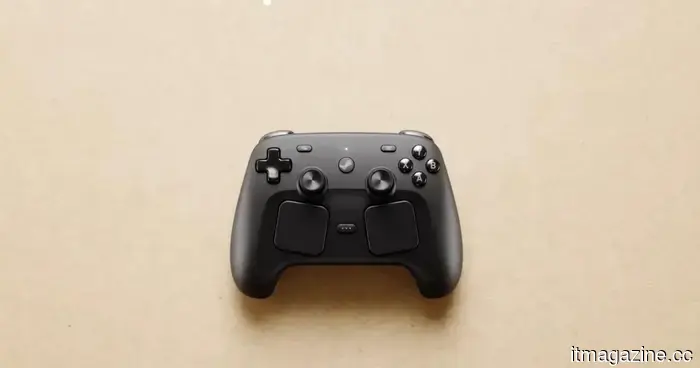 If you drop the Steam Controller, it will make a loud noise, and I’m unsure how to react to that.
Valve included a humorous Easter egg in the new Steam Controller, leading many to abandon their sold-out $99 controllers just to activate the famous Wilhelm scream.
If you drop the Steam Controller, it will make a loud noise, and I’m unsure how to react to that.
Valve included a humorous Easter egg in the new Steam Controller, leading many to abandon their sold-out $99 controllers just to activate the famous Wilhelm scream.
 Research reveals that EV batteries only require a little AI enhancement to receive a significant 23% increase in their lifespan.
Researchers have created a charging system powered by AI that accelerates the charging of electric vehicles while simultaneously safeguarding battery health, which could lead to an increase in battery life of almost 23%.
Research reveals that EV batteries only require a little AI enhancement to receive a significant 23% increase in their lifespan.
Researchers have created a charging system powered by AI that accelerates the charging of electric vehicles while simultaneously safeguarding battery health, which could lead to an increase in battery life of almost 23%.
 I tried out the AI Image to Video 2.0 feature on the Honor 600 Pro, and it exceeded my expectations.
Honor's AI Image to Video 2.0 represents a considerable improvement compared to the version that debuted with the 400 series last year. I experimented with the templates and tested custom prompts, and here's what you should be aware of.
I tried out the AI Image to Video 2.0 feature on the Honor 600 Pro, and it exceeded my expectations.
Honor's AI Image to Video 2.0 represents a considerable improvement compared to the version that debuted with the 400 series last year. I experimented with the templates and tested custom prompts, and here's what you should be aware of.
Research shows that EV batteries can receive a significant 23% increase in lifespan with just a little encouragement from AI.
Researchers have created an AI-driven charging system that accelerates electric vehicle charging while simultaneously safeguarding battery health, potentially increasing battery lifespan by almost 23%.