

How apprenticeship programs are broadening access to job opportunities.
Imagine a woman in her mid-30s weighing her options as she tries to juggle household finances alongside a long-time desire to pursue a more purposeful career. Transitioning into fields like teaching or nursing is deeply meaningful, but many degree programs necessitate taking time away from a reliable paycheck and entail a financial commitment that requires strategic planning. Her determination to advance is strong, even as this next step demands tough compromises.
This kind of decision appears to be increasingly prevalent, leading to innovative approaches regarding how education and work can integrate. Organizations such as Craft Education, a nonprofit focused on workforce data, and WGU, a national nonprofit university with a competency-based system, are facilitating this transformation. They acknowledge that the choice of higher education is frequently presented as a dilemma between investing significantly in a degree or opting out of formal education altogether. Their initiatives introduce apprenticeship degrees as a viable alternative, enabling individuals to earn while they study, gain experience alongside their academic pursuits, and enter roles that are in line with their training.
These ideas are surfacing at a time when the broader context is already prompting contemplation. Student loan debt in the United States has soared to $1.8 trillion, with average balances surpassing $39,000 for federal borrowers. Stacey Ludwig Johnson, Executive Director of Work-Based Pathways at WGU, asserts, “The financial implications of obtaining a degree are more burdensome than ever, and when people observe how graduates are faring in the job market, it adds another layer of uncertainty.”
A report highlights that the unemployment rate among recent graduates hit 5.8% in early 2025, while underemployment exceeded 40%. Additionally, findings from 2024 reveal that over half of graduates start their careers in positions that do not require a degree, a situation that Craft Education and WGU believe can affect long-term career advancement.
Mallory Dwinal-Palisch, President of Craft Education, remarks, “The relationship between education and employment has changed significantly. While a degree still has value, the timing and structure of obtaining one are now critical, especially in careers that necessitate both theoretical study and practical training.”
Professions like teaching and nursing exemplify this issue vividly. Preparing for these careers often necessitates extended periods of clinical practice or student teaching, which are vital for developing professional skills. However, fulfilling these requirements can lead to a lengthy hiatus from paid work. Dwinal-Palisch emphasizes that for many aspiring professionals, the challenge lies in managing this transition while ensuring financial security.
Abigail Seldin, Chief Growth Officer at Scholarship America, observes an increasing recognition among government, business, and philanthropic sectors that the cost of living—covering expenses like rent, groceries, transportation, and childcare—can hinder promising learners when their training interrupts work hours. “Scholarship sponsors across various sectors are investing to assist learners in achieving their credentials,” Seldin states. “Apprenticeship retention grants and emergency aid scholarships remain crucial when unexpected expenses, like a flat tire or a child’s prescription, arise, particularly when paired with a paid training opportunity.”
Apprenticeship degrees offer a different framework by merging training elements within paid roles. Instead of segregating education from employment, participants engage in real work settings while advancing through academic programs. “We are beginning to see a system develop where learning and working are viewed as part of a continuous experience,” Dwinal-Palisch points out. “This alignment can pave the way for individuals whose aspirations have always been there, even when the path forward seems remote.” Her viewpoint reflects her extensive work aimed at linking education with workforce demands, especially in sectors with continuous growth.
These programs combine several components. Participants start with compensated, hands-on experience, while their daily tasks contribute to academic credit. Degree programs are crafted in collaboration with employers and often meet licensure qualifications in areas like healthcare and education. Consequently, individuals strive toward a credential while accumulating experience that corresponds with the profession's realities.
Ludwig Johnson notes that this alignment also addresses a broader challenge many graduates face in entering the job market. “Employers frequently prefer candidates who possess both academic qualifications and practical experience, even for entry-level positions,” she explains. “Apprenticeship degree pathways meet this demand by integrating both aspects throughout the same journey.”
Ludwig Johnson links this model to a larger change in the recognition of learning. She points out, “There is a growing understanding that mastery can be shown through both application and knowledge. When individuals take on genuine responsibilities while studying, they can demonstrate readiness and competence in ways that are directly applicable to the workplace.”
As Dwinal-Palisch notes, the significance of this approach spans a diverse group of learners. While recent high school graduates are an important demographic, working adults contemplating career changes are equally essential in this discussion. Individuals adjusting to changes brought on by automation, as well as those managing family and financial obligations, are seeking options that better fit their situations. “Many workers possess valuable experience that might not yet
Other articles
 Nadella was concerned that Microsoft might end up being 'the next IBM' following the unveiling of a $92 billion return projection for OpenAI during the trial.
Microsoft CEO Satya Nadella stated during the Musk v. Altman trial that he was concerned his company might follow in IBM's footsteps. A memo from Brad Smith estimated that OpenAI's $13 billion investment could yield a $92 billion return.
Nadella was concerned that Microsoft might end up being 'the next IBM' following the unveiling of a $92 billion return projection for OpenAI during the trial.
Microsoft CEO Satya Nadella stated during the Musk v. Altman trial that he was concerned his company might follow in IBM's footsteps. A memo from Brad Smith estimated that OpenAI's $13 billion investment could yield a $92 billion return.
 GM terminates 600 IT employees as it transitions to software-defined vehicles, reallocating skills towards AI development.
General Motors is reducing its IT workforce by 500-600 employees and bringing on board engineers skilled in AI. The company is stepping back from electric vehicles and robotaxis, instead focusing more on AI-driven software-defined vehicles.
GM terminates 600 IT employees as it transitions to software-defined vehicles, reallocating skills towards AI development.
General Motors is reducing its IT workforce by 500-600 employees and bringing on board engineers skilled in AI. The company is stepping back from electric vehicles and robotaxis, instead focusing more on AI-driven software-defined vehicles.
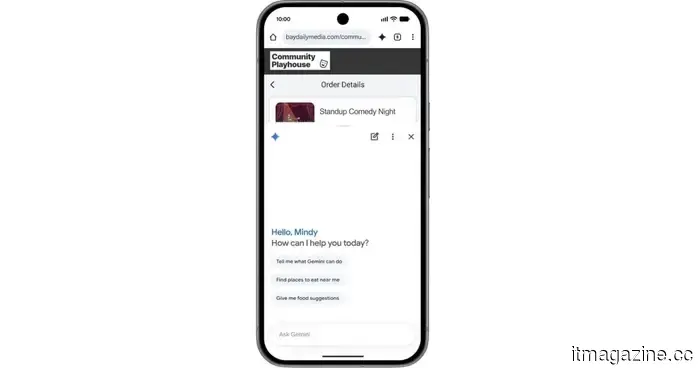 The upcoming Chrome update from Google is significant for Android users.
Chrome on Android is receiving a significant AI enhancement with Gemini at its center, transforming the browser into a more useful assistant capable of comprehending pages, managing tasks, and streamlining your web experience.
The upcoming Chrome update from Google is significant for Android users.
Chrome on Android is receiving a significant AI enhancement with Gemini at its center, transforming the browser into a more useful assistant capable of comprehending pages, managing tasks, and streamlining your web experience.
 GameStop's $56 billion offer is rejected by eBay.
eBay's board has dismissed GameStop's $56 billion acquisition proposal, stating it is neither credible nor appealing, pointing to uncertainties in financing and leverage issues.
GameStop's $56 billion offer is rejected by eBay.
eBay's board has dismissed GameStop's $56 billion acquisition proposal, stating it is neither credible nor appealing, pointing to uncertainties in financing and leverage issues.
 AI voice conversations often come across as uncomfortable because assistants struggle with timing their responses.
Thinking Machines Lab is evaluating full duplex AI capable of listening and responding simultaneously, but the true assessment will be how beneficial faster voice conversations seem once individuals have the opportunity to experience them.
AI voice conversations often come across as uncomfortable because assistants struggle with timing their responses.
Thinking Machines Lab is evaluating full duplex AI capable of listening and responding simultaneously, but the true assessment will be how beneficial faster voice conversations seem once individuals have the opportunity to experience them.
 Claude has recently taken control of the data center that Grok required the most.
Anthropic's agreement with SpaceX provides Claude with a significant increase in computing power from the Memphis data center, which xAI arguably required the most, highlighting how critically infrastructure influences the competition between Grok and its competitors.
Claude has recently taken control of the data center that Grok required the most.
Anthropic's agreement with SpaceX provides Claude with a significant increase in computing power from the Memphis data center, which xAI arguably required the most, highlighting how critically infrastructure influences the competition between Grok and its competitors.
How apprenticeship programs are broadening access to job opportunities.
Craft Education and WGU are working together to broaden apprenticeship degree pathways that integrate paid employment, hands-on training, and academic advancement in areas such as teaching and nursing.