
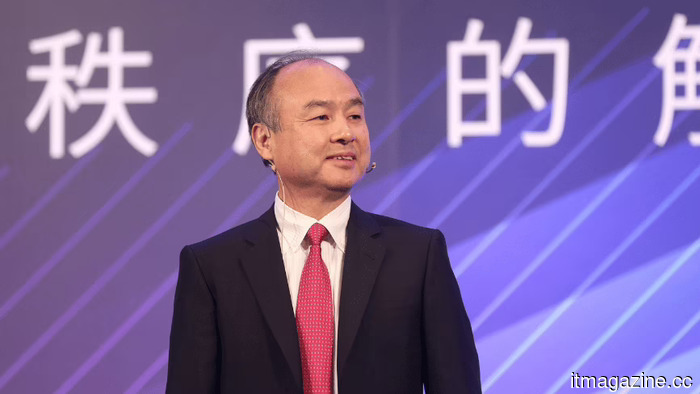
SoftBank reduces its margin loan target backed by OpenAI by 40% to $6 billion.
Lenders have expressed concerns regarding the valuation of OpenAI shares as collateral. This development comes two weeks after the initial $10 billion request was disclosed and indicates that even with an $852 billion primary round, there is still a significant gap between the valuation and what banks are willing to lend against it.
SoftBank Group has reduced the amount of its margin loan request tied to its OpenAI stake to as low as $6 billion from the original $10 billion due to hesitation from several creditors regarding the valuation, as reported by Bloomberg on Friday. According to Bloomberg's sources, the Tokyo-based conglomerate and the bankers managing the syndication have spent recent weeks guiding lenders through a smaller transaction.
Negotiations are still ongoing, and the final amount may be adjusted again. The pricing details have not been updated; the initial proposal indicated a margin of approximately 425 basis points above SOFR, which would result in a borrowing rate nearing 7.9% based on current rates.
The borrowing structure presents an unusual situation for SoftBank—not in terms of size but in terms of collateral. Margin loans secured by publicly traded shares are common treasury tools, while those backed by stakes in private companies are less so, with their pricing reliant on a lender's confidence that the valuation will remain stable under pressure and that recourse options are substantial if it does not.
The pushback from lenders relates to OpenAI’s post-money valuation of $852 billion, established during the primary round in March, which is both recent and substantial. SoftBank's initial $10 billion margin loan request was already considered conservative in terms of advance rates, and the revised request indicates an increased willingness on the part of lenders to apply a more significant haircut.
Two main points support the lenders' position. First is the secondary market, where reported pricing for OpenAI shares since the primary close has been below the $852 billion threshold, with sellers significantly outnumbering buyers in recent transactions. Second, the mounting debt that SoftBank has already accumulated against its position plays a role. The group secured a $40 billion bridge loan for its latest investment in OpenAI, utilizing OpenAI shares to leverage additional funds. Each new layer of debt decreases the cushion available to banks in case of a market downturn affecting the collateral.
S&P downgraded SoftBank’s credit outlook last month, expressing concerns that the extent of OpenAI exposure could threaten the group's liquidity and the quality of its overall asset base. The agency did not need to specifically point out the margin loan; the overarching signal is clear.
Upon completion of the new $30 billion investment, SoftBank’s total committed exposure to OpenAI will approximate $64.6 billion, granting the group about 13% ownership in the company. To reach this figure, Masayoshi Son liquidated the entire Nvidia stake (roughly $5.83 billion) and the remaining T-Mobile shares (around $12.73 billion) between June and December 2025, followed by borrowing the $40 billion bridge loan that is shared among eight banks.
As of now, the group's total debt amounts to approximately ¥20.45 trillion ($135 billion). The reduced margin loan would further increase this total, but it would do so during a favorable timeframe: secured, available for withdrawal, and refinancable, rather than being tied to long-term bonds.
The capital is being utilized at a consistent pace. Besides the OpenAI fundraising, SoftBank has invested in Stargate, a collaborative AI infrastructure project with OpenAI and Oracle, along with other related infrastructure, such as transforming a Sharp LCD factory into a battery production facility for AI data centers. All of these investments will require cash within the coming quarters.
SoftBank does not lack liquidity. The group has access to various debt tranches and has historically managed to refinance throughout different market cycles.
The key interest in regards to the margin loan is not whether the firm secures $6 billion, $8 billion, or returns to the original $10 billion, but rather what the current trajectory indicates about how the financing landscape is valuing OpenAI in relation to its initial valuations.
Two interpretations are being considered. The more optimistic view is that creditors are being cautiously procedural about a nascent collateral class and that the haircut will diminish as OpenAI matures, along with a clearer public valuation. The more pessimistic interpretation suggests that secondary-market pricing is accurate and that the primary round valuation was an outlier; if this is the case, the entire SoftBank-OpenAI investment thesis may be worth significantly less than advertised.
Neither interpretation can be definitively proven at this point. Both perspectives will be scrutinized when SoftBank reports its earnings in early August, when OpenAI is expected to share updated revenue figures, and when the next secondary lot is sold.
A closing at $6 billion with the original 425 basis points spread, or a wider spread for the same amount, will both indicate the actual cost of borrowing against private AI equity. Additionally, it
Other articles
 Top Global HR Software for International Businesses in 2026
We evaluated the top global HR software solutions for international businesses in 2026, featuring HiBob, Rippling, BambooHR, Personio, UKG, Sage HR, and ADP.
Top Global HR Software for International Businesses in 2026
We evaluated the top global HR software solutions for international businesses in 2026, featuring HiBob, Rippling, BambooHR, Personio, UKG, Sage HR, and ADP.
 Top Global HR Software for International Businesses in 2026
In 2026, we evaluated the top global HR software platforms for international businesses, including HiBob, Rippling, BambooHR, Personio, UKG, Sage HR, and ADP.
Top Global HR Software for International Businesses in 2026
In 2026, we evaluated the top global HR software platforms for international businesses, including HiBob, Rippling, BambooHR, Personio, UKG, Sage HR, and ADP.
 Supercell purchases Metacore, while Tencent enhances its foothold in the worldwide casual gaming sector.
This week, Supercell announced that it has fully acquired Metacore along with its main game, Merge Mansion, a move that has garnered significant attention.
Supercell purchases Metacore, while Tencent enhances its foothold in the worldwide casual gaming sector.
This week, Supercell announced that it has fully acquired Metacore along with its main game, Merge Mansion, a move that has garnered significant attention.
 SoftBank reduces the target for its OpenAI-supported margin loan by 40% to $6 billion.
SoftBank has reduced its margin loan target supported by OpenAI from $10 billion to potentially as low as $6 billion due to lenders' worries regarding the valuation of OpenAI shares used as collateral.
SoftBank reduces the target for its OpenAI-supported margin loan by 40% to $6 billion.
SoftBank has reduced its margin loan target supported by OpenAI from $10 billion to potentially as low as $6 billion due to lenders' worries regarding the valuation of OpenAI shares used as collateral.
 ChatGPT now allows you to designate someone to reach out to if you're feeling down.
ChatGPT can now notify a trusted person if situations become serious. This may be a straightforward feature, but it could be one of the most human-like aspects that OpenAI has incorporated into its chatbot.
ChatGPT now allows you to designate someone to reach out to if you're feeling down.
ChatGPT can now notify a trusted person if situations become serious. This may be a straightforward feature, but it could be one of the most human-like aspects that OpenAI has incorporated into its chatbot.
 Apple's upcoming AirPods may provide Siri with visual capabilities, and they are currently in the testing phase.
AirPods equipped with cameras may seem outrageous, but they could be just what Siri requires to break free from outdated limitations.
Apple's upcoming AirPods may provide Siri with visual capabilities, and they are currently in the testing phase.
AirPods equipped with cameras may seem outrageous, but they could be just what Siri requires to break free from outdated limitations.
SoftBank reduces its margin loan target backed by OpenAI by 40% to $6 billion.
SoftBank has reduced its margin loan target backed by OpenAI from $10 billion to as low as $6 billion due to lenders' worries regarding the valuation of OpenAI shares used as collateral.