
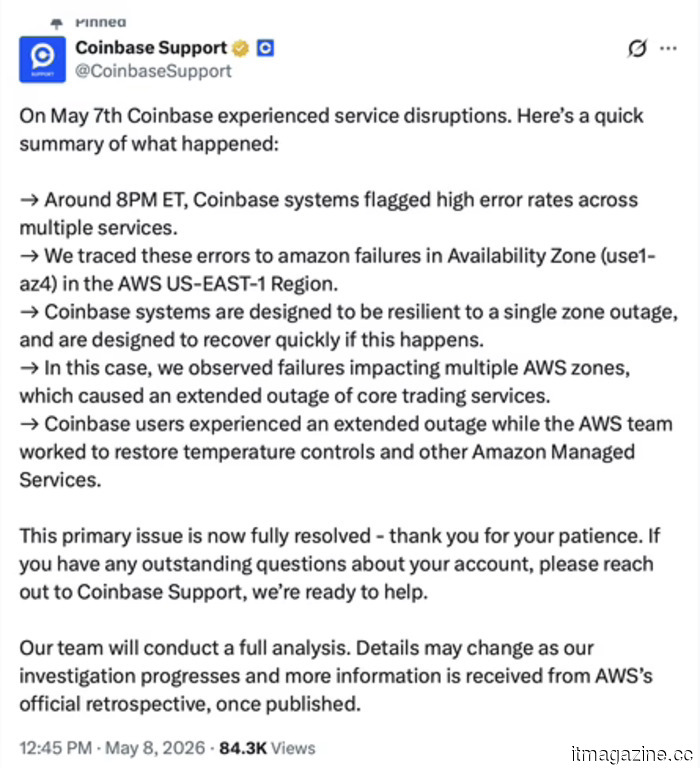
On Monday, Coinbase laid off 700 employees, reported a loss of $394 million on Thursday, and experienced a blackout on Friday due to an overheating data center.
**Summary**: Coinbase experienced a seven-hour outage on Friday due to an overheating data center in Virginia owned by AWS, marking a challenging week in which the exchange announced 700 job cuts and a $394 million quarterly loss.
On Monday, Coinbase revealed it would eliminate approximately 700 positions, about 14% of its workforce. By Thursday, the company disclosed a $394 million quarterly loss. The outage on Friday stemmed from a thermal failure at an AWS facility, leading to a halt in all trading, transfers, and essential exchange operations from roughly 9 a.m. Singapore time until around 4 p.m. The company's retail app also faced performance issues. The problem began in one AWS availability zone but escalated across multiple zones, overwhelming the systems in place for handling such failures.
The AWS US-EAST-1 region, noted for being the oldest and most utilized, supports a significant portion of internet infrastructure. As a result, when it encounters issues, the repercussions affect numerous customers, including Coinbase, CME Group, and FanDuel. AWS cited rising temperatures within a single data center as the cause of power disruptions to EC2 instances and EBS storage volumes.
This incident highlights broader challenges related to data centers generating significant heat and the need for effective cooling systems. While US utilities plan to invest $1.4 trillion by 2030 for AI data centers, this focus is primarily on electricity supply instead of the cooling systems required to prevent overheating issues like the one experienced by Coinbase.
This marks the second major AWS outage within seven months; the previous one in October 2025 lasted 15 hours and cost an estimated $1.1 billion. While the causes differed—one related to DNS failures and the current to overheating—the resulting impact of critical services being taken offline remained consistent.
Coinbase’s outage compounded an already difficult week. On Monday, CEO Brian Armstrong announced significant layoffs, framing them as part of a restructuring toward AI capabilities rather than a retreat. The company sought to automate workflows and replace traditional managers with "player-coaches," intending to save $120 to $150 million annually but incurring $50 to $60 million in severance costs.
On Thursday, Coinbase reported a 31% decline in year-over-year revenue, falling short of market expectations. Despite the net loss of $394 million and the $482 million in unrealized losses on crypto assets, Coinbase did note a record 8.6% market share of global crypto trading volume.
The outage underscored a widespread issue within the tech industry: reliance on cloud providers for critical services. Coinbase's operations hinge on infrastructure it doesn’t own and cannot control, leaving it vulnerable when external factors disrupt service.
Concerns over this reliance on cloud providers like AWS, Microsoft Azure, and Google Cloud have grown among industry analysts and regulators. Coinbase acknowledged that its systems were intended to be resilient to outages in a single availability zone, but this failure spread to multiple zones, illustrating a gap in the design’s assumptions.
As tech companies reported combined AI capital expenditures exceeding $650 billion, the question arose whether their expansions prioritize capacity over resilience, neglecting cooling and other essential infrastructure.
Coinbase has faced similar outages before, especially during periods of market volatility. This week’s event, however, resulted from infrastructure failure rather than increased traffic. The company plans a full analysis of the situation, but the fundamental question remains: should a major crypto exchange depend entirely on a single cloud provider’s infrastructure?
While Armstrong was busy promoting AI’s potential benefits for Coinbase, the reality turned into a seven-hour outage with customers left frustrated and unable to access their accounts, relying on systems that the company does not control.
Other articles
 Trump's proposal for H-1B visas would raise the minimum salary for entry-level tech positions to approximately $162,000.
A rule from the Trump administration would increase H-1B prevailing wages by approximately 30% at the entry-level tier, setting the minimum salary for foreign tech workers in San Francisco at $162,000.
Trump's proposal for H-1B visas would raise the minimum salary for entry-level tech positions to approximately $162,000.
A rule from the Trump administration would increase H-1B prevailing wages by approximately 30% at the entry-level tier, setting the minimum salary for foreign tech workers in San Francisco at $162,000.
 Intel's stock has tripled under Lip-Bu Tan, as relationships with Trump, Musk, and Apple surpass the company's current manufacturing execution needs.
Under CEO Lip-Bu Tan, Intel's stock has increased threefold, gaining the approval of Trump, collaborating with Musk on Terafab, and drawing in Apple. However, the factories continue to fall short compared to TSMC.
Intel's stock has tripled under Lip-Bu Tan, as relationships with Trump, Musk, and Apple surpass the company's current manufacturing execution needs.
Under CEO Lip-Bu Tan, Intel's stock has increased threefold, gaining the approval of Trump, collaborating with Musk on Terafab, and drawing in Apple. However, the factories continue to fall short compared to TSMC.
 The MacBook Neo was such a tremendous success for Apple that it could soon lead to a price increase.
To increase production to 10 million units, new A18 Pro chips must be sourced from TSMC at full price instead of using binned rejects, while DRAM prices have risen by 57% and 3nm capacity has become constrained.
The MacBook Neo was such a tremendous success for Apple that it could soon lead to a price increase.
To increase production to 10 million units, new A18 Pro chips must be sourced from TSMC at full price instead of using binned rejects, while DRAM prices have risen by 57% and 3nm capacity has become constrained.
 Asus’ incredibly sleek ExpertBook Ultra arrives in the US with a completely perplexing price tag.
The Asus ExpertBook Ultra features a 14-inch dual OLED display, Intel Core Ultra Series 3 performance, and enhanced security for businesses, all priced at an astonishing $3,599.99 in the US.
Asus’ incredibly sleek ExpertBook Ultra arrives in the US with a completely perplexing price tag.
The Asus ExpertBook Ultra features a 14-inch dual OLED display, Intel Core Ultra Series 3 performance, and enhanced security for businesses, all priced at an astonishing $3,599.99 in the US.
 Intel's stock has tripled during Lip-Bu Tan's leadership, as relationships with Trump, Musk, and Apple surpass the company's manufacturing execution, which still requires improvement.
Under CEO Lip-Bu Tan, Intel's stock has increased threefold, gaining the approval of Trump, collaborating with Musk on Terafab, and drawing the interest of Apple. However, the factories still fall short compared to TSMC.
Intel's stock has tripled during Lip-Bu Tan's leadership, as relationships with Trump, Musk, and Apple surpass the company's manufacturing execution, which still requires improvement.
Under CEO Lip-Bu Tan, Intel's stock has increased threefold, gaining the approval of Trump, collaborating with Musk on Terafab, and drawing the interest of Apple. However, the factories still fall short compared to TSMC.
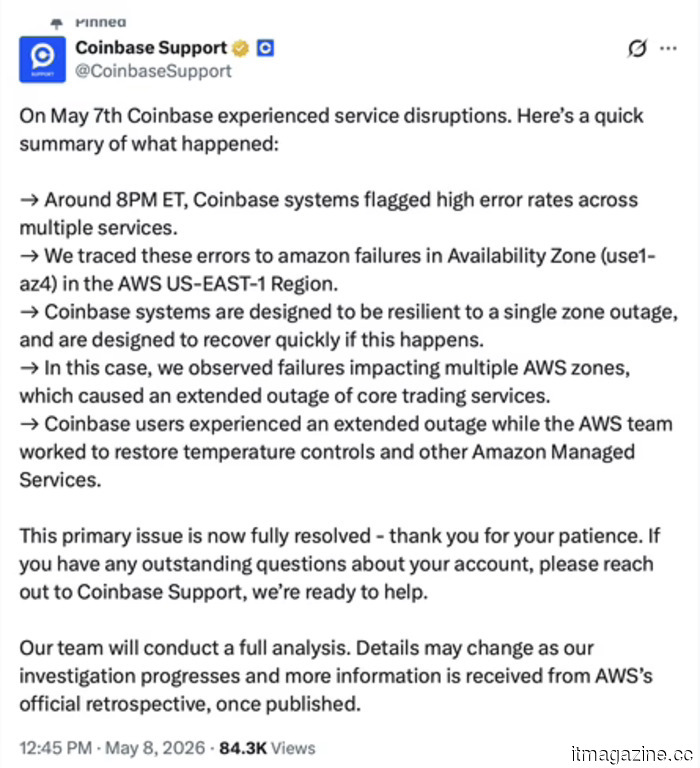 On Monday, Coinbase laid off 700 employees, reported a loss of $394 million on Thursday, and experienced an outage on Friday due to an overheated data center.
Coinbase experienced a seven-hour outage following an overheating incident at an AWS data center in Virginia. This disruption came at the end of a week marked by 700 job cuts and a quarterly loss of $394 million.
On Monday, Coinbase laid off 700 employees, reported a loss of $394 million on Thursday, and experienced an outage on Friday due to an overheated data center.
Coinbase experienced a seven-hour outage following an overheating incident at an AWS data center in Virginia. This disruption came at the end of a week marked by 700 job cuts and a quarterly loss of $394 million.
On Monday, Coinbase laid off 700 employees, reported a loss of $394 million on Thursday, and experienced a blackout on Friday due to an overheating data center.
Coinbase was unavailable for seven hours following an overheating incident at an AWS data center in Virginia. This disruption came at the end of a week that included 700 job cuts and a quarterly loss of $394 million.