
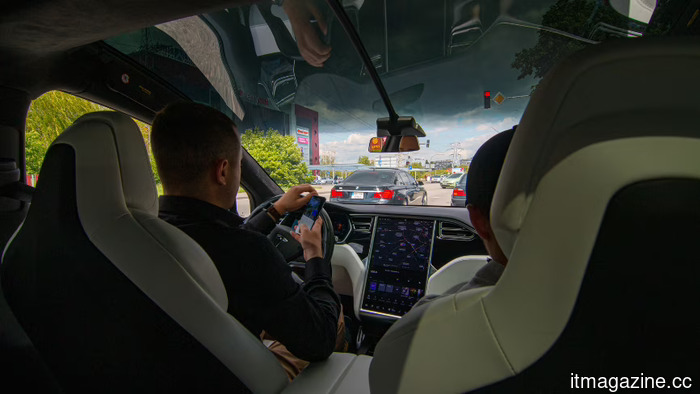
Uber's Q1 2026 report shows a revenue shortfall, yet the stock price rises by 10% as autonomous rides increase tenfold. Additionally, Uber One reaches 50 million members, and bookings experience a 25% rise.
TL;DR: Uber fell short of Q1 revenue forecasts by $90 million, yet its stock surged 10%. Gross bookings rose by 25% to $53.7 billion, autonomous trips increased tenfold, and the Uber One program with 50 million members now represents over half of all bookings. Wall Street is valuing Uber as a logistics platform rather than a ride-hailing service.
Uber fell short of its revenue forecast on Tuesday, but its stock climbed 10%. The gap between Wall Street's expectations and the market's response indicates that Uber has transitioned; it is no longer viewed solely as a ride-hailing service that delivers food, but rather as a logistics platform. Key factors such as autonomous vehicle partnerships, membership economics, and advertising revenue have made the revenue miss inconsequential for significant investors. The first-quarter revenue stood at $13.2 billion, a 14% increase year-over-year, yet about $90 million less than what was anticipated. Gross bookings rose 25% to $53.7 billion, with non-GAAP earnings per share climbing 44% to 72 cents. The company also guided for second-quarter bookings of $56.25 to $57.75 billion, exceeding consensus. The market responded positively to this trend and bought shares.
The revenue shortfall primarily affected Uber’s mobility sector, where sales increased 5% to $6.8 billion, compared to the $7.11 billion expected. This shortfall stemmed from a strategic pricing decision where Uber lowered ride prices in markets with insurance savings, opting to exchange immediate revenue for increased trip volumes. This strategy proved successful in metrics that management deems more important. Mobility gross bookings grew by 20%, and overall trips increased 20% year-over-year to 3.6 billion. In Los Angeles, the growth in trip trends was markedly better than in the rest of California and the larger U.S., according to CEO Dara Khosrowshahi. The company anticipates hundreds of millions in insurance savings benefiting U.S. mobility by 2026, with plans to reinvest these savings in price cuts to replicate this success in other locales.
Delivery services performed more robustly, with revenue hitting $5.07 billion—up 34% and surpassing the expected $4.89 billion. Delivery bookings increased by 23%, primarily driven by grocery and retail, thus broadening Uber’s market reach beyond just restaurant food. The advertising segment exceeded an annualized rate of $2 billion in fiscal 2025, growing more than 50% year-over-year and positioning Uber as a media business where brands pay to connect with consumers at the point of sale. The Uber One membership program has 50 million subscribers, accounting for over half of total bookings and spending three times as much as non-members. The economics for this membership resemble Amazon Prime more than a typical transportation app, providing a recurring revenue stream that enhances engagement, reduces churn, and creates a competitive advantage that is hard for other platforms to replicate.
Uber's autonomous vehicle trips expanded more than tenfold year-on-year. The company has over 30 autonomous partners in both mobility and delivery and aims to operate in up to 15 cities by the end of 2026. Through its collaboration with Waymo, Uber is facilitating 250,000 paid rides weekly. Volkswagen's MOIA is testing self-driving ID. Buzz minibuses in Los Angeles, intending to scale to over 100 vehicles by year-end, with an eye on a fully driverless service by 2027. Uber and Nuro are testing a Lucid Gravity robotaxi in San Francisco, with commercial vehicle production starting in late 2026.
The geographic rollout of autonomous services is advancing more swiftly than the improvement of the vehicles themselves. In late 2026, Uber, Wayve, and Nissan aim to launch robotaxis in Tokyo, pending regulatory approval. Motional plans to eliminate its safety operator in Las Vegas by the end of the year. Zoox is preparing to debut on Uber's platform in Las Vegas this summer, with ambitions for Los Angeles in 2027. The strategy is evident: Uber is not focused on creating autonomous vehicles; instead, it is establishing the distribution network essential for autonomous vehicle firms to reach consumers, thereby aggregating demand across various AV providers and positioning itself as a critical platform that can determine the success of robotaxi companies.
The financial results from the quarter depict a company whose profitability is growing more rapidly than its revenue. Adjusted EBITDA increased at a significantly higher rate than revenue, fueled by operating leverage, insurance savings, and the high-margin advertising and membership sectors. A $1 billion GAAP operating profit was counterbalanced by a $1.5 billion pre-tax charge from mark-to-market losses on equity holdings, a non-cash item differentiating GAAP diluted earnings per share of 13 cents from the non-GAAP figure of 72 cents. Free cash flow and capital returns were not the focus,
Other articles
 UFORCE, Ukraine's inaugural defense technology unicorn, has completed 150,000 combat missions as unmanned warfare becomes commercialized.
UFORCE reached a valuation of $1 billion following 150,000 combat missions. Ukraine asserts that robots have captured territory independently, without the need for infantry for the first time. The unmanned warfare sector is expanding.
Google is in discussions with Blackstone, KKR, and EQT regarding an omnibus licensing agreement for its Gemini AI, while OpenAI and Anthropic are developing consulting services.
Alphabet is in discussions for an omnibus Gemini licensing agreement with Blackstone, KKR, and EQT. This approach differs from OpenAI's $10 billion and Anthropic's $1.5 billion initiatives involving embedded engineers.
UFORCE, Ukraine's inaugural defense technology unicorn, has completed 150,000 combat missions as unmanned warfare becomes commercialized.
UFORCE reached a valuation of $1 billion following 150,000 combat missions. Ukraine asserts that robots have captured territory independently, without the need for infantry for the first time. The unmanned warfare sector is expanding.
Google is in discussions with Blackstone, KKR, and EQT regarding an omnibus licensing agreement for its Gemini AI, while OpenAI and Anthropic are developing consulting services.
Alphabet is in discussions for an omnibus Gemini licensing agreement with Blackstone, KKR, and EQT. This approach differs from OpenAI's $10 billion and Anthropic's $1.5 billion initiatives involving embedded engineers.
 Google Search updates aim to transform AI responses into a starting point for your inquiries rather than a concluding one.
Google is launching five updates to AI Mode and AI Overviews in Search aimed at highlighting more links and encouraging users to visit the websites associated with them.
Google Search updates aim to transform AI responses into a starting point for your inquiries rather than a concluding one.
Google is launching five updates to AI Mode and AI Overviews in Search aimed at highlighting more links and encouraging users to visit the websites associated with them.
 Google has enhanced its AI Overviews by adding Further Exploration links and subscription labels, responding to a 58% drop in publisher clicks that has led to antitrust lawsuits.
Google has introduced five new features to AI Overviews in order to increase traffic to publishers following a 58% drop in click-through rates. The EU, DOJ, and Penske Media are closely monitoring the situation.
Google has enhanced its AI Overviews by adding Further Exploration links and subscription labels, responding to a 58% drop in publisher clicks that has led to antitrust lawsuits.
Google has introduced five new features to AI Overviews in order to increase traffic to publishers following a 58% drop in click-through rates. The EU, DOJ, and Penske Media are closely monitoring the situation.
 Google enhances AI Overviews with Further Exploration links and subscription labels as a 58% drop in publisher clicks sparks antitrust lawsuits.
Google has introduced five new features to AI Overviews to help increase traffic for publishers following a 58% decline in click-through rates. The EU, DOJ, and Penske Media are closely monitoring the situation.
Google enhances AI Overviews with Further Exploration links and subscription labels as a 58% drop in publisher clicks sparks antitrust lawsuits.
Google has introduced five new features to AI Overviews to help increase traffic for publishers following a 58% decline in click-through rates. The EU, DOJ, and Penske Media are closely monitoring the situation.
Uber's Q1 2026 report shows a revenue shortfall, yet the stock price rises by 10% as autonomous rides increase tenfold. Additionally, Uber One reaches 50 million members, and bookings experience a 25% rise.
Uber fell short of its Q1 revenue by $90 million, yet its stock jumped 10%. Gross bookings reached $53.7 billion, while autonomous vehicle trips increased tenfold, and Uber One gained 50 million members. The market views Uber as a platform rather than just a taxi service.