
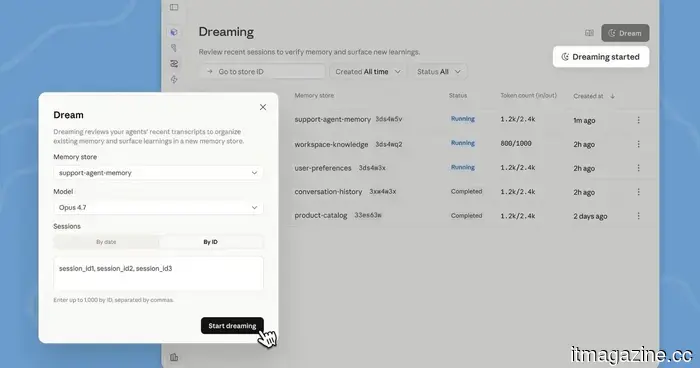
Anthropic has recently enabled Claude to dream between tasks, enhancing the agents' intelligence significantly.
Dreaming transforms Claude from an AI that forgets everything once a session ends into one that silently improves its performance each time it is not in use.
Anthropic has given Claude an intriguing feature reminiscent of a science fiction narrative: the ability to dream. The company recently announced three enhancements for Claude Managed Agents: Dreaming, Outcomes, and Multiagent Orchestration.
While I acknowledge that Dreaming has the most captivating name, it also holds the most practical benefits for developers creating AI agents capable of managing complex, ongoing tasks.
Live from Code with Claude: we’re introducing dreaming in Claude Managed Agents as a research preview. Outcomes, multiagent orchestration, and webhooks are now in public beta. pic.twitter.com/p4DFRzFEd8— Claude (@claudeai) May 6, 2026
What does Claude’s Dreaming feature entail?
Despite its poetic title, Dreaming is simply a scheduled background process that occurs between active sessions. Its role is to analyze everything the agent has previously accomplished, including past conversations, memory logs, completed tasks, and to identify patterns among them.
Dreaming evaluates all tasks executed by the agent, identifies recurring mistakes, recognizes preferred approaches developed over time, and shares insights across multiple agents operating together (when several Claude agents are active at once).
Once the agent assimilates this information, it secures those insights in its memory, so that each new session starts with the context of what was effective and what was not from previous interactions. Developers can choose to have Dreaming update the memory automatically or manually assess the changes before they are implemented.
Outcomes allows you to define quality standards. You create a rubric, an independent grader assesses the results, and the agent iterates until it meets the criteria. Subscribe to webhooks to be notified upon completion.— Claude (@claudeai) May 6, 2026
What do Outcomes and Multiagent Orchestration bring to the table?
Currently, the Dreaming feature is available in research preview on the Claude Platform. This feature acts as a self-improvement mechanism, enabling the agent to enhance its usefulness over time, especially by recognizing previous session mistakes.
Outcomes, as indicated by its name, enables developers to establish a set of specifications, requirements, or guidelines to evaluate the agent's output. This evaluation is performed by a separate grading system that ensures it remains unaffected by the agent’s own reasoning. If the agent’s output does not meet the established criteria, the grader requests a revision.
Multiagent Orchestration permits multiple Claude agents to collaborate on varying aspects of a complex task. This approach minimizes the time required and broadens the range of responses within a single workflow. Webhooks enhance this update by allowing event-driven triggers for agents without the need for continuous manual prompting.
For over five years, Shikhar has continuously simplified advancements in consumer technology and communicated them effectively…
A startling study has prompted me to reconsider my AI usage, and you may want to do the same.
The issue isn't with AI; it’s about what you're asking it to do for you.
I’ve always considered myself a casual AI user. I don’t rely on ChatGPT to draft my emails or turn my thoughts into narratives. I primarily use it for quick look-ups or to fill in gaps in my memory. This felt like a responsible approach. As a journalist, I am keenly aware of AI's hallucination issues and the "burden of truth verification" that entails using an AI assistant. However, a recent study has made me reconsider the modest benefits I’ve gained from AI tools like Google’s Gemini for everyday tasks.
The findings are more compelling than anticipated.
Google halts Project Mariner, its AI agent designed for human-like web browsing.
The autonomous browser agent introduced by Google at I/O 2025 is no longer operational. Its technology is now being integrated into the Gemini API and Gemini Agent.
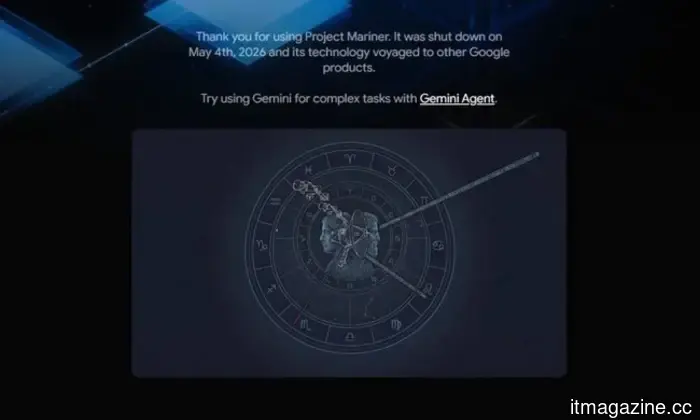
Google has terminated Project Mariner, the autonomous web browsing agent launched at I/O the previous year. The tool, which could navigate Chrome, complete forms, search listings, and make travel arrangements by visually recognizing elements on web pages, is no longer accessible. Its landing page now features a notification indicating the shutdown date as May 4, 2026.
A browsing agent that perceived what you saw.
Google addresses Chrome’s silent installation of the Gemini Nano but does not fully discuss consent issues.
Chrome's VP and GM, Parisa Tabriz, has responded to complaints regarding the browser's practice of silently downloading a 4GB AI model onto users' devices, asserting that on-device AI is a crucial aspect of the browser’s security and development strategy.
What sparked the backlash?



Other articles
 Huawei makes smart devices an extension of humanity.
Huawei held a global launch of its new products in Bangkok.
Huawei makes smart devices an extension of humanity.
Huawei held a global launch of its new products in Bangkok.
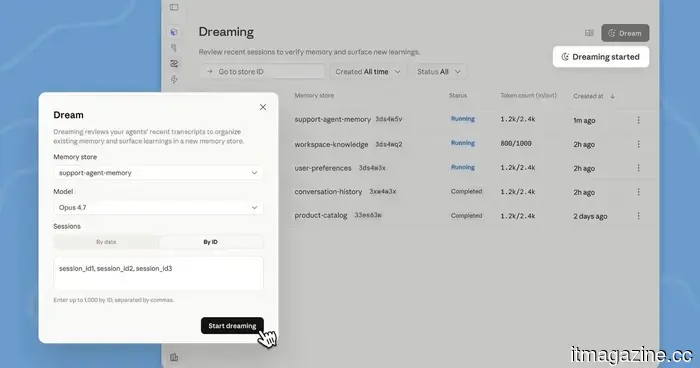 Anthropic has just instructed Claude to dream between tasks, which significantly enhances the intelligence of agents.
Claude's new Dreaming feature is a memory refinement system that operates between sessions, analyzing previous agent behavior to spot consistent errors and workflow patterns, and subsequently updates its memory.
Anthropic has just instructed Claude to dream between tasks, which significantly enhances the intelligence of agents.
Claude's new Dreaming feature is a memory refinement system that operates between sessions, analyzing previous agent behavior to spot consistent errors and workflow patterns, and subsequently updates its memory.
 Tata and JSW to invest $1 billion in creating India's alternative to reliance on Chinese batteries.
Tata Group and JSW Group are independently investing in R&D centers focused on next-generation batteries and electric vehicle systems, totaling a joint investment of $1 billion.
Tata and JSW to invest $1 billion in creating India's alternative to reliance on Chinese batteries.
Tata Group and JSW Group are independently investing in R&D centers focused on next-generation batteries and electric vehicle systems, totaling a joint investment of $1 billion.
 A recent study indicates that even short periods of AI usage may impair your thinking skills.
A recent study conducted by researchers from MIT, Carnegie Mellon, Oxford, and UCLA discovered that even short periods of using AI can negatively impact your problem-solving skills once the tool is no longer available.
A recent study indicates that even short periods of AI usage may impair your thinking skills.
A recent study conducted by researchers from MIT, Carnegie Mellon, Oxford, and UCLA discovered that even short periods of using AI can negatively impact your problem-solving skills once the tool is no longer available.
 Huawei makes smart devices an extension of humanity.
Huawei held a global launch of its new products in Bangkok.
Huawei makes smart devices an extension of humanity.
Huawei held a global launch of its new products in Bangkok.
 Google addresses the silent installation of Gemini Nano in Chrome but does not fully tackle the issue of user consent.
Parisa Tabriz, the Vice President and General Manager of Google Chrome, has addressed the criticism regarding Chrome's approach of quietly downloading a 4GB Gemini Nano model onto users' devices.
Google addresses the silent installation of Gemini Nano in Chrome but does not fully tackle the issue of user consent.
Parisa Tabriz, the Vice President and General Manager of Google Chrome, has addressed the criticism regarding Chrome's approach of quietly downloading a 4GB Gemini Nano model onto users' devices.
Anthropic has recently enabled Claude to dream between tasks, enhancing the agents' intelligence significantly.
Claude's new Dreaming feature is a memory refinement system that operates between sessions, analyzing previous agent behavior to pinpoint frequent errors and workflow patterns, and subsequently updates the memory.