
Anthropic has just instructed Claude to dream between tasks, which significantly enhances the intelligence of agents.
Dreaming transforms Claude from an AI that forgets everything once a session concludes into one that gradually improves at its tasks during inactive periods.
Anthropic has bestowed Claude with an intriguing feature resembling a concept from science fiction: the capability to dream. The company has unveiled three updates for Claude Managed Agents: Dreaming, Outcomes, and Multiagent Orchestration.
While the name Dreaming is certainly the most captivating, it also carries significant practical benefits for developers creating AI agents capable of managing complex, extended tasks.
Debuting at Code with Claude: we are introducing the dreaming feature in Claude Managed Agents as a research preview. Outcomes, multiagent orchestration, and webhooks are now available in public beta. pic.twitter.com/p4DFRzFEd8— Claude (@claudeai) May 6, 2026
What does Claude’s Dreaming feature entail?
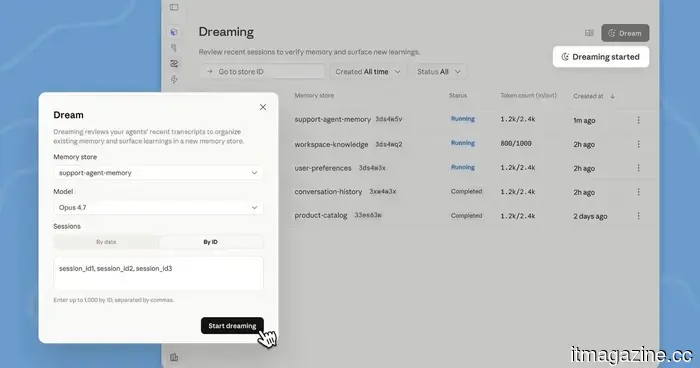
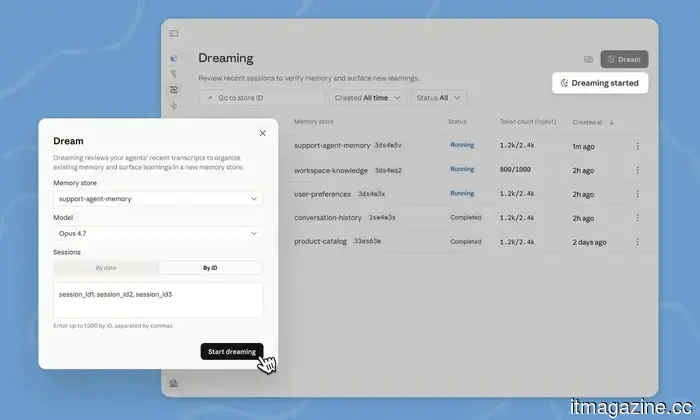
Despite its artistic title, Dreaming is a scheduled process running in the background between active sessions. Its aim is to analyze all the activities an agent has previously engaged in, including past conversations, stored memory, and completed tasks, to identify patterns among them.
Dreaming reviews the various tasks performed by the agent, identifies recurring mistakes, notes preferred methods developed over time, and shares insights with multiple agents operating concurrently (when several Claude agents are working together).
Once the agent has gathered this information, it locks these insights into its memory, ensuring that every new session begins with the same understanding of what was successful and what wasn't in prior interactions. Developers can choose to have Dreaming update the memory automatically or can review the changes before they are finalized.
Outcomes allows you to establish quality standards. You create a rubric, a different evaluator assesses the output, and the agent continues to refine its results until it meets the criteria. Subscribe to webhooks to receive notifications upon completion.— Claude (@claudeai) May 6, 2026
What additional features do Outcomes and Multiagent Orchestration provide?
Currently, the Dreaming feature is offered as a research preview on the Claude Platform. This self-improvement mechanism enables the agent to enhance its utility over time, particularly by acknowledging mistakes made in earlier sessions.
Outcomes, as indicated by its name, allows developers to set a specific set of criteria, requirements, or standards against which the agent’s output is judged. A separate grading system evaluates the performance, ensuring independence from the agent's self-assessment. If the output falls short of expectations, the grader requests a new attempt.
Multiagent Orchestration permits multiple Claude agents to collaborate on different segments of a complex task. This approach reduces completion time and broadens the range of responses within a single workflow. Webhooks complement this enhancement by enabling event-driven triggers for agents without the need for constant manual prompts.
For over five years, Shikhar has been adept at clarifying advancements in consumer technology and delivering insightful presentations on these topics.
A surprising study made me reconsider my use of AI, and you might want to do the same.
The issue isn't with AI itself; it’s about what you're asking it to do for you.
I’ve always considered myself a minimal AI user. I don’t rely on ChatGPT to write my emails or convert my thoughts into narratives. Primarily, I use it for quick lookups or to assist with ideas that I can’t fully articulate. This felt like a responsible approach. As a journalist, I understand the potential pitfalls of AI hallucinations and the "burden of truth verification" that accompanies using AI assistance. However, a recent study has led me to reconsider even the minimal usefulness I derived from AI tools like Google’s Gemini for everyday tasks.
The findings are more compelling than one might anticipate.
Read more
Google halts Project Mariner, the AI agent designed to browse the web like a human.
The autonomous browser agent unveiled by Google at I/O 2025 is no longer operational. Its technology is being integrated into the Gemini API and Gemini Agent.
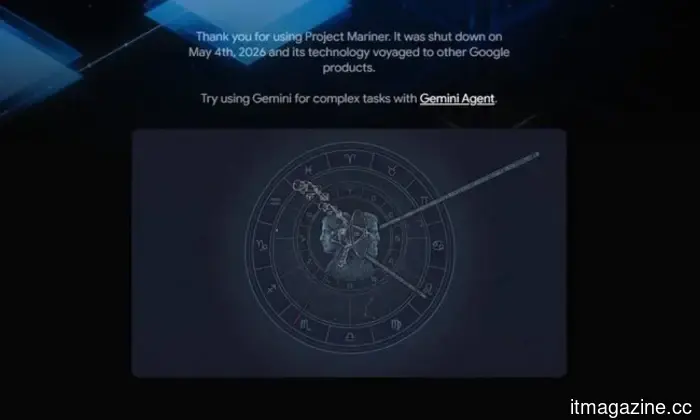
Google has discontinued Project Mariner, the self-sufficient web browsing agent introduced at last year's I/O event. The tool, which could navigate Chrome, fill out forms, search listings, and make travel reservations using visual recognition and screenshots, is now unavailable. Its landing page indicates that the shutdown occurred on May 4, 2026.
A browsing assistant that perceived what you saw.
Read more
Google addresses Chrome’s unexpected Gemini Nano download but avoids discussing consent.
In response to criticisms regarding Chrome’s practice of silently installing a 4GB AI model onto users' devices, Chrome’s VP and GM, Parisa Tabriz, stated that on-device AI is fundamental to the browser's security strategy, but did not clarify why deleting it results in an automatic re-download.
What sparked the backlash?
Read more.



Other articles
 Tata and JSW to invest $1 billion in developing India's independence from Chinese batteries.
Tata Group and JSW Group are individually investing in research and development centers focused on next-generation batteries and electric vehicle systems, with a total funding of $1 billion.
Tata and JSW to invest $1 billion in developing India's independence from Chinese batteries.
Tata Group and JSW Group are individually investing in research and development centers focused on next-generation batteries and electric vehicle systems, with a total funding of $1 billion.
 Tata and JSW to invest $1 billion in creating India's alternative to reliance on Chinese batteries.
Tata Group and JSW Group are independently investing in R&D centers focused on next-generation batteries and electric vehicle systems, totaling a joint investment of $1 billion.
Tata and JSW to invest $1 billion in creating India's alternative to reliance on Chinese batteries.
Tata Group and JSW Group are independently investing in R&D centers focused on next-generation batteries and electric vehicle systems, totaling a joint investment of $1 billion.
 Google addresses the silent installation of Gemini Nano in Chrome but does not fully tackle the issue of user consent.
Parisa Tabriz, the Vice President and General Manager of Google Chrome, has addressed the criticism regarding Chrome's approach of quietly downloading a 4GB Gemini Nano model onto users' devices.
How AI Orchestration Layers Are Transforming the Car Purchasing Experience
BadCo.AI is developing AI orchestration layers that integrate CRM systems, dealership operations, and customer interaction to create a smoother car buying experience.
Google addresses the silent installation of Gemini Nano in Chrome but does not fully tackle the issue of user consent.
Parisa Tabriz, the Vice President and General Manager of Google Chrome, has addressed the criticism regarding Chrome's approach of quietly downloading a 4GB Gemini Nano model onto users' devices.
How AI Orchestration Layers Are Transforming the Car Purchasing Experience
BadCo.AI is developing AI orchestration layers that integrate CRM systems, dealership operations, and customer interaction to create a smoother car buying experience.
 A recent study indicates that even short periods of AI usage may impair your thinking skills.
A recent study conducted by researchers from MIT, Carnegie Mellon, Oxford, and UCLA discovered that even short periods of using AI can negatively impact your problem-solving skills once the tool is no longer available.
A recent study indicates that even short periods of AI usage may impair your thinking skills.
A recent study conducted by researchers from MIT, Carnegie Mellon, Oxford, and UCLA discovered that even short periods of using AI can negatively impact your problem-solving skills once the tool is no longer available.
 Anthropic has recently enabled Claude to dream between tasks, enhancing the agents' intelligence significantly.
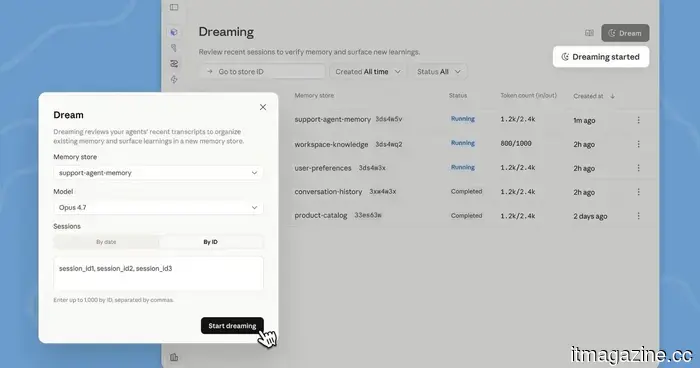
Claude's new Dreaming feature is a memory refinement system that operates between sessions, analyzing previous agent behavior to pinpoint frequent errors and workflow patterns, and subsequently updates the memory.
Anthropic has recently enabled Claude to dream between tasks, enhancing the agents' intelligence significantly.
Claude's new Dreaming feature is a memory refinement system that operates between sessions, analyzing previous agent behavior to pinpoint frequent errors and workflow patterns, and subsequently updates the memory.
Anthropic has just instructed Claude to dream between tasks, which significantly enhances the intelligence of agents.
Claude's new Dreaming feature is a memory refinement system that operates between sessions, analyzing previous agent behavior to spot consistent errors and workflow patterns, and subsequently updates its memory.