
DeepSeek's valuation of $45 billion serves as a strategic declaration from Beijing.
What began in mid-April as a $300 million fundraising effort at a $10 billion valuation, with Alibaba and Tencent showing interest, has now evolved into an FT-reported deal at a valuation of $45 billion, led by the China Integrated Circuit Industry Investment Fund. The strategic rationale has significantly transformed.
In venture-capital pricing, there exists a unique type of valuation increase that is not typical for a company that has historically avoided external funding. On Wednesday, Bloomberg, referencing a scoop from the Financial Times, reported that China's primary state-backed semiconductor investment vehicle is currently in discussions to lead DeepSeek’s inaugural external funding round at a valuation of about $45 billion.
This valuation is more than double the figure that was under consideration just two weeks prior. The change in trajectory is notable, and even more so is the identity of the lead investor.
The China Integrated Circuit Industry Investment Fund, commonly referred to as the "Big Fund," is the main state entity financing China’s initiative for semiconductor self-sufficiency since 2014. Across three phases, it has invested over $50 billion into various Chinese companies involved in chip design, fabrication, packaging, and equipment. Until Wednesday's reports, the fund’s focus was primarily on the silicon aspects of the AI stack, such as fabs, foundries, memory manufacturers, and EDA tools.
A direct lead investment in an advanced AI model lab would represent the largest expansion of the fund’s mandate thus far. It also indicates Beijing’s decision regarding the strategic connection between AI capabilities and chip capabilities. TNW has been monitoring the broader US-China chip-export-control situation for several years, consistently noting that the US has imposed semiconductor export controls to restrict China's access to cutting-edge AI computing, while China has been looking for a strategic response to regain parity.
With the Big Fund leading a DeepSeek round, this demonstrates that the response strategy now emphasizes model capabilities rather than just chip capabilities. If China is unable to acquire Nvidia’s advanced GPUs in the quantities needed, it appears, based on this evidence, that they will fund model labs that can produce cutting-edge results without them.
How did DeepSeek reach this point?
DeepSeek's commercial narrative is now well-known. Established in July 2023 by Liang Wenfeng, a 40-year-old computer scientist and one of the founders of the quantitative hedge fund High-Flyer Capital Management, DeepSeek relied solely on High-Flyer’s balance sheet for funding until April 2026, without seeking external venture capital or disclosing revenue. The South China Morning Post posed a pertinent question last month: why is a company that seemingly does not require cash now pursuing it? According to available reports, there are two main explanations.
The first is operational. DeepSeek-R1, the reasoning model released in January 2025 that triggered significant equity reactions in US tech stocks, was reportedly trained for $6 million, which is substantially lower than its US counterparts. DeepSeek V4, the company's trillion-parameter flagship model, debuted on April 24, 2026, the same week that funding discussions began to emerge. Even with support from High-Flyer’s balance sheet, training and maintaining frontier models at the scale DeepSeek is now operating is not a sustainable model for internal funding.
The second is strategic. Yicai Global reported that Liang himself infused additional personal capital in April, increasing DeepSeek’s registered capital by 50 percent. His ownership share surged from around 1 percent to 34 percent, with his total direct and indirect ownership now close to 84 percent. This cap-table restructuring seems to have been intentionally arranged prior to accepting external investment, both to consolidate founder control and to create a clean structure for the institutional investors coming on board.
From $10 billion to $20 billion to $45 billion in three weeks
The pricing trajectory warrants clarification. DeepSeek discreetly launched its first funding round at a $10 billion valuation, aiming for about $300 million. By April 22, when Bloomberg confirmed that Tencent and Alibaba were in discussions to participate, the valuation increased to over $20 billion. Following Wednesday’s FT report, with the Big Fund involved as a potential lead, the valuation reached $45 billion, more than four times the initial figure.
Three factors have influenced this price increase. The first is investor demand: every new institutional participant elevated the implied valuation that the next investor needed to meet. The second is the strategic value associated with the Big Fund’s involvement; when a state entity of this magnitude expresses interest, foreign and private investors adjust their expectations. The third is the broader context of Chinese AI funding, which has notably tightened during the same period.
Earlier this year, we discussed Tencent’s launch of ClawPro and the concurrent investments by Alibaba, Tencent, and ByteDance into their respective enterprise AI platforms; Alibaba now holds a 35.8 percent market share in AI cloud services, with Tencent's planned AI expenditure for 2025 at ¥18 billion,
Other articles
 Samsung Electronics surpasses $1 trillion, joining TSMC.
On Wednesday, Samsung Electronics reached a market capitalization of $1 trillion, becoming the second Asian company to achieve this milestone, following TSMC.
Samsung Electronics surpasses $1 trillion, joining TSMC.
On Wednesday, Samsung Electronics reached a market capitalization of $1 trillion, becoming the second Asian company to achieve this milestone, following TSMC.
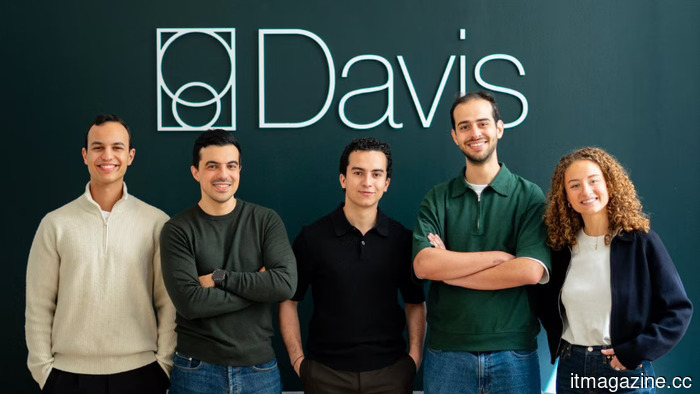 Davis secures $5.5 million in pre-seed funding to streamline real estate development.
Davis, located in Paris, has secured $5.5 million in pre-seed funding to streamline real estate development from months down to days, utilizing a new generative model named Gaudi-1.
Davis secures $5.5 million in pre-seed funding to streamline real estate development.
Davis, located in Paris, has secured $5.5 million in pre-seed funding to streamline real estate development from months down to days, utilizing a new generative model named Gaudi-1.
 The CEO of Xbox has decided to abandon the Copilot AI for consoles in order to redirect the platform's focus towards prioritizing gameplay experiences.
Microsoft has halted the development of Xbox Copilot AI for consoles and mobile devices, as CEO Asha Sharma refocuses efforts on enhancing player experience and improving the core platform.
The CEO of Xbox has decided to abandon the Copilot AI for consoles in order to redirect the platform's focus towards prioritizing gameplay experiences.
Microsoft has halted the development of Xbox Copilot AI for consoles and mobile devices, as CEO Asha Sharma refocuses efforts on enhancing player experience and improving the core platform.
 The CEO of Xbox has abandoned the Copilot AI initiative for consoles in order to concentrate on prioritizing gameplay experiences.
Microsoft has halted the development of Xbox Copilot AI for consoles and mobile, as CEO Asha Sharma redirects attention to enhancing player experience and core platform upgrades.
The CEO of Xbox has abandoned the Copilot AI initiative for consoles in order to concentrate on prioritizing gameplay experiences.
Microsoft has halted the development of Xbox Copilot AI for consoles and mobile, as CEO Asha Sharma redirects attention to enhancing player experience and core platform upgrades.
 Reasons the EU's anonymization approach might not withstand the GDPR evaluation
Sergei Vassilvitskii, a scientist at Google, has alerted the European Commission that the anonymization technique used for mandatory search-data sharing under the DMA can be compromised in under two hours.
Reasons the EU's anonymization approach might not withstand the GDPR evaluation
Sergei Vassilvitskii, a scientist at Google, has alerted the European Commission that the anonymization technique used for mandatory search-data sharing under the DMA can be compromised in under two hours.
 DeepSeek's $45 billion valuation also serves as a strategic statement from Beijing.
China's Big Fund is currently in discussions to take the lead on DeepSeek's initial external funding round, valued at $45 billion, which is more than double the amount that was being considered a fortnight ago.
DeepSeek's $45 billion valuation also serves as a strategic statement from Beijing.
China's Big Fund is currently in discussions to take the lead on DeepSeek's initial external funding round, valued at $45 billion, which is more than double the amount that was being considered a fortnight ago.
DeepSeek's valuation of $45 billion serves as a strategic declaration from Beijing.
China's Big Fund is currently in discussions to spearhead DeepSeek's initial external funding round at $45 billion, which is more than twice the amount that was being considered two weeks prior.