
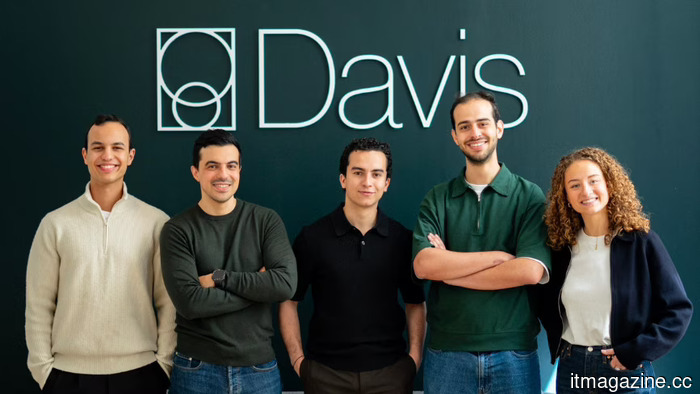
Davis secures $5.5 million in pre-seed funding to streamline real estate development.
The Paris-based AI-centric real estate firm, established by Entrepreneurs First graduates Mehdi Rais and Amine Chraibi, is seeing Heartcore and Balderton co-lead its funding round, which is an uncommon structure for a pre-seed financing. The technical aspects of the proposal are more intriguing than the main headline suggests.
In 2026, securing a certain type of AI seed round in Europe has become more challenging than the headline numbers indicate: a pre-seed where two of the continent's leading firms agree to co-lead. On Tuesday, the Paris firm Davis announced a $5.5 million pre-seed round with Heartcore Capital and Balderton Capital both at the helm.
The participation lineup includes firms like Evantic, Yellow VC, and Entrepreneurs First, along with an angel group consisting of professionals and researchers from Meta, Black Forest Labs, Hugging Face, Supabase, Spore.Bio, and members from the founding team of SpaceMaker, the architectural AI startup that Autodesk acquired in 2020.
This latter detail is the most revealing. On the surface, Davis appears to be a real estate tech company, but the technical specifics it has chosen to share suggest it offers something more compelling.
What does Davis actually do?
In simple terms, its proposal aims to close the architectural feasibility gap. Real estate developers and investors assessing a site often spend weeks or months navigating a disjointed array of tools, consultants, and software to transform raw land data into a viable feasibility study and a credible architectural concept.
Davis streamlines this process by replacing much of the time spent with a single integrated workflow: regulatory, technical, and market data are input as constraints, while feasibility studies and architectural designs (like volumetrics, floor plans, space planning, ROI estimates) are generated within days. Human architects review each output before it is presented to clients.
The firm is not marketing software; rather, it is intentionally selling outcomes. Developers and investors receive completed feasibility studies and design concepts much like they would from a traditional architectural consulting firm, but with an AI-driven production process that includes an architect validation step.
This hybrid model is structurally significant, allowing Davis to price its services rather than positioning itself as a SaaS product, capture a larger value share per project, and circumvent the tooling adoption hurdles that have traditionally hindered PropTech integration into conventional development processes.
Davis believes that architectural AI should generate buildings as structured compositions rather than merely as images. Most contemporary tools in this category rely on continuous diffusion models, similar to those used for image and video generation. Davis is opting for a different method: its models produce buildings as organized arrangements of rooms, walls, layouts, and architectural components.
This distinction is crucial. It aligns with the technical lineage of research like HouseDiffusion, which demonstrated that discrete and continuous denoising can yield superior floor plan geometry compared to pixel-space generation, particularly in terms of relationships that are vital to architects: parallelism, orthogonality, shared corners, and clear incident geometry.
The company is introducing its first proprietary model, Gaudi-1, alongside this funding round. Davis claims to achieve state-of-the-art results on RPLAN and MSD, which includes the Swiss Dwellings dataset of 5,372 detailed floor plans, measuring metrics such as IoU, FID, and KID. If these claims withstand independent assessment, it represents a significant position in the market. Davis aims to address the aspect of architectural AI that has kept many tools in the demo phase: generating outputs that meet real-world design, regulatory, and financial demands.
Importance of the founding team and capital structure
Davis was established in 2025 by Mehdi Rais, CEO, and Amine Chraibi, CTO. Rais's background in an architect family provides the company with a practitioner's perspective on the issue at hand. Chraibi, an AI researcher from École Polytechnique, has focused research on generative models for structured data, correlating with the technical area that Davis is now commercializing.
The two collaborated through Entrepreneur First's Paris cohort and, according to EF, they were among the quickest teams in the cohort to secure funding. The capital structure underscores this momentum. The co-leadership of a pre-seed round by Heartcore and Balderton signals a strong endorsement within European AI. Max Niederhofer from Heartcore highlighted the combination of a discrete architectural model, regulatory constraints, architect validation, and the potential to shorten feasibility work from months to mere days. Rob Moffat from Balderton framed the appeal more succinctly: few AI startups are both quick to market and developing proprietary models.
The inclusion of angel investors adds another dimension to the backing. Founders from the team behind Spacemaker, sold to Autodesk in 2020 for $240 million, have directly invested in Davis. This aspect is significant because Spacemaker represents the most successful exit precedent in architectural AI.
Spacemaker supplied
Otros artículos
 ¿Abrirá iOS 27 de Apple opciones de IA de terceros y ayudará a los iPhones chinos a escapar de su dilema de IA?
Apple supuestamente está planeando permitir a los usuarios elegir modelos de IA de terceros por primera vez en su próxima versión de iOS 27, ampliando Apple
¿Abrirá iOS 27 de Apple opciones de IA de terceros y ayudará a los iPhones chinos a escapar de su dilema de IA?
Apple supuestamente está planeando permitir a los usuarios elegir modelos de IA de terceros por primera vez en su próxima versión de iOS 27, ampliando Apple
 Ahora puedes recuperar un poco de privacidad con el uso compartido de ubicación aproximada en Chrome.
Chrome en Android ahora admite el uso compartido de ubicación aproximada, lo que permite a los usuarios limitar cuán precisamente los sitios web pueden rastrearlos mientras aún se habilitan funciones esenciales.
Ahora puedes recuperar un poco de privacidad con el uso compartido de ubicación aproximada en Chrome.
Chrome en Android ahora admite el uso compartido de ubicación aproximada, lo que permite a los usuarios limitar cuán precisamente los sitios web pueden rastrearlos mientras aún se habilitan funciones esenciales.
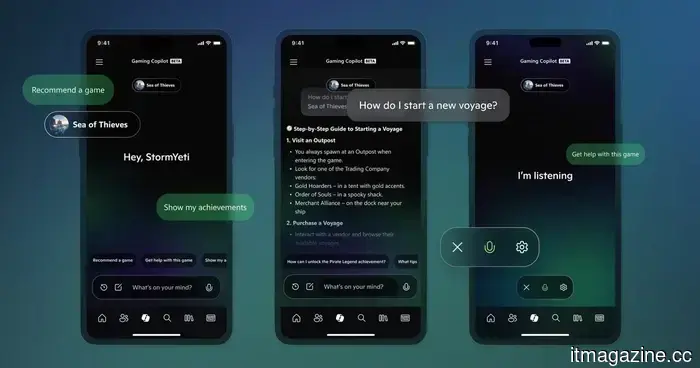 El CEO de Xbox descarta la IA Copilot para consolas para reenfocar la plataforma en experiencias centradas en el juego.
Microsoft ha cancelado el desarrollo de Xbox Copilot AI para consolas y móviles, ya que la CEO Asha Sharma cambia el enfoque hacia la experiencia del jugador y las mejoras de la plataforma principal.
El CEO de Xbox descarta la IA Copilot para consolas para reenfocar la plataforma en experiencias centradas en el juego.
Microsoft ha cancelado el desarrollo de Xbox Copilot AI para consolas y móviles, ya que la CEO Asha Sharma cambia el enfoque hacia la experiencia del jugador y las mejoras de la plataforma principal.
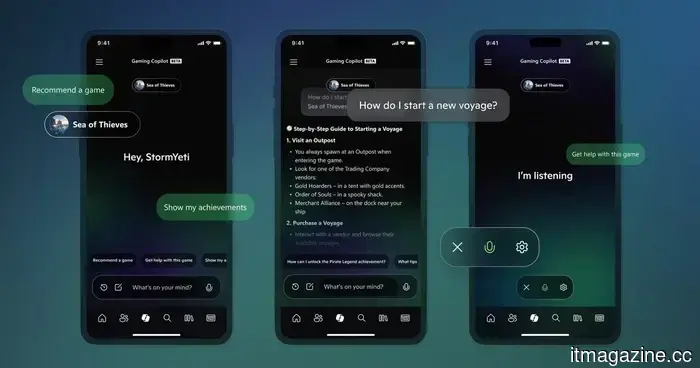 El CEO de Xbox descarta la IA Copilot para consolas para reenfocar la plataforma en experiencias centradas en el juego.
Microsoft ha cancelado el desarrollo de Xbox Copilot AI para consolas y móviles, ya que la CEO Asha Sharma cambia el enfoque hacia la experiencia del jugador y las mejoras en la plataforma principal.
El CEO de Xbox descarta la IA Copilot para consolas para reenfocar la plataforma en experiencias centradas en el juego.
Microsoft ha cancelado el desarrollo de Xbox Copilot AI para consolas y móviles, ya que la CEO Asha Sharma cambia el enfoque hacia la experiencia del jugador y las mejoras en la plataforma principal.
 Esta actualización de Google Home se trata de una automatización más inteligente.
La actualización de Google Home amplía la automatización con nuevos desencadenantes, condiciones y acciones, permitiendo un control más inteligente a través de dispositivos como cerraduras, luces, electrodomésticos y sensores.
Esta actualización de Google Home se trata de una automatización más inteligente.
La actualización de Google Home amplía la automatización con nuevos desencadenantes, condiciones y acciones, permitiendo un control más inteligente a través de dispositivos como cerraduras, luces, electrodomésticos y sensores.
 La valoración de Qutwo de Peter Sarlin alcanza los 380 millones de dólares en una ronda de ángeles.
Qutwo, la empresa de orquestación cuántico-clásica fundada por Peter Sarlin de Silo AI, ha alcanzado una valoración de 380 millones de dólares en una ronda de inversores ángeles.
La valoración de Qutwo de Peter Sarlin alcanza los 380 millones de dólares en una ronda de ángeles.
Qutwo, la empresa de orquestación cuántico-clásica fundada por Peter Sarlin de Silo AI, ha alcanzado una valoración de 380 millones de dólares en una ronda de inversores ángeles.
Davis secures $5.5 million in pre-seed funding to streamline real estate development.
Davis, based in Paris, has secured a $5.5 million pre-seed funding to accelerate real estate development from months to days, utilizing a new generative model known as Gaudi-1.