
Samsung showcases an exceptionally bright OLED display for smartphones that maintains color accuracy.
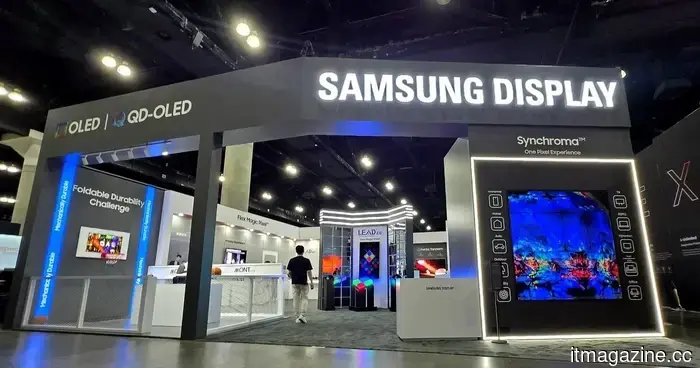
Samsung Display has introduced its newest smartphone display advancements at Display Week 2026, focusing on enhancing brightness, color precision, and overall efficiency. The innovative developments aim to address practical challenges, particularly visibility in bright outdoor settings and more precise color reproduction for contemporary content.
Brighter Screens and Improved Colors
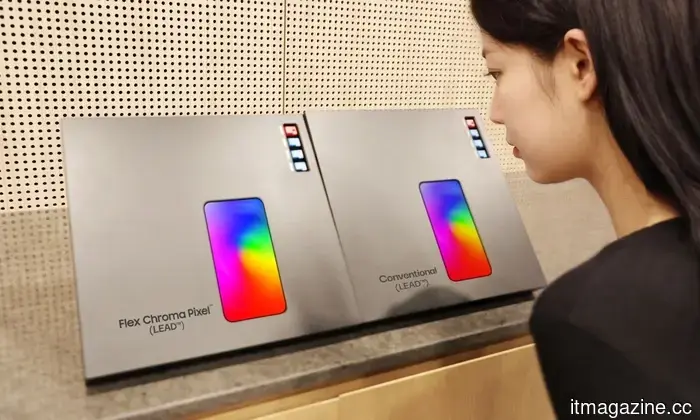
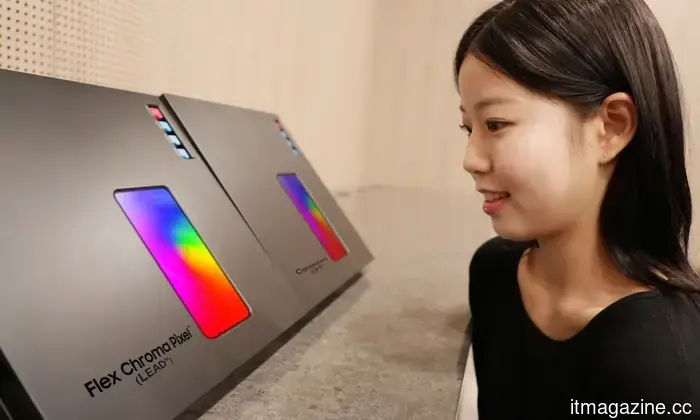
The centerpiece of the announcement is Samsung’s new “Flex Chroma Pixel” OLED panel, designed specifically for smartphones. This panel can achieve a brightness of up to 3,000 nits in High Brightness Mode (HBM), representing a significant increase compared to most existing smartphone displays.
This enhancement is more significant than it appears. A major limitation of current smartphones is the difficulty in clearly viewing the screen under direct sunlight. By increasing brightness to this level, Samsung tackles this challenge, making screens easier to read outdoors without sacrificing durability. While many smartphones can achieve remarkable peak brightness levels—like the Huawei Mate 80 Pro Max, which reaches impressive heights of 8,000 nits—the focus here is on HBM, which differs from peak brightness.
Peak brightness or PBM mode operates only in specific areas of the display and for brief moments; in contrast, high-brightness mode is where the real impact lies, with Samsung claiming it can reach 3000 nits in HBM, currently the highest in the market. For comparison, the iPhone 17 Pro reaches an HBM of 1,600 nits with a peak brightness of 3,000 nits.
In addition to brightness, Samsung is enhancing color performance. The panel achieves up to 96% coverage of the BT.2020 color space, whereas most current smartphones cover around 70%. This results in more vibrant and accurate colors, especially for HDR content. Given that BT.2020 encompasses a much broader spectrum than DCI-P3, users should notice a substantial difference in practical applications.
What Powers These Enhancements
These advancements are not merely about increasing brightness. Samsung is employing new materials and design innovations for improved efficiency. A key element is phosphorescent sensitized fluorescence (PSF), which enhances color purity and overall efficiency.
The panel also utilizes Samsung’s LEAD technology, eliminating the need for a traditional polarizer. This technology allows the display to maintain high brightness while reducing power consumption and extending the lifespan of OLED materials. In simpler terms, it enables the screen to achieve greater brightness without the typical drawbacks.
Sensor OLED Introduces Additional Functionality
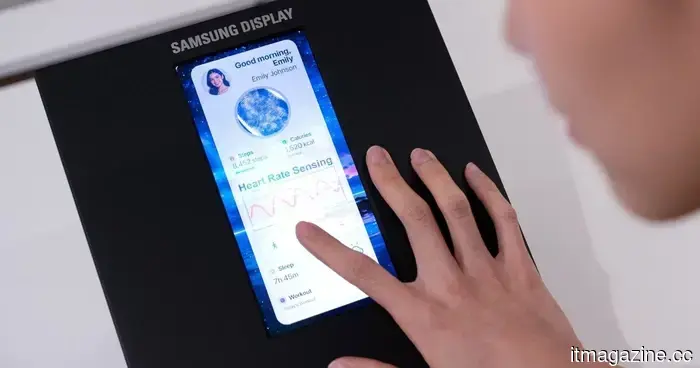
Samsung further unveiled a new “Sensor OLED Display” featuring a resolution of 500 PPI, an increase from last year’s 374 PPI, representing about a 33% enhancement and aligning it with premium smartphone displays.
The unique aspect of this panel is its integration of organic photodiodes directly into the display. This allows it to collect biometric data such as heart rate and blood pressure using light emitted from the screen itself. This introduces an early glimpse into how displays might evolve to play additional roles beyond merely displaying content.
Future Implications
These advancements indicate a broader transformation in smartphone displays. The emphasis is shifting from simply resolution or refresh rate to encompass brightness, color fidelity, efficiency, and additional functionalities.
For consumers, this could result in phones that are more user-friendly outdoors, superior for content consumption, and capable of supporting new features without requiring additional hardware.
While these technologies are still in the prototype phase, they provide a clear indication of the future trajectory for smartphone displays. Upcoming devices are expected to be brighter, more efficient, and more capable than current offerings.
Other articles
 Tesla's rollout of FSD in Europe faces skepticism from regulators, as Musk has been indicating.
Reuters has released internal communications from EU regulators that reveal ongoing doubts about Tesla's claims regarding the safety of its FSD and its rollout approach, even after receiving type approval in the Netherlands in April.
Tesla's rollout of FSD in Europe faces skepticism from regulators, as Musk has been indicating.
Reuters has released internal communications from EU regulators that reveal ongoing doubts about Tesla's claims regarding the safety of its FSD and its rollout approach, even after receiving type approval in the Netherlands in April.
 ServiceNow anticipates reaching $30 billion by 2030, with one-third of annual contract value (ACV) coming from AI.
ServiceNow forecasts $30 billion in subscription revenue for 2030, with 30% of that annual contract value coming from Now Assist, the company’s premier AI product. The presentation for investors addresses concerns about the potential displacement of AI in the SaaS sector.
ServiceNow anticipates reaching $30 billion by 2030, with one-third of annual contract value (ACV) coming from AI.
ServiceNow forecasts $30 billion in subscription revenue for 2030, with 30% of that annual contract value coming from Now Assist, the company’s premier AI product. The presentation for investors addresses concerns about the potential displacement of AI in the SaaS sector.
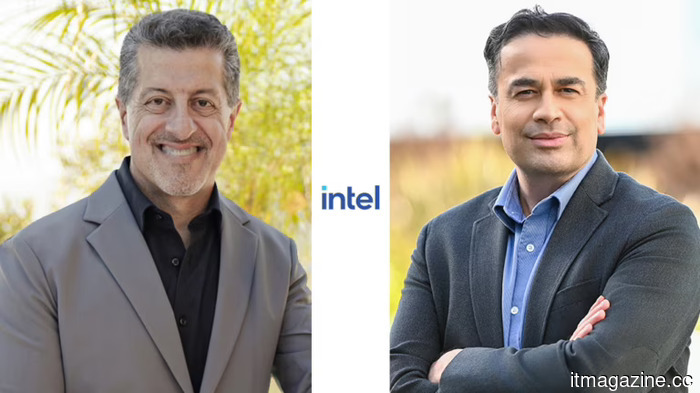 Intel has appointed Qualcomm veteran Alex Katouzian to head a new Client Computing and Physical AI division.
Intel has brought on Alex Katouzian, a veteran of Qualcomm with 25 years of experience, to head a newly merged Client Computing and Physical AI division. This marks the second high-level hire from Qualcomm during CEO Lip-Bu Tan's leadership.
Intel has appointed Qualcomm veteran Alex Katouzian to head a new Client Computing and Physical AI division.
Intel has brought on Alex Katouzian, a veteran of Qualcomm with 25 years of experience, to head a newly merged Client Computing and Physical AI division. This marks the second high-level hire from Qualcomm during CEO Lip-Bu Tan's leadership.
 Samsung's upcoming display technology has the capability to monitor heart rate and blood pressure using your fingertip.
Samsung's latest Sensor OLED Display incorporates health sensors directly within the panel, allowing it to measure heart rate and blood pressure using just your fingertip, without the need for any wearables.
Samsung's upcoming display technology has the capability to monitor heart rate and blood pressure using your fingertip.
Samsung's latest Sensor OLED Display incorporates health sensors directly within the panel, allowing it to measure heart rate and blood pressure using just your fingertip, without the need for any wearables.
 ServiceNow anticipates reaching $30 billion by 2030, with one-third of its annual contract value coming from AI.
ServiceNow anticipates achieving $30 billion in subscription revenue by 2030, with 30% of that annual contract value coming from Now Assist, its primary AI product. The presentation during investor day serves as a structural response to worries regarding AI-SaaS displacement.
ServiceNow anticipates reaching $30 billion by 2030, with one-third of its annual contract value coming from AI.
ServiceNow anticipates achieving $30 billion in subscription revenue by 2030, with 30% of that annual contract value coming from Now Assist, its primary AI product. The presentation during investor day serves as a structural response to worries regarding AI-SaaS displacement.
 Fervo Energy announces a $1.33 billion IPO, marking the biggest climate-tech listing of 2026.
Fervo Energy commenced its IPO roadshow with a goal of raising up to $1.33 billion by offering shares priced between $21 and $24. The Nasdaq listing is aimed at positioning the company as a climate-tech player in the AI infrastructure sector.
Fervo Energy announces a $1.33 billion IPO, marking the biggest climate-tech listing of 2026.
Fervo Energy commenced its IPO roadshow with a goal of raising up to $1.33 billion by offering shares priced between $21 and $24. The Nasdaq listing is aimed at positioning the company as a climate-tech player in the AI infrastructure sector.
Samsung showcases an exceptionally bright OLED display for smartphones that maintains color accuracy.
Samsung has introduced a new OLED panel that can reach brightness levels of up to 3,000 nits and offers expanded color coverage, with the goal of enhancing outdoor visibility and overall display quality.