
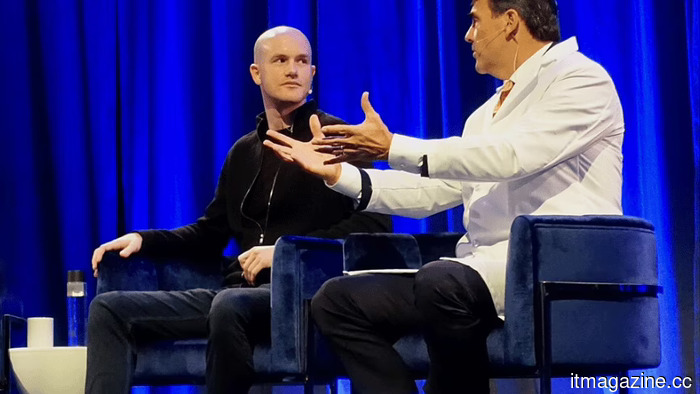
Coinbase reduces its workforce by 14% and restructures to focus on AI-driven teams as cryptocurrency revenue declines by 26% and trading volumes reach an 18-month low.
**Summary:** Coinbase is reducing its workforce by 14 percent, equating to around 660 employees from a total of 4,700, just two days before announcing a quarter where revenue experienced a 26 percent drop and crypto trading volumes reached their lowest since October 2024. The CEO, Brian Armstrong, revealed the layoffs in a letter that briefly noted the downturn in the crypto market and largely focused on how artificial intelligence is transforming the company's operations. The restructuring plan involves removing pure management roles, limiting the organizational structure to five layers beneath the CEO and COO, and creating AI-native "pods," small teams utilizing AI tools to accomplish tasks that previously required entire departments. Armstrong suggests that the changes reflect a necessary structural transformation, rather than a reaction to market conditions.
**The Figures:** The timing of these layoffs coincides with expected first-quarter revenues of approximately $1.5 billion for 2026, marking a 26 percent decrease compared to the same timeframe last year. Forecasts indicate earnings per share at 36 cents, down from $1.94 a year earlier. Additionally, consumer transaction revenue plummeted 45 percent year-on-year to $734 million due to declining cryptocurrency prices and a shift to lower-fee trading options. Bitcoin suffered its worst first quarter since 2018, dropping between 22 and 24 percent, while Ether saw a 41 percent decrease. Overall, global cryptocurrency trading volume declined nearly 48 percent since its peak in October 2025, descending to $4.3 trillion in March, the lowest since October 2024. Coinbase's shares are currently trading 57 percent lower than their 52-week high of $444.65, with operating expenses rising 22 percent year-on-year to $1.5 billion, escalating faster than revenue due to costs associated with the acquisition of Deribit. The restructuring is anticipated to incur severance costs between $50 and $60 million.
**The Highlights:** Institutional trading revenue is a positive note, having risen 31 percent year-on-year to $185 million, bolstered by Deribit's successful quarter in derivatives. However, this segment cannot offset the significant drop in consumer trading volume that historically contributed the bulk of Coinbase's earnings. The company anticipates subscription and service revenue around $590 million for the first quarter, falling short of the Wall Street consensus of $761 million by 22 percent well before the quarter concluded. These figures do not depict a company restructuring solely due to AI advancements but rather indicate a necessity driven by market conditions.
**The Narrative:** Armstrong’s communication is meticulously crafted; while he acknowledges the market downturn, he presents the layoffs as a hastening of an ongoing transformation. He highlights that AI enables engineers to accomplish in days what used to take weeks, as the restructuring removes "pure manager" roles and replaces them with player-coaches who lead while also executing. The AI-native pods are structured to minimize coordination overhead and utilize AI tools across various functions. Armstrong conveyed to employees that future hiring will prioritize strong AI capabilities, emphasizing that the company's success hinges on adopting an AI-first approach.
**The Trend:** This trend of labeling layoffs as driven by AI rather than market pressures is termed AI-washing, where companies credit job cuts to AI advancements without clear proof of replacement. A December 2025 survey revealed that 59 percent of hiring managers emphasized AI in layoff announcements for more favorable stakeholder perceptions rather than admitting to financial challenges. Research highlighted that AI-related job reductions constituted just 4.5 percent of total layoffs in early 2025, while traditional economic factors accounted for nearly four times as many. OpenAI’s Sam Altman characterized this phenomenon as AI-washing, arguing that fewer than one percent of job losses in 2025 could be directly linked to AI.
**The Difference:** The Coinbase restructuring diverges from others like Block’s or Klarna’s as it involves more specific organizational adjustments. Armstrong isn't merely reducing the workforce while citing AI; he is transforming the management structure, implementing a five-level cap, and introducing an AI-native pod design meant to prioritize AI tools as essential rather than as mere productivity enhancers. The concept of a single-person team illustrates this model: one engineer utilizing AI for all aspects of development and customer engagement to deliver results that once required larger teams. Success with this approach could showcase how a company with close to $5 billion in annual revenue can function with a significantly reduced workforce.
Mark Zuckerberg at Meta candidly referenced his company’s layoffs as related to reallocating capital instead of AI-driven productivity. Armstrong, however, makes a broader claim that AI has revolutionized capabilities, necessitating structural changes to keep pace. While there is validity to this assertion, the timing—immediately preceding a report of major revenue declines—blurs the line between subsequent necessity and AI-driven innovation.
**The Context:** The overall impact of AI on employment is complex and varies beyond individual corporate changes. The tech sector has already seen over 73,000 job losses across
Other articles
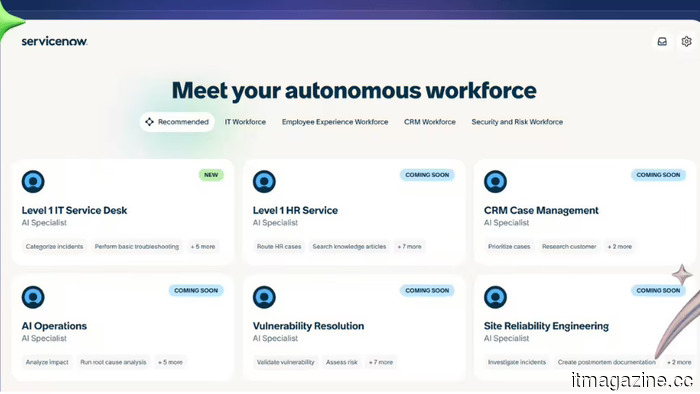 ServiceNow anticipates reaching $30 billion by 2030, with one-third of its annual contract value coming from AI.
ServiceNow anticipates achieving $30 billion in subscription revenue by 2030, with 30% of that annual contract value coming from Now Assist, its primary AI product. The presentation during investor day serves as a structural response to worries regarding AI-SaaS displacement.
ServiceNow anticipates reaching $30 billion by 2030, with one-third of its annual contract value coming from AI.
ServiceNow anticipates achieving $30 billion in subscription revenue by 2030, with 30% of that annual contract value coming from Now Assist, its primary AI product. The presentation during investor day serves as a structural response to worries regarding AI-SaaS displacement.
 Employees at Google DeepMind have decided to unionize following a Pentagon AI agreement that contradicts eight years of ethical commitments.
Staff at DeepMind UK voted 98% in favor of joining the CWU and Unite following Google's signing of a classified Pentagon agreement for "any lawful purpose." They are advocating for the cessation of military AI applications and the reinstatement of ethical standards.
Employees at Google DeepMind have decided to unionize following a Pentagon AI agreement that contradicts eight years of ethical commitments.
Staff at DeepMind UK voted 98% in favor of joining the CWU and Unite following Google's signing of a classified Pentagon agreement for "any lawful purpose." They are advocating for the cessation of military AI applications and the reinstatement of ethical standards.
 Google, Microsoft, and xAI have consented to provide pre-release evaluations of their government AI models as the Mythos crisis compels an increase in oversight.
Five leading AI laboratories are currently submitting their models for evaluation by the US government. This voluntary initiative lacks legal authority but includes all significant AI developers following the Mythos crisis.
Google, Microsoft, and xAI have consented to provide pre-release evaluations of their government AI models as the Mythos crisis compels an increase in oversight.
Five leading AI laboratories are currently submitting their models for evaluation by the US government. This voluntary initiative lacks legal authority but includes all significant AI developers following the Mythos crisis.
 Coinbase reduces its workforce by 14% and reorganizes around AI-focused pods as cryptocurrency revenue declines by 26% and trading volumes reach an 18-month low.
Coinbase is reducing its workforce by 660 employees and reorganizing into AI-focused teams with a maximum of five layers of management. Revenue for Q1 is projected to decline by 26% due to a 48% decrease in cryptocurrency trading volumes.
Coinbase reduces its workforce by 14% and reorganizes around AI-focused pods as cryptocurrency revenue declines by 26% and trading volumes reach an 18-month low.
Coinbase is reducing its workforce by 660 employees and reorganizing into AI-focused teams with a maximum of five layers of management. Revenue for Q1 is projected to decline by 26% due to a 48% decrease in cryptocurrency trading volumes.
 Nscale has invested €695 million in Portugal, while the crypto-to-AI neocloud reaches a valuation of $14.6 billion within two years, collaborating with Microsoft.
Nscale is set to provide 66,000 Nvidia Rubin GPUs for Microsoft's 1.2 GW Sines campus. Once a crypto miner, it has now become Europe's most valuable AI infrastructure startup, valued at $14.6 billion.
Nscale has invested €695 million in Portugal, while the crypto-to-AI neocloud reaches a valuation of $14.6 billion within two years, collaborating with Microsoft.
Nscale is set to provide 66,000 Nvidia Rubin GPUs for Microsoft's 1.2 GW Sines campus. Once a crypto miner, it has now become Europe's most valuable AI infrastructure startup, valued at $14.6 billion.
 Intel has appointed Qualcomm veteran Alex Katouzian to head a new Client Computing and Physical AI division.
Intel has brought on Alex Katouzian, who spent 25 years at Qualcomm, to head a newly formed Client Computing and Physical AI division. This marks the second high-profile recruitment from Qualcomm during CEO Lip-Bu Tan's leadership.
Intel has appointed Qualcomm veteran Alex Katouzian to head a new Client Computing and Physical AI division.
Intel has brought on Alex Katouzian, who spent 25 years at Qualcomm, to head a newly formed Client Computing and Physical AI division. This marks the second high-profile recruitment from Qualcomm during CEO Lip-Bu Tan's leadership.
Coinbase reduces its workforce by 14% and restructures to focus on AI-driven teams as cryptocurrency revenue declines by 26% and trading volumes reach an 18-month low.
Coinbase is cutting 660 jobs and reorganizing into AI-native pods while implementing a five-layer management limit. Revenue for Q1 is anticipated to decline by 26% due to a 48% drop in crypto trading volumes.