
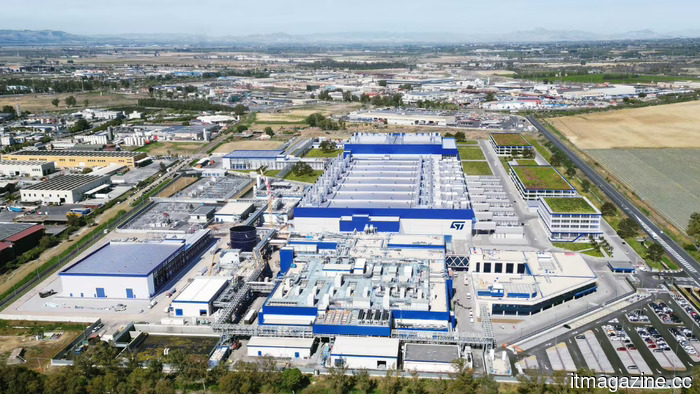
STMicroelectronics aims to exceed $3 billion from the space sector.
The Geneva-based semiconductor company has delivered over 5 billion RF antenna chips to Starlink and anticipates its low-Earth-orbit segment alone to generate more than $3 billion in total revenue from 2026 to 2028. Orbital data centers are a consideration for the future.
When STMicroelectronics first received qualification for its chips from the European Space Agency in 1977, the satellite industry functioned differently. Programs were driven by government initiatives, customized hardware was the norm, and the small segment of the semiconductor market used in space was designed for unique missions rather than mass production.
Nearly fifty years later, this Geneva-based firm is experiencing what it describes as an unparalleled growth phase in its space business. On Monday, they shared with investors just how extraordinary this growth is.
According to a Reuters report shared through TradingView during the company's investor call, STMicro aims for over $3 billion in total revenue from its space semiconductor division from 2026 to 2028. The growth implied by this projection is quite significant.
ST's low-Earth-orbit revenue, which the company tracks separately, was about $175 million in 2021 and increased to approximately $600 million by 2025. According to the company's own forecasts, this figure is expected to approach $1 billion by the end of 2026. Thus, the $3 billion target appears more as a continuation of existing momentum rather than an overly ambitious goal.
Sources of revenue
The shift ST executives have pointed out is the transition from government-driven space programs to commercial constellation operators, with SpaceX's Starlink being the primary customer.
Over a decade, ST has supplied more than 5 billion RF antenna chips to Starlink user terminals and estimates that this number could rise to around 10 billion by 2027 as the constellation expands. Other commercial players, such as Amazon’s Kuiper and OneWeb, follow Starlink in terms of demand.
The company also mentioned contracts on the European front that, while structured differently, hold strategic importance. ST is providing components for inter-satellite laser communication links on future SpaceX platforms and collaborating with Thales and Eutelsat on the European Union’s upcoming Iris² sovereign satellite constellation, a key element of European technological sovereignty policy.
TNW has extensively covered the competitive landscape in the European satellite sector, noting that Iris²'s anticipated launch is scheduled for the end of the decade, making ST a crucial operational supplier for the European program.
The same engineering expertise that secures high volumes with Starlink also qualifies ST for Iris².
Beyond its headline customers, ST’s space segment includes a broader range of products than is typically recognized. Their offerings encompass radiation-hardened logic, voltage regulators, mixed-signal ASICs, and rad-hard discrete components for satellite systems.
While the economic dynamics of these products vary among customers, the fundamental engineering required to produce chips that perform reliably in a vacuum, endure extreme thermal cycles, and withstand sustained radiation represents one of the higher-margin specializations in semiconductor fabrication.
Understanding New Space
In ST’s view, the emergence of New Space has changed the paradigm. Until around 2018, the standard radiation-hardened chip for satellites was a customized component designed for a customer planning to build a single, $200 million geosynchronous satellite.
Constellation operators constructing hundreds or thousands of uniform, low-cost satellites require a different approach: rad-hard components available in plastic packaging, in large volumes, at prices that maintain the unit economics of a 1,200-spacecraft constellation.
In 2022, ST launched its first affordable rad-hard line targeted at New Space, featuring cost-effective plastic packaging across power, analog, and logic categories. Four years later, that initial commitment appears to have been exceptionally well-timed.
The overall market context aligns with this growth trajectory. Independent assessments of the space semiconductor sector suggest that global revenues currently fall between $5 billion and $7 billion, with annual growth rates in the mid-single digits across various forecasts.
ST's own revenue trajectory in low-Earth orbit suggests it is capturing a significant portion of that growth. The $3 billion cumulative goal, spread over three years, aligns with the company potentially controlling about a quarter of global space semiconductor revenue at its peak.
Orbital data centers as an optional opportunity
ST executives also pointed out that orbital data centers might present a future market but stressed that they have not included any potential revenue from this in their current 2026–2028 target. This caution is prudent. Earlier this year, TNW reported on SpaceX’s pre-IPO disclosures, where the company cautioned investors that orbital AI data centers depend on "unproven technologies" and may not achieve commercial viability.
SpaceX's S-1 framing was notably forthright for a company that had previously positioned orbital computing as almost inevitable. The challenges regarding thermal management, in particular, remain brutal: dissipating one megawatt of heat at 20°C in orbit entails approximately
Other articles
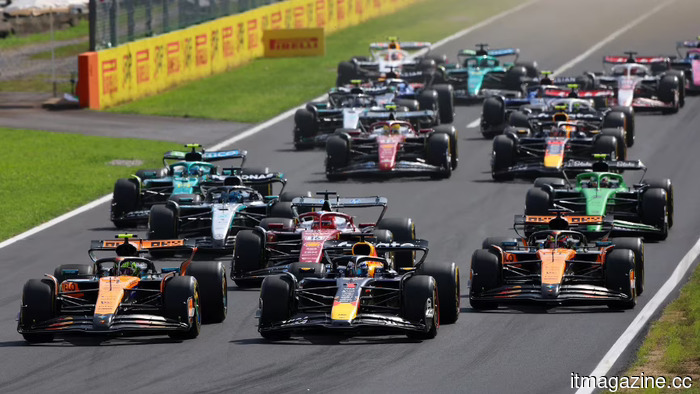 AI has now become a sponsor, strategist, and technical director in F1.
In the past six months, Formula One has welcomed eight new AI partnerships, with Williams utilizing Claude, McLaren employing Gemini, and Red Bull partnering with Oracle.
AI has now become a sponsor, strategist, and technical director in F1.
In the past six months, Formula One has welcomed eight new AI partnerships, with Williams utilizing Claude, McLaren employing Gemini, and Red Bull partnering with Oracle.
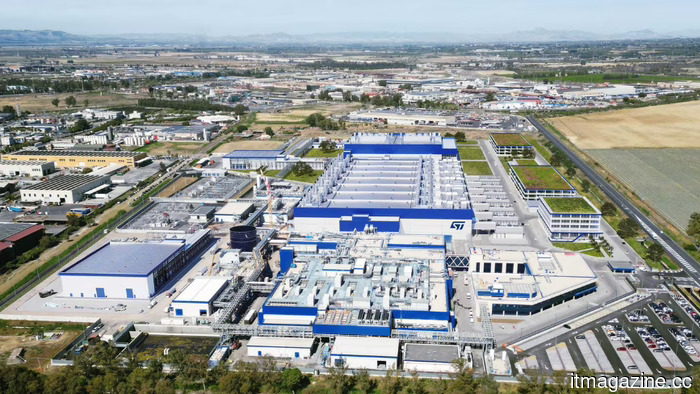 STMicroelectronics aims to generate over $3 billion from the space sector.
STMicroelectronics aims for over $3 billion in total revenue from space chips from 2026 to 2028, driven by the growth of Starlink.
STMicroelectronics aims to generate over $3 billion from the space sector.
STMicroelectronics aims for over $3 billion in total revenue from space chips from 2026 to 2028, driven by the growth of Starlink.
 Microsoft has announced that it is working on a solution for the Outlook issue that caused documents to appear blank.
Microsoft is deploying a server-side solution for a longstanding Outlook issue that caused shared Word, Excel, and PowerPoint files to open as blank. In the meantime, browser-based alternatives are available until the fix is implemented for all users.
Microsoft has announced that it is working on a solution for the Outlook issue that caused documents to appear blank.
Microsoft is deploying a server-side solution for a longstanding Outlook issue that caused shared Word, Excel, and PowerPoint files to open as blank. In the meantime, browser-based alternatives are available until the fix is implemented for all users.
 Rivian has managed to cut the production costs of the R2 EVs by 50%. Hopefully, this reduction will be reflected in prices for consumers.
Rivian claims that the R2 is more than 50% less expensive to manufacture compared to its R1 models, which represents a significant advance towards more affordable electric vehicles, provided that consumers recognize the value.
Rivian has managed to cut the production costs of the R2 EVs by 50%. Hopefully, this reduction will be reflected in prices for consumers.
Rivian claims that the R2 is more than 50% less expensive to manufacture compared to its R1 models, which represents a significant advance towards more affordable electric vehicles, provided that consumers recognize the value.
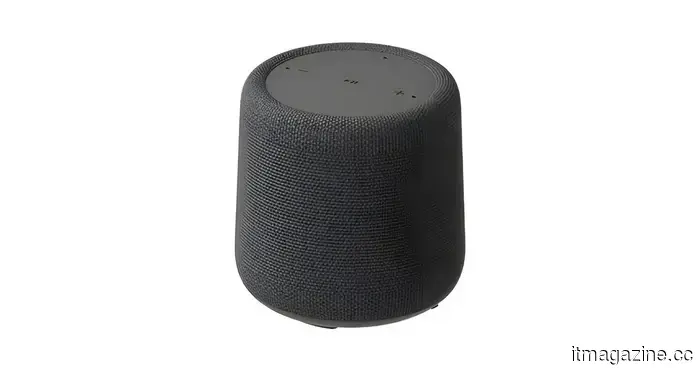 A Walmart leak reveals a growing Onn product lineup that includes a smart speaker compatible with Gemini.
A certification listing indicates that Walmart's Onn lineup is set to grow with the introduction of a Gemini-powered smart speaker that includes Matter support, Google Cast, and a 10W speaker.
A Walmart leak reveals a growing Onn product lineup that includes a smart speaker compatible with Gemini.
A certification listing indicates that Walmart's Onn lineup is set to grow with the introduction of a Gemini-powered smart speaker that includes Matter support, Google Cast, and a 10W speaker.
 Microsoft announced that it is working on a solution for an Outlook issue that caused documents to appear blank.
Microsoft is implementing a server-side solution for a longstanding Outlook issue that caused shared Word, Excel, and PowerPoint files to open with a blank screen. In the meantime, browser-based alternatives are available until the fix is fully deployed.
Microsoft announced that it is working on a solution for an Outlook issue that caused documents to appear blank.
Microsoft is implementing a server-side solution for a longstanding Outlook issue that caused shared Word, Excel, and PowerPoint files to open with a blank screen. In the meantime, browser-based alternatives are available until the fix is fully deployed.
STMicroelectronics aims to exceed $3 billion from the space sector.
STMicroelectronics aims to achieve over $3 billion in total revenue from space chips from 2026 to 2028, propelled by the growth of Starlink.