
Chinese courts have determined that using AI replacement as a justification for terminating employees is not a valid legal reason, amid a global wave of tech layoffs totaling 78,000 positions.
TL;DR: Chinese courts in Hangzhou and Beijing have ruled in two separate cases that businesses cannot terminate employees solely to replace them with AI. This establishes that adopting AI is a strategic business decision, not an unforeseen change in circumstances according to China’s Labour Contract Law. These rulings come as 78,000 tech workers have been laid off globally in early 2026, with nearly half of those layoffs due to AI advancements, highlighting a significant contrast with the US and EU, where similar legal protections are lacking.
In one case, a quality assurance supervisor known as Zhou was employed by a tech firm in Hangzhou starting November 2022. His responsibilities involved working with AI language models, improving outputs, and filtering sensitive content for a monthly salary of 25,000 yuan (about $3,640). In 2024, the company decided to automate Zhou’s position. It offered him a lower-level job with a 40% pay cut, reducing his salary to 15,000 yuan, which Zhou declined. When the company terminated his employment, he sought arbitration, resulting in a ruling that his dismissal was unlawful. The Hangzhou Intermediate People's Court supported this decision, concluding that the choice to implement AI is a strategic business decision and does not qualify as an objective circumstance justifying termination under China’s Labour Contract Law. The company was ordered to pay compensation, marking the second ruling within six months establishing that firing an employee solely due to AI capability is not permissible in China.
The initial case occurred in Beijing, involving an employee named Liu, who worked as a data collector for a tech company since 2009. In early 2024, the firm transitioned entirely to AI-driven data collection, disbanded the navigation products department, and terminated Liu's contract, claiming significant circumstantial change. This case was listed among the top ten labor arbitration decisions by the Beijing Municipal Human Resources and Social Security Bureau in December 2025. The arbitration panel ruled that the implementation of AI fell under the employer’s discretionary business decisions and constituted technological innovation intended to respond to market dynamics. While such changes may necessitate adjustments in job roles, employers are expected to anticipate those risks as part of regular operations. The company’s appeal to overturn this ruling was rejected by both the trial and appeals courts.
Both cases hinge on Article 40 of China’s Labour Contract Law, which allows for termination only when objective circumstances materially change and make contracts unperformable. Chinese courts have established that AI adoption does not fit this definition, as it is a choice made by companies rather than an external imposition. The courts distinguished between external shocks that make job performance impossible and internal decisions that render roles redundant, with the former justifying termination legally.
These rulings come during a tumultuous period in the global tech industry, which has seen job cuts reminiscent of post-pandemic adjustments in 2022 and 2023. Over 78,000 tech workers were laid off in the first four months of 2026, with almost half of those reductions linked to AI replacing human roles. Notable layoffs included approximately 8,000 positions at Meta and 20,000-30,000 at Oracle, all citing AI as a main factor.
China is rapidly advancing in AI compared to the US while investing significantly less in computing resources. The country aims to enhance AI utilization economically while regulating its applications. In 2026, China launched a campaign against AI misuse, targeting deepfakes and misinformation, and implemented labeling standards for AI-generated content. The government’s strategy focuses on regulation rather than restriction, motivated by concerns over social stability amidst rising youth unemployment.
In contrast to China, the United States lacks similar protections in employment law, where at-will employment allows termination for any reason not specifically prohibited. A proposed Senate bill to monitor layoffs due to AI automation has not progressed, and while states like Illinois and Colorado have some regulations regarding AI in hiring, they do not match the protections established by Chinese courts.
The European Union's AI Act addresses AI in the workplace but does not prevent layoffs induced by AI. It sets high-risk classifications for AI applications in employment, effective in August 2026, but does not ban AI-related job eliminations. Calls for stronger protections and proposals for a European AI Social Compact have not yet been enacted. The disparity between China's legal stance and that of the West lies not in a lack of awareness, but rather in the choices made regarding legislative and judicial responses.
The Chinese rulings create a coherent legal framework while presenting challenges for companies in the country. If AI adoption is a strategic choice rather than an unforeseen circumstance, then businesses that automate positions must either retrain affected workers, reassign them to equivalent roles at similar pay, or retain them in roles deemed no longer essential. The courts assert that the financial burden of technological advancements should not solely affect employees, implying that companies must carry these costs.
The impact of AI on jobs is nuanced; while many firms are reevaluating roles due to
Other articles
 VW, Toyota, and Hyundai are relying on Chinese tech partners as local brands dominate 70% of the market.
The early 2026 market share increases for foreign automakers in China indicate a lingering effect of subsidies rather than a resurgence. The technology disparity has shifted.
VW, Toyota, and Hyundai are relying on Chinese tech partners as local brands dominate 70% of the market.
The early 2026 market share increases for foreign automakers in China indicate a lingering effect of subsidies rather than a resurgence. The technology disparity has shifted.
 VW, Toyota, and Hyundai are placing their bets on Chinese technology partners as local brands dominate 70% of the market.
The early 2026 market share increases of foreign automakers in China are indicative of a lingering effect from subsidies, rather than a resurgence. The technology gap has shifted.
VW, Toyota, and Hyundai are placing their bets on Chinese technology partners as local brands dominate 70% of the market.
The early 2026 market share increases of foreign automakers in China are indicative of a lingering effect from subsidies, rather than a resurgence. The technology gap has shifted.
 VW, Toyota, and Hyundai are partnering with Chinese tech firms as local brands dominate 70% of the market.
The early 2026 market share increases for foreign automakers in China indicate a lingering effect of subsidies rather than a resurgence. The technology gap has inverted.
VW, Toyota, and Hyundai are partnering with Chinese tech firms as local brands dominate 70% of the market.
The early 2026 market share increases for foreign automakers in China indicate a lingering effect of subsidies rather than a resurgence. The technology gap has inverted.
 Oura launches features for hormonal health, including tracking for birth control and menopause.
Oura unveils new features for hormonal health, which include tracking birth control and providing insights on menopause, with the goal of linking biometric information to actual physiological changes.
Oura launches features for hormonal health, including tracking for birth control and menopause.
Oura unveils new features for hormonal health, which include tracking birth control and providing insights on menopause, with the goal of linking biometric information to actual physiological changes.
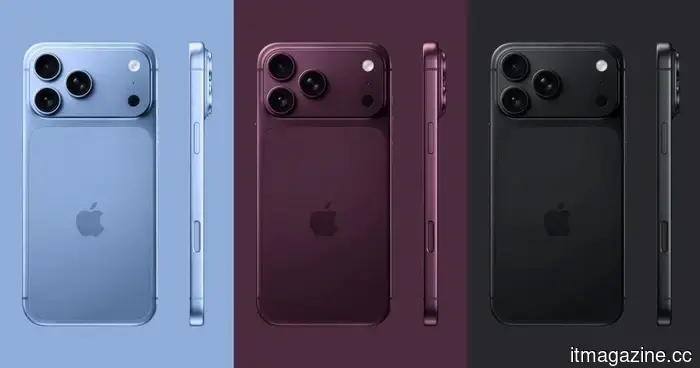 Similar to the MacBook Neo, Apple may deliver another pricing shock with the iPhone 18 Pro.
A leak regarding the pricing of the iPhone 18 Pro indicates that Apple might expand the distinction between the Pro and standard models, adopting a strategy akin to its MacBook Neo method.
Similar to the MacBook Neo, Apple may deliver another pricing shock with the iPhone 18 Pro.
A leak regarding the pricing of the iPhone 18 Pro indicates that Apple might expand the distinction between the Pro and standard models, adopting a strategy akin to its MacBook Neo method.
 Alphabet approaches Nvidia in the race to become the world's most valuable company following strong Q1 earnings in cloud, search, and AI.
Alphabet's market capitalization reached $4.6 trillion following a 22% increase in Q1 earnings. Google Cloud experienced a 63% growth. Meanwhile, Nvidia saw a decline of 6%. The difference is $200 billion and is decreasing.
Alphabet approaches Nvidia in the race to become the world's most valuable company following strong Q1 earnings in cloud, search, and AI.
Alphabet's market capitalization reached $4.6 trillion following a 22% increase in Q1 earnings. Google Cloud experienced a 63% growth. Meanwhile, Nvidia saw a decline of 6%. The difference is $200 billion and is decreasing.
Chinese courts have determined that using AI replacement as a justification for terminating employees is not a valid legal reason, amid a global wave of tech layoffs totaling 78,000 positions.
Two courts in China determined that adopting AI is a business decision and does not warrant termination. There is no similar protection in the US and EU. This disparity is intentional.