

The 6,000 mAh battery in the Razr Fold could be a cause for concern for Samsung and Google: here’s the reason.
If there’s one thing holding foldables back from mainstream smartphone success, it’s their battery life, and Motorola aims to address that issue. Nearly every major smartphone manufacturer offers a book-style foldable in the U.S., all marketing their premium devices with elaborate hinges, flexible displays, and other engineering feats, yet this does not seem to translate into improved battery performance.
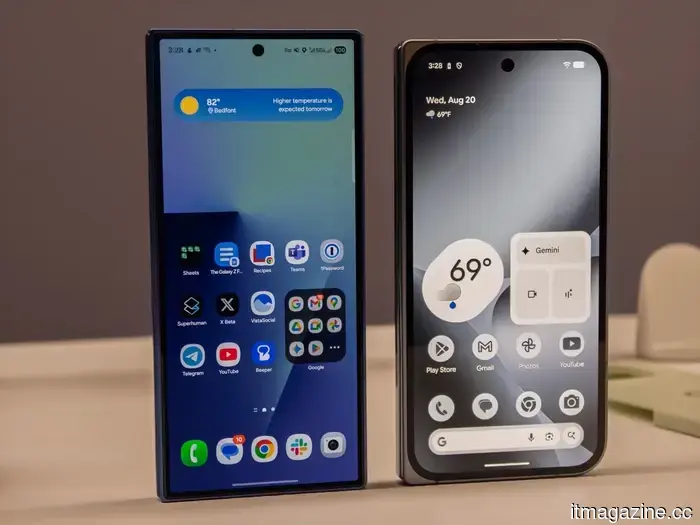
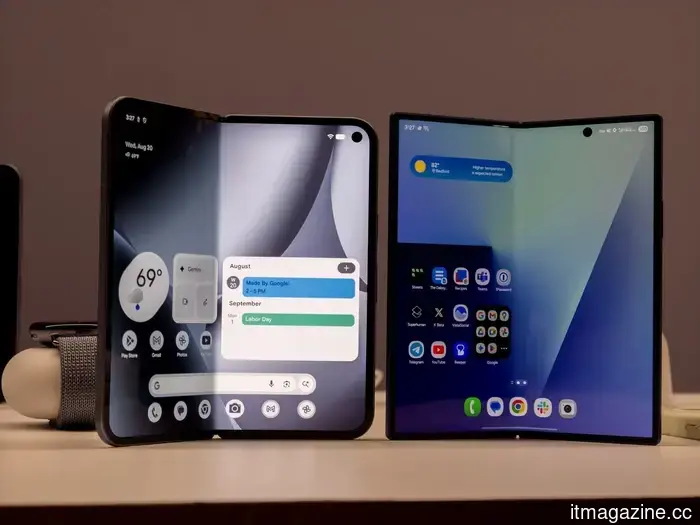
A foldable's appeal lies in its ability to unfold and effectively double its screen size. However, does that mean the battery life is also doubled? Regrettably, it is not. Both widely available book-style foldables in the U.S. — Samsung's Galaxy Z Fold 7 and Google’s Pixel 10 Pro Fold — exhibit average battery life that still falls short compared to standard smartphones.
Motorola
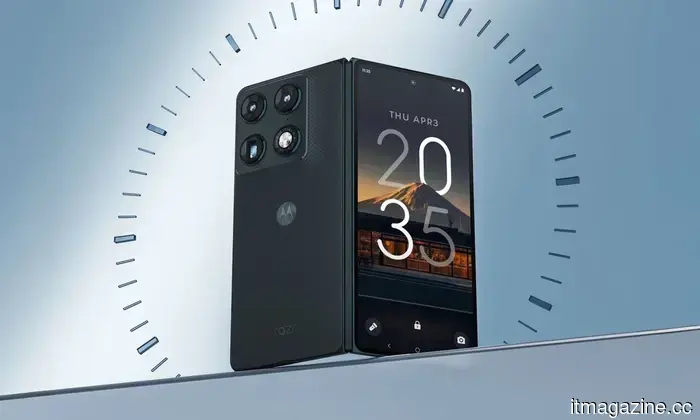
Haven’t smartphones already achieved over 10 hours of screen-on time thanks to silicon-carbon battery technology? This is precisely the gap Motorola seeks to fill with its inaugural book-style foldable: the Razr Fold. For the first time, a foldable is entering the U.S. market equipped with a 6,000 mAh battery capable of 80W wired charging.
If it performs as expected, the Razr Fold may close that gap ahead of Samsung or Google.
The battery issue that has plagued foldables
Consider what the battery in the Fold 7 or Pixel 10 Pro Fold must power: two screens (the cover and the foldable), a flagship-grade chipset taken from traditional smartphones, and at least two to three rear-facing cameras, all while maintaining a constant Wi-Fi or cellular connection.
This cumulative power demand necessitates that foldables incorporate larger batteries to match the endurance of conventional smartphones. A few years ago, when the technology was less advanced, utilizing a 4,000 or 4,400 mAh battery for a foldable was typical.
Motorola
It seems to me that OEMs, particularly in the U.S., are intentionally limiting battery capacity in foldables, while Chinese manufacturers like Honor and Oppo are pushing boundaries.
This is the central issue that the Motorola Razr Fold could potentially resolve.
**Phone Specifications:**
| Phone | Battery | Wired Charging | Wireless Charging | Status |
|--------------------------------|-------------|----------------|-------------------|------------------|
| Samsung Galaxy Z Fold 7 | 4,400 mAh | 25W | 15W (Qi2 Ready*) | Available |
| Google Pixel 10 Pro Fold | 5,015 mAh | 39W | 15W (Qi2) | Available |
| Samsung Galaxy Z TriFold | 5,600 mAh | 45W | 15W (Qi) | Discontinued |
| Motorola Razr Fold | 6,000 mAh | 80W | 50W | Launching May 21 |
**Who does the Razr Fold compete against?**
I’ve briefly used the Fold 7, and by many standards, it’s an impressive piece of technology. It is the thinnest book-style foldable in the U.S., measuring just 4.2 mm when unfolded. However, with a 4,400 mAh battery providing around six hours of screen-on time on average, it did not last an entire day for me.
The phone also requires approximately 90 minutes for a full charge due to its support for only 25W wired charging. You can't simply plug it in for 20 minutes before leaving home; timing is crucial.
Nirave Gondhia / Digital Trends
Google’s Pixel 10 Pro Fold made a significant advancement with its 5,015 mAh battery and up to 39W charging, enabling between seven and eight hours of screen-on time, genuinely lasting through a full day of use.
But is that enough? Not quite. In an era where phones are exceeding 7,000 mAh (like the OnePlus 15 and OnePlus 15R) and providing nearly two days of battery life, needing to charge a foldable around 8 or 9 PM feels inadequate for a $2,000 purchase.
For foldable phones to compete effectively with mainstream smartphones, manufacturers must enhance battery life, which is why the Razr Fold has caught my interest.
**What can you expect from the Razr Fold?**
The Razr Fold’s 6,000 mAh battery is approximately 36% larger than that of the Galaxy Z Fold 7 and about 20% larger than the Pixel 10 Pro Fold. The company has achieved this using technology found in modern Chinese flagship devices: silicon-carbon battery chemistry, which stores more energy in a smaller footprint without adding bulk. The result is a book-style foldable that unfolds to just 4.7 mm, slightly thicker than the Fold 7, but not to a concerning degree.
At this point, I’m



Other articles
 McKinsey's latest AI report claims that the productivity benefits are genuine but contingent.
McKinsey's latest report contends that the majority of companies are speeding up their current tasks instead of rethinking their workflows in relation to AI.
McKinsey's latest AI report claims that the productivity benefits are genuine but contingent.
McKinsey's latest report contends that the majority of companies are speeding up their current tasks instead of rethinking their workflows in relation to AI.
 Where technology leaders prefer to gather now
Tech executives are dedicating less time to large conferences and more time in intimate, private settings where actual decisions are made.
Where technology leaders prefer to gather now
Tech executives are dedicating less time to large conferences and more time in intimate, private settings where actual decisions are made.
 US debt surpasses 100% of GDP as Big Tech's $690 billion investment in AI competes for the same capital resources.
US debt reaches 100% of GDP for the first time since World War II. Interest payments exceed $1 trillion. Big Tech's capital expenditures on AI surpass $690 billion. Both are funded through debt from the same source.
US debt surpasses 100% of GDP as Big Tech's $690 billion investment in AI competes for the same capital resources.
US debt reaches 100% of GDP for the first time since World War II. Interest payments exceed $1 trillion. Big Tech's capital expenditures on AI surpass $690 billion. Both are funded through debt from the same source.
 McKinsey's latest AI report claims that the benefits of productivity are genuine but dependent on specific factors.
McKinsey's latest report suggests that the majority of companies are speeding up their current processes instead of restructuring workflows to incorporate AI.
McKinsey's latest AI report claims that the benefits of productivity are genuine but dependent on specific factors.
McKinsey's latest report suggests that the majority of companies are speeding up their current processes instead of restructuring workflows to incorporate AI.
 The locations where technology leaders prefer to gather now.
Technology executives are dedicating less time to large conferences and more to intimate, private meetings where important decisions are made.
The locations where technology leaders prefer to gather now.
Technology executives are dedicating less time to large conferences and more to intimate, private meetings where important decisions are made.
 China's $16.5 billion micro-drama sector emerges as the world's first widespread application of AI-generated video.
In just one month, 50,000 AI micro-dramas were launched on Douyin. The cost of production has decreased by 90%. State-funded subsidies support the hubs. China's micro-drama sector represents the initial commercial-scale experiment with AI-generated content.
China's $16.5 billion micro-drama sector emerges as the world's first widespread application of AI-generated video.
In just one month, 50,000 AI micro-dramas were launched on Douyin. The cost of production has decreased by 90%. State-funded subsidies support the hubs. China's micro-drama sector represents the initial commercial-scale experiment with AI-generated content.
The 6,000 mAh battery in the Razr Fold could be a cause for concern for Samsung and Google: here’s the reason.
Samsung and Google have dominated the U.S. foldable market for years, while subtly overlooking its most significant flaw. Now, Motorola has entered the scene and made that flaw difficult to overlook.