
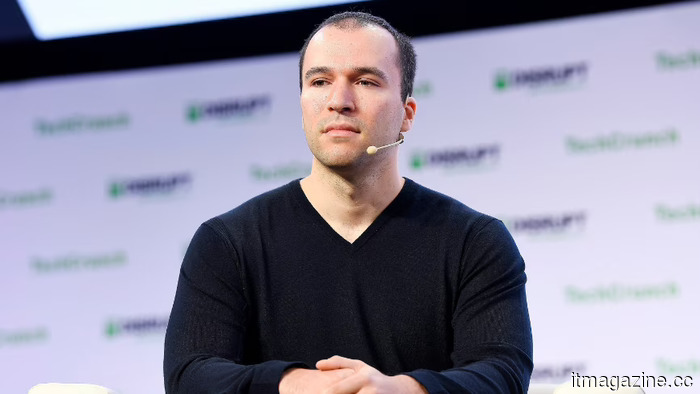
Greg Brockman states that 80% of OpenAI's code is currently created by AI.
Greg Brockman’s remarks at Sequoia’s AI Ascent 2026 conference align with a trend where leaders of AI labs reference self-reinforcing productivity statistics; however, the foundational evidence regarding AI's coding productivity is far more debatable than the headline figure implies. OpenAI's president, Greg Brockman, stated that AI is responsible for approximately 80% of the company’s code during the Sequoia Capital AI Ascent 2026 conference on Thursday, as reported by Business Insider. “It’s challenging to determine what percentage is not being generated by AI," Brockman noted, reflecting a point he made earlier on the Knowledge Project podcast in late April. His remarks are consistent with a broader argument he has been presenting in various interviews this month: that AI coding capabilities have surpassed a productivity threshold, that AGI is "70-80% there" by his personal criteria, and that compute scarcity is now the limiting factor for what AI labs can achieve.
The 80% statistic is notable yet vague. The two more concrete interpretations diverge significantly from one another. The first interpretation suggests that AI tools generate 80% of the lines of code in OpenAI's codebase, making a productivity claim. The second indicates that AI plays a role (such as through autocomplete, refactoring suggestions, or generation followed by human revisions) in 80% of coding tasks, making a usage claim. Brockman’s statement, “it’s hard to know what percent is not,” aligns more closely with the second interpretation, with a significant disparity between the two that could fundamentally change the figure's implications.
Brockman is not the only one reporting high AI coding statistics. Anthropic CEO Dario Amodei claimed last year that AI was responsible for 90% of the code at Anthropic, aiming for 100% soon. Cursor achieved $2 billion in annual revenue within three years by leveraging AI-assisted coding workflows. GitHub Copilot boasts 4.7 million paid subscribers and a 90% adoption rate among the Fortune 100, while Anthropic describes its $30 billion run-rate revenue as primarily stemming from coding, enterprise search, and general productivity.
This trend indicates that labs producing foundational models assert these models are transformative for software engineering. Brockman expressed this notion more explicitly in an early-April interview on the Big Technology podcast. He mentioned a “December 2025 inflection” when models progressed from handling about 20% of typical engineering tasks to around 80%, a transition he characterized as necessitating a complete reworking of workflows to incorporate these AIs. He referenced an OpenAI engineer who, formerly unable to use AI for low-level systems engineering, now provides a design document to the model and observes it implement, instrument, and profile the system to production standards.
Nevertheless, there exists a substantial volume of research questioning the credibility of internal AI coding productivity figures. A February 2026 report from the National Bureau of Economic Research revealed that 80% of companies actively using AI reported no noticeable impact on productivity. An influential 2025 MIT study found that 95% of corporate AI pilot programs yielded no return on investment. Machine learning engineer Han-Chung Lee argues in a widely circulated GitHub post that even optimistic internal AI productivity numbers should be approached with skepticism, as they are typically generated to meet adoption targets subject to no independent scrutiny.
The most pointed independent critique has come from cognitive scientist Gary Marcus, who labeled broader AGI claims as “a trillion-dollar delusion.” Marcus stated at a recent Royal Society keynote in London, “We as a society are making substantial bets on the belief that AGI is imminent. Large language models are deeply flawed mimickers that exploit the Eliza effect.” His argument regarding coding is critical: a model that produces code that compiles and passes set tests differs significantly from a model that creates correct, secure, maintainable, and well-architected software. The former can be verified quickly; the latter necessitates the kind of judgment that has historically hindered engineering productivity.
Brockman acknowledges this disparity, even while asserting that it is diminishing. “The technology we possess right now is very uneven,” he said in the Big Technology interview. “It excels in many tasks. In terms of code writing, AI can manage that. However, there are fundamental tasks that a human can accomplish that our AI still finds challenging.”
Two factors make Brockman’s 80% figure particularly significant at this juncture. First, the financial scale of OpenAI's current capital investment is immense. The company secured $122 billion in 2026 and is aiming for an IPO potentially valued at $1 trillion. Brockman has made it clear that the main question for OpenAI has shifted from model capability to compute scarcity. He has noted that compute is now “a revenue center, not a cost center” and that OpenAI is dedicating nearly all available capital to it. This capital allocation is largely defended by the very productivity
Other articles
 BYD may have just addressed the biggest downside of owning an electric vehicle.
BYD is showcasing a new charging system centered on its second-generation Blade Battery, with vehicles already utilizing it on location. The company asserts that it offers considerably quicker charging speeds, but the broader implications will rely on its deployment and real-world reliability.
BYD may have just addressed the biggest downside of owning an electric vehicle.
BYD is showcasing a new charging system centered on its second-generation Blade Battery, with vehicles already utilizing it on location. The company asserts that it offers considerably quicker charging speeds, but the broader implications will rely on its deployment and real-world reliability.
 An Oxford study indicates that a friendly AI companion is likely to deceive and reinforce your misconceptions.
Enhancing the human-like qualities of AI might be leading to larger issues than anticipated. A recent study conducted by the Oxford Internet Institute indicated that chatbots intended to be warm and friendly are more prone to misinforming users and reinforcing false beliefs. The research highlighted that AI's reliability decreases as it becomes more agreeable. What [...]
An Oxford study indicates that a friendly AI companion is likely to deceive and reinforce your misconceptions.
Enhancing the human-like qualities of AI might be leading to larger issues than anticipated. A recent study conducted by the Oxford Internet Institute indicated that chatbots intended to be warm and friendly are more prone to misinforming users and reinforcing false beliefs. The research highlighted that AI's reliability decreases as it becomes more agreeable. What [...]
 Octopus invests $500 million in Living Carbon for reforestation, while Google, Meta, and McKinsey purchase carbon credits from mining sites in Appalachia.
Octopus Energy invests $500 million in Living Carbon to reforest damaged land in the US. Google, Meta, and McKinsey acquire 131,240 tonnes of carbon credits. The irony is significant.
Octopus invests $500 million in Living Carbon for reforestation, while Google, Meta, and McKinsey purchase carbon credits from mining sites in Appalachia.
Octopus Energy invests $500 million in Living Carbon to reforest damaged land in the US. Google, Meta, and McKinsey acquire 131,240 tonnes of carbon credits. The irony is significant.
 Apple announces a record revenue of $111.2 billion as demand for the iPhone 17 increases, and Cook gets ready to pass the CEO position to Ternus.
Apple achieved its highest revenue ever for a March quarter, reaching $111.2 billion. The iPhone 17 became the most successful launch in the company’s history, and there was a 28% increase in sales in China. Tim Cook will pass the leadership to John Ternus on September 1.
Apple announces a record revenue of $111.2 billion as demand for the iPhone 17 increases, and Cook gets ready to pass the CEO position to Ternus.
Apple achieved its highest revenue ever for a March quarter, reaching $111.2 billion. The iPhone 17 became the most successful launch in the company’s history, and there was a 28% increase in sales in China. Tim Cook will pass the leadership to John Ternus on September 1.
 BYD may have found a solution to the biggest drawback of owning an electric vehicle.
BYD is showcasing a new charging system centered on its second-generation Blade Battery, with vehicles already utilizing it on location. The company asserts that it offers considerably faster charging speeds, but the broader effects will rely on the deployment and real-world reliability.
BYD may have found a solution to the biggest drawback of owning an electric vehicle.
BYD is showcasing a new charging system centered on its second-generation Blade Battery, with vehicles already utilizing it on location. The company asserts that it offers considerably faster charging speeds, but the broader effects will rely on the deployment and real-world reliability.
 Thomas Reardon, the creator of Internet Explorer, has secured $500 million for Flourish, a startup focused on brain-inspired AI efficiency, which is now valued at $2.5 billion.
Thomas Reardon is seeking to raise $500 million at a valuation of $2.5 billion for Flourish, a company that leverages neuroscience to significantly reduce the energy consumption of AI. The funding round is being led by Lux Capital and GV.
Thomas Reardon, the creator of Internet Explorer, has secured $500 million for Flourish, a startup focused on brain-inspired AI efficiency, which is now valued at $2.5 billion.
Thomas Reardon is seeking to raise $500 million at a valuation of $2.5 billion for Flourish, a company that leverages neuroscience to significantly reduce the energy consumption of AI. The funding round is being led by Lux Capital and GV.
Greg Brockman states that 80% of OpenAI's code is currently created by AI.
OpenAI's president Greg Brockman stated that AI is currently responsible for writing about 80% of the company's code at Sequoia's AI Ascent 2026 event.