
BYD may have just addressed the biggest downside of owning an electric vehicle.
Electric vehicles are becoming increasingly prevalent on the roads, but charging continues to pose a significant challenge. Even when a fast charger is located, stopping can easily prolong a journey by 30 minutes or more, making long-distance travel less convenient compared to refueling a gasoline vehicle.
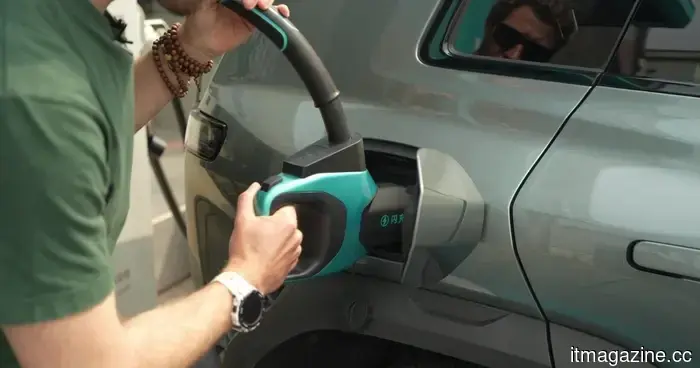
At BYD’s charging facility in Beijing, the company is showcasing a system designed to eliminate that waiting time. Vehicles are able to pull in, connect, and charge using BYD’s second generation Blade Battery along with a flash charging setup, providing a better understanding of how the technology performs outside of a controlled prototype setting.
Charging speeds are being pushed well beyond existing standards.
BYD emphasizes the rapid addition of usable range rather than the speed of a full battery charge. The company describes the experience as a brief stop, proposing that a vehicle could acquire a considerable amount of range while one takes a moment to grab a coffee.
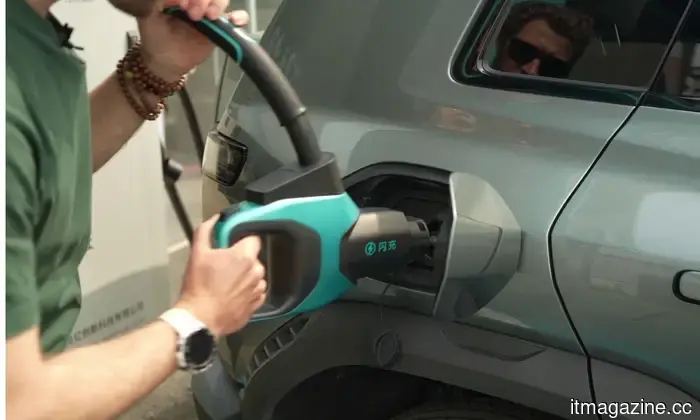
The charging design reflects this philosophy. The cable is suspended from an overhead rail instead of lying on the ground, making it easier to manage and allowing it to adjust freely according to the vehicle's position. Additionally, it accommodates connections from either side, which minimizes the need to move the car in a busy charging area.
Most of the innovation is occurring in the battery.
While the charger captures attention, BYD is touting the second generation Blade Battery as the system's centerpiece. The company claims the battery has been re-engineered to support higher charging speeds while also addressing typical issues like heat buildup and performance in low temperatures.
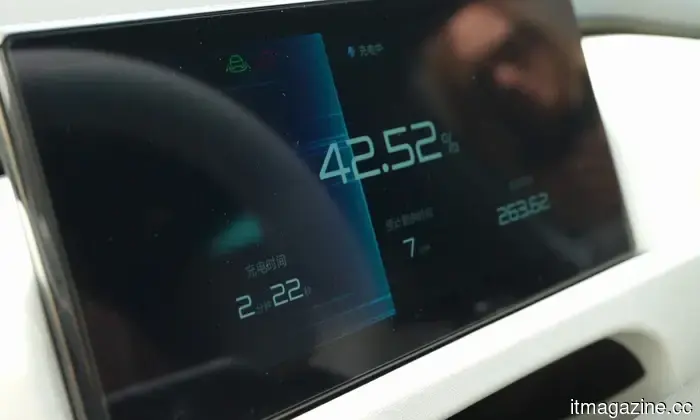
BYD asserts that the system can charge from 10 percent to 97 percent in about 12 minutes, even in temperatures as low as minus 30 degrees Celsius. The company also mentions that the battery successfully undergoes simultaneous nail penetration and charging tests, which are designed to replicate severe failure scenarios.
When compared to current fast charging capabilities.
Currently available fast chargers generally operate at around 350 kilowatts, though some newer models can reach near 500 kilowatts under ideal conditions. Even in those instances, charging from 10 percent to 80 percent typically takes between 20 and 30 minutes.
BYD claims their flash charging system can deliver up to 1,500 kilowatts via a single connector, which would significantly surpass existing charging capabilities. Under these conditions, the company asserts that the system can charge from 10 percent to 70 percent in about five minutes and reach 97 percent in roughly nine minutes.
This system is already operational, with plans for rapid expansion.
The charging setup at BYD's Beijing facility is not just a prototype; vehicles are currently utilizing the charging stations available, providing a practical demonstration of how the technology functions outside of a controlled environment.
BYD describes this as an initial phase of deployment and aims to establish up to 20,000 of these charging stations by the end of 2026. The network is projected to grow beyond China as part of a broader global initiative, a scale that will ultimately determine whether the system remains confined to specific locations or integrates into everyday charging infrastructure.


Other articles
 Greg Brockman states that 80% of OpenAI's code is currently created by AI.
OpenAI's president Greg Brockman stated that AI is currently responsible for writing about 80% of the company's code at Sequoia's AI Ascent 2026 event.
Greg Brockman states that 80% of OpenAI's code is currently created by AI.
OpenAI's president Greg Brockman stated that AI is currently responsible for writing about 80% of the company's code at Sequoia's AI Ascent 2026 event.
 An Oxford study indicates that a friendly AI companion is likely to deceive and reinforce your misconceptions.
Enhancing the human-like qualities of AI might be leading to larger issues than anticipated. A recent study conducted by the Oxford Internet Institute indicated that chatbots intended to be warm and friendly are more prone to misinforming users and reinforcing false beliefs. The research highlighted that AI's reliability decreases as it becomes more agreeable. What [...]
An Oxford study indicates that a friendly AI companion is likely to deceive and reinforce your misconceptions.
Enhancing the human-like qualities of AI might be leading to larger issues than anticipated. A recent study conducted by the Oxford Internet Institute indicated that chatbots intended to be warm and friendly are more prone to misinforming users and reinforcing false beliefs. The research highlighted that AI's reliability decreases as it becomes more agreeable. What [...]
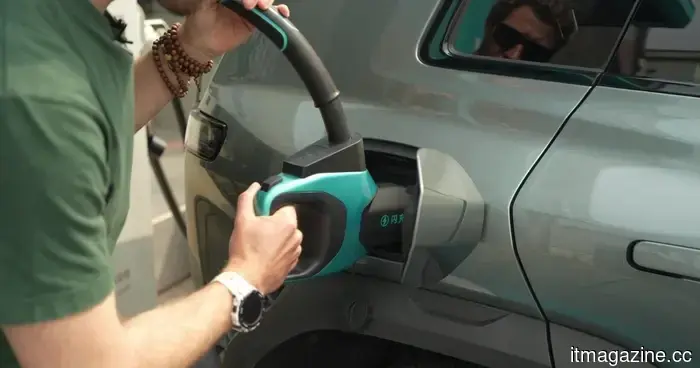 BYD may have found a solution to the biggest drawback of owning an electric vehicle.
BYD is showcasing a new charging system centered on its second-generation Blade Battery, with vehicles already utilizing it on location. The company asserts that it offers considerably faster charging speeds, but the broader effects will rely on the deployment and real-world reliability.
BYD may have found a solution to the biggest drawback of owning an electric vehicle.
BYD is showcasing a new charging system centered on its second-generation Blade Battery, with vehicles already utilizing it on location. The company asserts that it offers considerably faster charging speeds, but the broader effects will rely on the deployment and real-world reliability.
 Apple announces a record revenue of $111.2 billion, driven by strong demand for the iPhone 17, while Cook gets ready to pass the CEO position to Ternus.
Apple achieved its highest revenue ever for a March quarter, totaling $111.2 billion. The iPhone 17 marked the most successful launch in the company's history, with a 28% increase in China. Tim Cook will pass the leadership to John Ternus on September 1.
Apple announces a record revenue of $111.2 billion, driven by strong demand for the iPhone 17, while Cook gets ready to pass the CEO position to Ternus.
Apple achieved its highest revenue ever for a March quarter, totaling $111.2 billion. The iPhone 17 marked the most successful launch in the company's history, with a 28% increase in China. Tim Cook will pass the leadership to John Ternus on September 1.
 Octopus has invested $500 million in Living Carbon for reforestation efforts, while Google, Meta, and McKinsey have purchased carbon credits from mines in the Appalachian region.
Octopus Energy invests $500 million in Living Carbon for the purpose of planting trees on damaged land in the US. Meanwhile, Google, Meta, and McKinsey purchase 131,240 tons of carbon credits. The irony is quite profound.
Octopus has invested $500 million in Living Carbon for reforestation efforts, while Google, Meta, and McKinsey have purchased carbon credits from mines in the Appalachian region.
Octopus Energy invests $500 million in Living Carbon for the purpose of planting trees on damaged land in the US. Meanwhile, Google, Meta, and McKinsey purchase 131,240 tons of carbon credits. The irony is quite profound.
 Octopus invests $500 million in Living Carbon for reforestation, while Google, Meta, and McKinsey purchase carbon credits from mining sites in Appalachia.
Octopus Energy invests $500 million in Living Carbon to reforest damaged land in the US. Google, Meta, and McKinsey acquire 131,240 tonnes of carbon credits. The irony is significant.
Octopus invests $500 million in Living Carbon for reforestation, while Google, Meta, and McKinsey purchase carbon credits from mining sites in Appalachia.
Octopus Energy invests $500 million in Living Carbon to reforest damaged land in the US. Google, Meta, and McKinsey acquire 131,240 tonnes of carbon credits. The irony is significant.
BYD may have just addressed the biggest downside of owning an electric vehicle.
BYD is showcasing a new charging system centered on its second-generation Blade Battery, with vehicles already utilizing it on location. The company asserts that it offers considerably quicker charging speeds, but the broader implications will rely on its deployment and real-world reliability.