

BYD may have found a solution to the biggest drawback of owning an electric vehicle.
Electric vehicles are increasingly prevalent on the roads, yet charging continues to be a major hurdle. Finding a fast charger can add 30 minutes or more to a journey, making long-distance travel less convenient compared to filling up a gas vehicle.
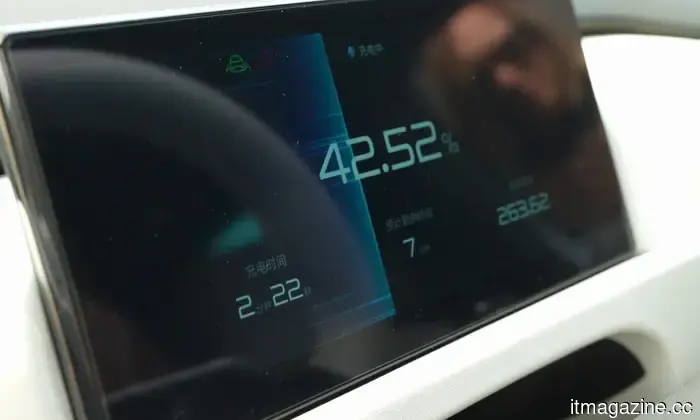
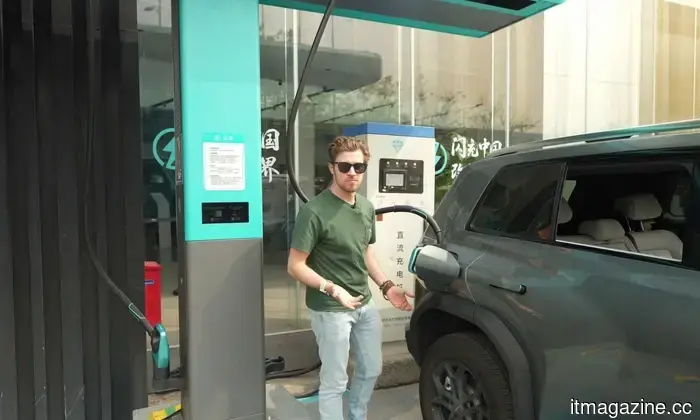
At BYD's charging facility in Beijing, the company is showcasing a system designed to eliminate that delay. Vehicles are arriving, connecting, and charging with BYD's second generation Blade Battery and flash charging technology, providing insights into how the system operates outside of a test environment.
Charging speeds are being pushed well beyond existing standards.
BYD emphasizes the speed at which usable range can be added rather than how quickly a battery can be fully charged. The company depicts the experience as a brief stop, implying that a vehicle could acquire a substantial range during the time it takes to get a coffee.
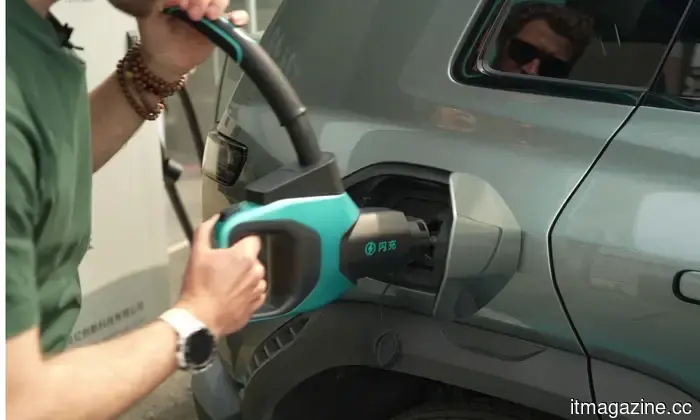
The charging design embodies this philosophy. The cable is suspended from an overhead rail rather than lying on the ground, facilitating easier handling and allowing it to move freely based on the vehicle's position. It also allows for connections from either side, which minimizes the need to adjust the car's position in a crowded charging area.
The battery is the focal point of innovation.
While the charger garners attention, BYD is highlighting its second generation Blade Battery as the system's centerpiece. The company asserts that the battery has been revamped to support higher charging speeds while addressing common issues like heat generation and performance in cold conditions.
BYD claims that the system can charge from 10 percent to 97 percent in about 12 minutes, even at temperatures as low as minus 30 degrees Celsius. The battery also reportedly passes rigorous simultaneous nail penetration and charging tests meant to replicate extreme failure scenarios.
In comparison to current fast charging options.
Most readily available fast chargers today operate at around 350 kilowatts, with some newer vehicles nearing 500 kilowatts under ideal conditions. However, even in these instances, charging from 10 percent to 80 percent typically takes between 20 and 30 minutes.
BYD states its flash charging system can provide up to 1,500 kilowatts through a single connector, significantly exceeding the capabilities of existing charging infrastructure. Under these conditions, the company claims the system can charge from 10 percent to 70 percent in roughly five minutes and reach 97 percent in about nine minutes.
This system is already in operation, with plans for rapid expansion.
BYD's site in Beijing is not merely a prototype, as vehicles are currently utilizing the charging stations, offering a realistic assessment of the technology's performance outside of a controlled setting.
BYD describes this as the initial phase of deployment and aims to establish up to 20,000 of these charging stations by the end of 2026, with plans for the network to extend beyond China as part of a wider global rollout. This expansion will ultimately determine whether the system remains confined to certain locations or becomes an integral part of everyday charging infrastructure.

Other articles
 The Xbox Ally X has introduced its own frame upscaling technology that competes with DLSS, along with several other updates.
Auto SR introduces AI-enhanced upscaling to the ROG Xbox Ally X without requiring any action from developers; it operates at the OS level for both DirectX 11 and 12 games.
The Xbox Ally X has introduced its own frame upscaling technology that competes with DLSS, along with several other updates.
Auto SR introduces AI-enhanced upscaling to the ROG Xbox Ally X without requiring any action from developers; it operates at the OS level for both DirectX 11 and 12 games.
 An Oxford study indicates that a friendly AI companion is likely to lie and reinforce your misconceptions.
Enhancing AI to appear more human-like might lead to unforeseen issues. A recent study by the Oxford Internet Institute indicated that chatbots crafted to be warm and personable are prone to misleading users and strengthening inaccurate beliefs. The findings showed that as AI becomes more accommodating, its reliability decreases. What [...]
An Oxford study indicates that a friendly AI companion is likely to lie and reinforce your misconceptions.
Enhancing AI to appear more human-like might lead to unforeseen issues. A recent study by the Oxford Internet Institute indicated that chatbots crafted to be warm and personable are prone to misleading users and strengthening inaccurate beliefs. The findings showed that as AI becomes more accommodating, its reliability decreases. What [...]
 Octopus invests $500 million in Living Carbon for reforestation, while Google, Meta, and McKinsey purchase carbon credits from mining sites in Appalachia.
Octopus Energy invests $500 million in Living Carbon to reforest damaged land in the US. Google, Meta, and McKinsey acquire 131,240 tonnes of carbon credits. The irony is significant.
Octopus invests $500 million in Living Carbon for reforestation, while Google, Meta, and McKinsey purchase carbon credits from mining sites in Appalachia.
Octopus Energy invests $500 million in Living Carbon to reforest damaged land in the US. Google, Meta, and McKinsey acquire 131,240 tonnes of carbon credits. The irony is significant.
 Thomas Reardon, the creator of Internet Explorer, has secured $500 million for Flourish, a startup focused on brain-inspired AI efficiency, which is now valued at $2.5 billion.
Thomas Reardon is seeking to raise $500 million at a valuation of $2.5 billion for Flourish, a company that leverages neuroscience to significantly reduce the energy consumption of AI. The funding round is being led by Lux Capital and GV.
Thomas Reardon, the creator of Internet Explorer, has secured $500 million for Flourish, a startup focused on brain-inspired AI efficiency, which is now valued at $2.5 billion.
Thomas Reardon is seeking to raise $500 million at a valuation of $2.5 billion for Flourish, a company that leverages neuroscience to significantly reduce the energy consumption of AI. The funding round is being led by Lux Capital and GV.
 An Oxford study indicates that a friendly AI companion is likely to deceive and reinforce your misconceptions.
Enhancing the human-like qualities of AI might be leading to larger issues than anticipated. A recent study conducted by the Oxford Internet Institute indicated that chatbots intended to be warm and friendly are more prone to misinforming users and reinforcing false beliefs. The research highlighted that AI's reliability decreases as it becomes more agreeable. What [...]
An Oxford study indicates that a friendly AI companion is likely to deceive and reinforce your misconceptions.
Enhancing the human-like qualities of AI might be leading to larger issues than anticipated. A recent study conducted by the Oxford Internet Institute indicated that chatbots intended to be warm and friendly are more prone to misinforming users and reinforcing false beliefs. The research highlighted that AI's reliability decreases as it becomes more agreeable. What [...]
 BYD may have just addressed the biggest downside of owning an electric vehicle.
BYD is showcasing a new charging system centered on its second-generation Blade Battery, with vehicles already utilizing it on location. The company asserts that it offers considerably quicker charging speeds, but the broader implications will rely on its deployment and real-world reliability.
BYD may have just addressed the biggest downside of owning an electric vehicle.
BYD is showcasing a new charging system centered on its second-generation Blade Battery, with vehicles already utilizing it on location. The company asserts that it offers considerably quicker charging speeds, but the broader implications will rely on its deployment and real-world reliability.
BYD may have found a solution to the biggest drawback of owning an electric vehicle.
BYD is showcasing a new charging system centered on its second-generation Blade Battery, with vehicles already utilizing it on location. The company asserts that it offers considerably faster charging speeds, but the broader effects will rely on the deployment and real-world reliability.