
Google Meet's AI note-taker has significantly improved and become less overwhelming.
Your meeting notes are now smarter, more customizable, and significantly more actionable.
Google Meet's feature "Take notes for me," which was introduced in 2024, has become an essential tool for those balancing note-taking with active participation in meetings.
Since its launch, Google has implemented various enhancements to its AI notetaking service, including the capability to capture notes during in-person meetings and to generate more comprehensive meeting notes.
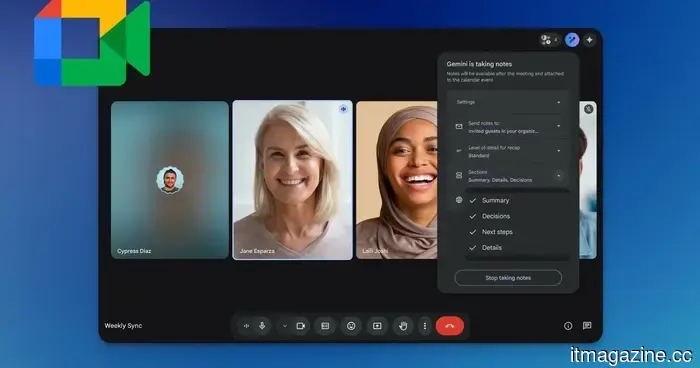
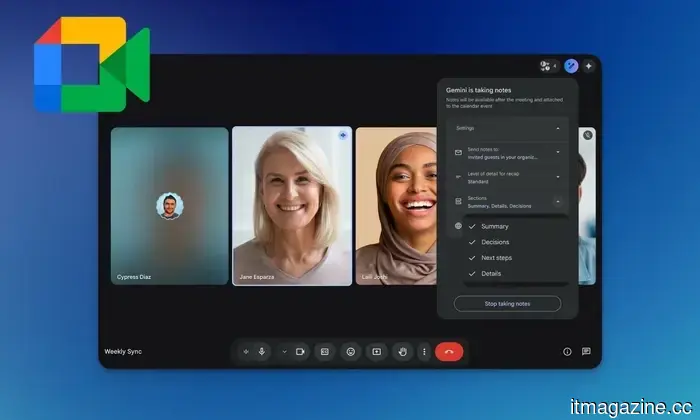
Now, Google has further improved the service by introducing new customization options that allow you to decide exactly what appears in your meeting notes.
What’s new?
The most notable addition is the ability to toggle specific sections on or off during a meeting. You can now select which of the four sections you want included in your notes: Summary, Decisions, Next Steps, and Details. These adjustments are limited to the current meeting, so your default settings for future meetings remain unchanged.
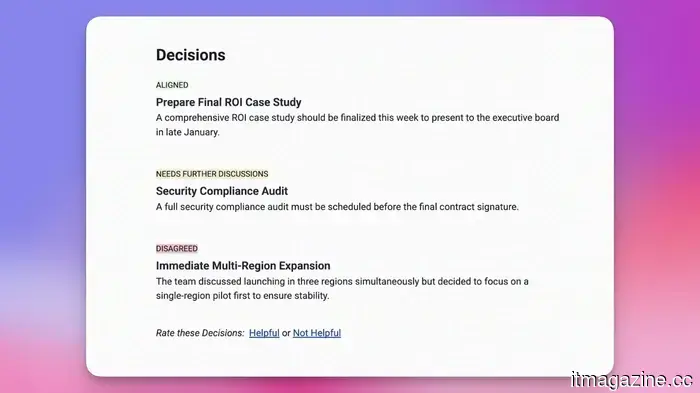
For me, the new Decisions section is the highlight. Instead of sifting through extensive text to find agreements, this section clearly outlines outcomes and tracks their status. However, it's worth noting that the Decisions section is currently available only in English.
Additionally, Google has enhanced the Summary section to make it more succinct and easier to scan, enabling quicker access to key points without needing to read through everything.
Is there anything you need to do to use it?
Not really. If you already have access to "Take notes for me," this update will automatically incorporate the new features. Just activate the feature in your next meeting and try out the enhancements.
The update is being gradually rolled out, beginning on April 30, 2026, and is available on Business Standard and Plus, Enterprise Standard and Plus, Frontline Plus, Google AI Pro for Education, and Google AI Pro and Ultra plans.
Rachit is an experienced tech journalist with over seven years of reporting on consumer technology.
I hesitated to purchase the MacBook Neo. I hope the next version addresses these five minor issues before I spend my money.
Apple has set an impressive price point, especially in a market where increasing component costs are challenging for manufacturers. However, it’s the absent features that are leading me to wait for the next iteration.
The MacBook Neo caught my attention—not just because it is a stunning piece of technology that appeals to my inner enthusiast, but also due to Apple’s compelling offer—aluminum construction, efficient silicon, and excellent battery life, all for an unbelievable price of $599. I was ready to buy it and almost made the purchase a few weeks ago.
However, I decided against it. My hesitation wasn’t due to the Neo being a poor device; I had the opportunity to use it for a couple of days (thanks to a friend who purchased one), and the more I discovered about what Apple omitted to achieve that impressively low price, the more I felt inclined to defer my purchase until the Neo is improved.
The Mac mini will be in short supply for several months, as Apple has confirmed.
Finding a Mac mini anytime soon may be challenging.
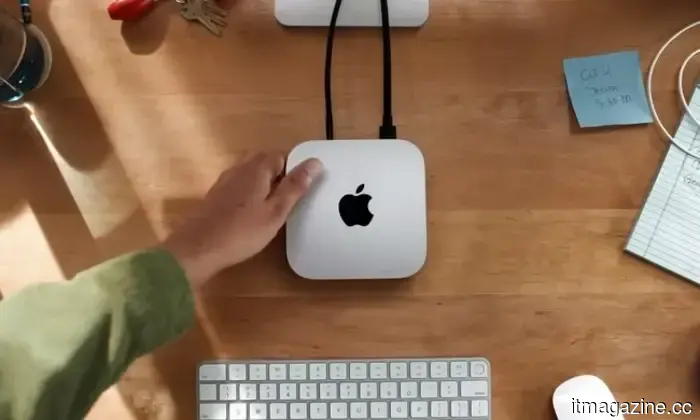
Apple’s smallest desktop computer is facing availability issues. During the company's Q2 2026 earnings call, Apple stated that the Mac mini and Mac Studio may take "several months" to achieve a balance between supply and demand. This information was provided in response to a query regarding Mac availability, with Apple acknowledging that demand had exceeded expectations.
Why is the Mac mini difficult to find?
Apple is experiencing a favorable problem: it simply cannot produce enough Macs. During the fiscal Q2 2026 earnings call, CEO Tim Cook confirmed that demand for the Mac lineup has surpassed the company’s production capabilities—a statement that seems surprising given that Mac growth was previously overshadowed by the iPhone.
The reasons behind this are noteworthy. The Mac Mini and Mac Studio are selling rapidly, and Cook credits a significant part of this surge to users recognizing the effectiveness of Apple Silicon in running AI tools and efficient workflows locally. This trend appears to have caught the company off guard. When even the CEO admits that the demand was underestimated, it’s truly unexpected.



Other articles
 NYBCe and Chan Zuckerberg Biohub are joining forces to create an iPSC platform derived from cord blood for use in regenerative medicine.
NYBCe and CZ Biohub will obtain iPSC lines from immune cells in cord blood, establishing common, widely compatible resources for cell therapy, disease modeling, and AI-based drug development.
NYBCe and Chan Zuckerberg Biohub are joining forces to create an iPSC platform derived from cord blood for use in regenerative medicine.
NYBCe and CZ Biohub will obtain iPSC lines from immune cells in cord blood, establishing common, widely compatible resources for cell therapy, disease modeling, and AI-based drug development.
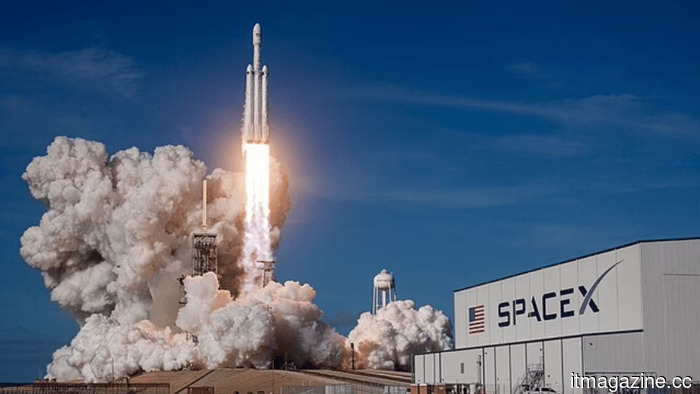 SpaceX has invested over $15 billion in Starship.
SpaceX has invested over $15 billion in the development of Starship and is aiming for a launch frequency similar to that of airlines.
SpaceX has invested over $15 billion in Starship.
SpaceX has invested over $15 billion in the development of Starship and is aiming for a launch frequency similar to that of airlines.
 Press freedom reaches its lowest point in 25 years as RSF identifies tech platforms in addition to authoritarian regimes as contributing factors.
RSF's 2026 index indicates that press freedom is at its lowest point in 25 years, with more than half of all countries classified as having difficult or worse conditions. The report identifies Meta, X, and AI-generated disinformation as underlying factors contributing to this decline.
According to Sing Tao, Uber has purchased its competitor Fly Taxi in Hong Kong.
Sing Tao Daily reports that Uber has purchased Fly Taxi in Hong Kong. If the deal is verified, it eliminates the primary competitor for metered-taxi-hailing apps from the market.
Press freedom reaches its lowest point in 25 years as RSF identifies tech platforms in addition to authoritarian regimes as contributing factors.
RSF's 2026 index indicates that press freedom is at its lowest point in 25 years, with more than half of all countries classified as having difficult or worse conditions. The report identifies Meta, X, and AI-generated disinformation as underlying factors contributing to this decline.
According to Sing Tao, Uber has purchased its competitor Fly Taxi in Hong Kong.
Sing Tao Daily reports that Uber has purchased Fly Taxi in Hong Kong. If the deal is verified, it eliminates the primary competitor for metered-taxi-hailing apps from the market.
 Apple reports that users are purchasing Macs more quickly than ever, resulting in a supply shortage.
Apple is struggling to meet the unprecedented demand for Macs, as the MacBook Neo and AI-capable Mac Mini and Studio sold out more quickly than the company had anticipated.
Apple reports that users are purchasing Macs more quickly than ever, resulting in a supply shortage.
Apple is struggling to meet the unprecedented demand for Macs, as the MacBook Neo and AI-capable Mac Mini and Studio sold out more quickly than the company had anticipated.
 US debt surpasses 100% of GDP as the $690 billion AI investment by Big Tech vies for the same capital markets.
U.S. debt reaches 100% of GDP for the first time since World War II, with interest payments exceeding $1 trillion. Meanwhile, Big Tech's AI capital expenditures surpass $690 billion. Both are funded through debt from the same source.
US debt surpasses 100% of GDP as the $690 billion AI investment by Big Tech vies for the same capital markets.
U.S. debt reaches 100% of GDP for the first time since World War II, with interest payments exceeding $1 trillion. Meanwhile, Big Tech's AI capital expenditures surpass $690 billion. Both are funded through debt from the same source.
Google Meet's AI note-taker has significantly improved and become less overwhelming.
You can now personalize your Google Meet notes to display only the essential information, and a new Decisions section simplifies tracking what was agreed upon during your meeting.