
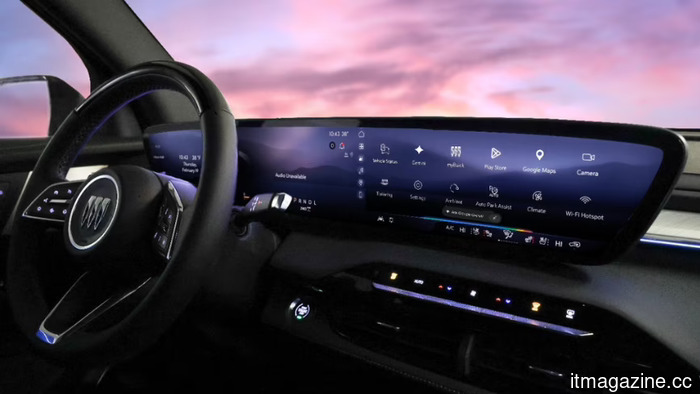
GM introduces Google Gemini to four million vehicles.
The over-the-air update will replace Google Assistant in Cadillac, Chevrolet, Buick, and GMC vehicles from model year 2022 and later, but it comes amid GM’s ongoing data-sharing controversy and an impending FTC consent order. General Motors has revealed that Google Gemini is set to roll out to about four million vehicles in the United States, marking what the company describes as one of the largest implementations of a generative AI assistant in the automotive sector.
The update was announced on April 28 and will come through an over-the-air Play Store update, replacing the current Google Assistant experience in eligible vehicles equipped with Google Built-in. "Gemini provides conversational AI to millions of drivers across all segments and prices for a variety of everyday needs. Such a scale is made possible by the connected vehicle foundation that GM has developed through OnStar over the last 30 years," stated Tim Twerdahl, Global Vice President of Product Management at General Motors. "Later this year, GM will deliver a more deeply integrated AI experience informed by OnStar intelligence."
The scale is credible, as the four million eligible vehicles likely surpass any existing deployment of a conversational AI assistant by a single manufacturer in production vehicles. This reach is a direct result of GM's long-term investment in Android Automotive OS, the Google Built-in platform that offers Buick, Chevrolet, Cadillac, and GMC vehicles native access to Google’s apps and services, supported by OnStar's connectivity infrastructure, which has been in place since 1996.
The transition from Google Assistant to Gemini introduces a greater depth of conversation. The current in-car Google Assistant operates as a command-recognition system, functioning well with recognized phrases but failing when users deviate from them. In contrast, Gemini acts as a large language model, capable of addressing free-form requests, maintaining conversational context, and handling follow-up questions without needing to restart the dialogue. It is also significantly more adaptable to variations in accents and unconventional phrasing.
Drivers will notice the most visible transformation in how the assistant manages multi-part requests and switches tasks mid-conversation. GM’s press release illustrates this: a user can ask for directions while texting a family member, then modify the route to include a coffee stop with outdoor seating—all in a single spoken interaction. The assistant is compatible with in-vehicle applications such as Amazon Music, Apple Music, Spotify, YouTube, HBO Max, Hulu, and Prime Video, and can utilize web searches to answer location-specific and contextual queries.
To receive the update, drivers need to be connected to OnStar, logged into the Google Play Store on their infotainment system, and using US English as the assistant language. The rollout will occur over several months and will initially be limited to the US, with plans for additional markets and languages to follow. For 2025 and newer models, access to basic OnStar voice features, which in turn grants access to Gemini, will be included in the standard OnStar Basics package at no extra cost for eight years.
GM has made it clear that Gemini is an interim solution. The company’s goal, initially outlined at its GM Forward event in October 2025, is to launch a custom-built AI assistant that is tailored to proprietary vehicle data and integrated with OnStar—essentially a domain-specific model that understands the intricacies of an individual vehicle, can identify maintenance issues proactively, and adapt to personal preferences over time. This tailored assistant is expected to debut ‘later this year.’
Gemini serves as the commercial bridge, offering GM four million users a notably improved in-car AI experience now, while the company develops a vehicle-specific layer. Architecturally, GM's Senior Vice President of Software and Services, Dave Richardson, explained that the method involves taking a base model, training it on vehicle specifications, distilling it, and deploying it in the vehicle. This hybrid on-vehicle and cloud architecture will be significant as the models expand, regulatory scrutiny on connected vehicle data tightens, and connectivity varies across different markets.
The competitive landscape is intensifying, with Stellantis collaborating with French AI firm Mistral for in-car assistants, Mercedes-Benz integrating ChatGPT, Tesla deploying xAI’s Grok across its fleet, and BMW pursuing its AI assistant program. GM's approach is more gradual compared to Tesla's vertically integrated model; it is leveraging Android Automotive and Gemini while developing its layer on top. However, the scale of the four million vehicle deployment presents a genuine differentiator that its competitors currently cannot match on a similar basis.
This announcement occurs against the backdrop of a notable data controversy. In January 2025, the Federal Trade Commission acted against GM and OnStar regarding the collection and sale of precise geolocation and driving behavior data to insurance companies, reportedly without clear consumer consent. The consent order prohibits GM from selling such data without explicit consumer permission for five years. GM’s data practices, including allegations of sharing driving scores with insurers that led to increased premiums for uninformed drivers, sparked considerable public and regulatory backlash.
Deploying an AI assistant
Other articles
 Steam Deck 2 wish list: features I'd like to see in the next generation model.
Valve already possesses the top handheld foundation available, so the upcoming Steam Deck 2 requires only intelligent enhancements in the most crucial areas.
Steam Deck 2 wish list: features I'd like to see in the next generation model.
Valve already possesses the top handheld foundation available, so the upcoming Steam Deck 2 requires only intelligent enhancements in the most crucial areas.
 You can now utilize Google Translate to improve your pronunciation with instant AI feedback.
Google Translate is marking its 20th anniversary by introducing an AI pronunciation coach that listens to your speech and identifies your mistakes accurately.
You can now utilize Google Translate to improve your pronunciation with instant AI feedback.
Google Translate is marking its 20th anniversary by introducing an AI pronunciation coach that listens to your speech and identifies your mistakes accurately.
 Dex secures $5.3 million to develop an AI talent agency for engineers.
Dex, an AI-based talent agency for technical recruitment, has secured $5.3 million in funding, spearheaded by Notion Capital, and currently has an annual recurring revenue (ARR) of $1.8 million.
Dex secures $5.3 million to develop an AI talent agency for engineers.
Dex, an AI-based talent agency for technical recruitment, has secured $5.3 million in funding, spearheaded by Notion Capital, and currently has an annual recurring revenue (ARR) of $1.8 million.
 This small brain implant has the potential to alleviate depression from home.
Motif Neurotech has recently received FDA approval to test a small brain implant aimed at treating depression, and the entire procedure can be completed in just 20 minutes.
This small brain implant has the potential to alleviate depression from home.
Motif Neurotech has recently received FDA approval to test a small brain implant aimed at treating depression, and the entire procedure can be completed in just 20 minutes.
 Steam Deck 2 wish list: features I desire in the next-generation model.
Valve already possesses the top handheld foundation available, so the upcoming Steam Deck 2 only requires more intelligent enhancements where it counts the most.
Steam Deck 2 wish list: features I desire in the next-generation model.
Valve already possesses the top handheld foundation available, so the upcoming Steam Deck 2 only requires more intelligent enhancements where it counts the most.
 The top headphone offers of 2026: substantial discounts on earbuds, studio headphones, and high-fidelity equipment.
Whether you're looking for true wireless earbuds for your daily commute or a pair of high-end headphones meant to last for years, this is an exceptionally good time to make a purchase. We're currently tracking discounts reaching up to 50% on some of the top-rated headphones available, including brands like Beats, Apple, Sennheiser, and HIFIMAN. [...]
The top headphone offers of 2026: substantial discounts on earbuds, studio headphones, and high-fidelity equipment.
Whether you're looking for true wireless earbuds for your daily commute or a pair of high-end headphones meant to last for years, this is an exceptionally good time to make a purchase. We're currently tracking discounts reaching up to 50% on some of the top-rated headphones available, including brands like Beats, Apple, Sennheiser, and HIFIMAN. [...]
GM introduces Google Gemini to four million vehicles.
GM is deploying Google Gemini to around four million vehicles in the US through an over-the-air update, which will replace Google Assistant in a significant advancement in in-car AI technology.