
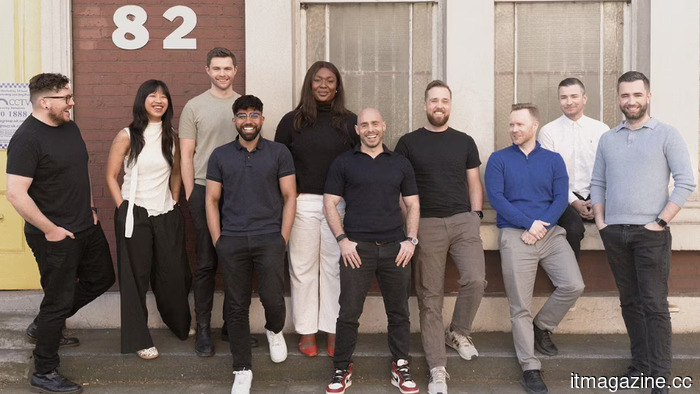
Dex secures $5.3 million to develop an AI talent agency for engineers.
Established by a former talent advisor at Atomico, Dex imposes agency fees on employers only for successful placements and has swiftly grown from zero to $1.8 million in annual recurring revenue (ARR) in less than six months. Paddy Lambros, who spent two and a half years advising around 100 European startups on recruitment while at Atomico, identified a clear pattern: nearly every significant challenge faced by early-stage companies stemmed from hiring-related decisions. A wrong hire or a prolonged vacancy in an essential position could hinder otherwise promising firms.
This insight led to the creation of Dex, an AI-driven talent agency focused on technical recruitment, which Lambros launched in early 2025. The London-based startup has secured a $5.3 million seed round led by Notion Capital, with contributions from a16z Speedrun, Concept Ventures, and several angel investors associated with OpenAI and other organizations, as announced on Monday. This latest investment elevates the total capital raised to $8.4 million, following a $3.1 million pre-seed round last year.
What does Dex do? The heart of EU tech: the latest developments from the European tech landscape, insights from our esteemed founder Boris, and some questionable AI-generated art. It's available for free each week directly to your inbox. Sign up now! Dex has strategically concentrated on a specific segment of the technical talent market, focusing on AI researchers, software developers, and engineers specializing in machine learning and quantitative analysis.
Over 15,000 engineers have registered on the platform, and more than 50 tech companies, including Lovable, ElevenLabs, Synthesia, Granola, and Fyxer, are utilizing the service. Since it started charging in late 2025, Dex has escalated to around $1.8 million in annual recurring revenue. Lambros mentioned that achieving profitability by the end of the year is "conceivable."
The service operates in two phases. A candidate initiates a dialogue, either through voice or text, with Dex’s AI agent, which poses open-ended questions regarding their experience, goals, and motivations. The agent, which employs a blend of models from Google, Anthropic, and OpenAI, then presents relevant job opportunities from a carefully curated selection, assists candidates in researching companies, evaluating compensation, and preparing for interviews.
In terms of matching, Dex applies what Lambros refers to as ‘old-school machine learning’ through a proprietary system that builds richer, more detailed profiles based on the insights gathered during conversational interactions, allowing employers to discover suitable candidates. When both parties express mutual interest, Dex facilitates an introduction to the hiring manager.
The business model is intentionally designed to resemble an agency rather than a software-as-a-service (SaaS) approach. Dex does not provide software to recruiters or integrate with applicant tracking systems. Instead, it charges employers a success fee between 20% to 30% of a hired candidate's first-year salary, mirroring the fee structure of traditional executive search firms. "We only earn money if we perform well," stated Lambros.
This fee structure serves both as a strategic decision and as a proposition to employers who are increasingly skeptical of software subscriptions that claim to enhance hiring processes but lack accountability for results. Lambros posits that AI capable of engaging in sustained, contextually-rich conversations has made the core functions of traditional agencies genuinely automatable and potentially superior to human recruiters when scaled.
While a human recruiter may know a few hundred candidates, an AI agent can engage in detailed discussions with hundreds of thousands. A human recruiter typically manages a handful of clients at a time, while an AI agent can cater to thousands simultaneously. Furthermore, Lambros argues that the information candidates are willing to share in a private conversation with an AI agent is significantly more comprehensive than what they would disclose on a public LinkedIn profile or resume.
This disparity in data is the foundational concept behind Dex: the quality of candidate matching hinges on the caliber of the candidate model, and most current tools, including LinkedIn's recruitment products, cold outreach scrapers, and job boards, rely on superficial, publicly available information.
The seed funding will be utilized to establish offices in New York and San Francisco in 2026, entering the fiercely competitive market for AI engineering talent. Lambros’ background, including his experience at Improbable as it expanded from 50 to 650 employees, along with his roles in talent acquisition at the construction-tech startup Sensat and advisory work across Atomico's portfolio, lends him credibility on both sides of the hiring equation.
Whether a London-based, niche-focused AI talent agency can maintain its position against better-funded generalist competitors as both entities expand into the US market will be a question for the next twelve months to answer.
Other articles
 Asus has placed the astonishing dual-screen ROG Zephyrus Duo on the market at a staggering price.
The ROG Zephyrus Duo makes its comeback featuring two complete 16-inch ROG Nebula HDR OLED touchscreens, offering over 21 inches of total display area, powered by the Intel Core Ultra 9 386H and supporting up to the RTX 5090 Laptop GPU at 135W.
Asus has placed the astonishing dual-screen ROG Zephyrus Duo on the market at a staggering price.
The ROG Zephyrus Duo makes its comeback featuring two complete 16-inch ROG Nebula HDR OLED touchscreens, offering over 21 inches of total display area, powered by the Intel Core Ultra 9 386H and supporting up to the RTX 5090 Laptop GPU at 135W.
 You can now utilize Google Translate to improve your pronunciation with instant AI feedback.
Google Translate is marking its 20th anniversary by introducing an AI pronunciation coach that listens to your speech and identifies your mistakes accurately.
You can now utilize Google Translate to improve your pronunciation with instant AI feedback.
Google Translate is marking its 20th anniversary by introducing an AI pronunciation coach that listens to your speech and identifies your mistakes accurately.
 GM introduces Google Gemini to four million vehicles.
GM is deploying Google Gemini to around four million vehicles in the US through an over-the-air update, which will replace Google Assistant in a significant advancement in in-car AI technology.
GM introduces Google Gemini to four million vehicles.
GM is deploying Google Gemini to around four million vehicles in the US through an over-the-air update, which will replace Google Assistant in a significant advancement in in-car AI technology.
 Cognizant acquires Astreya for $600 million, marking its fourth significant acquisition.
Cognizant has consented to purchase Astreya, a company specializing in AI infrastructure and managed services for data centers, for around $600 million. This marks its fourth significant acquisition in the past 18 months.
Cognizant acquires Astreya for $600 million, marking its fourth significant acquisition.
Cognizant has consented to purchase Astreya, a company specializing in AI infrastructure and managed services for data centers, for around $600 million. This marks its fourth significant acquisition in the past 18 months.
 The top headphone discounts of 2026: significant savings on earbuds, studio headphones, and high-end audio equipment.
Whether you’re looking for true wireless earbuds for your daily commute or a set of reference headphones that will serve you for ten years, now is an exceptionally favorable time to make a purchase. We are monitoring price reductions of up to 50% on some of the most highly-rated headphones available — including brands like Beats, Apple, Sennheiser, and HIFIMAN. [...]
The top headphone discounts of 2026: significant savings on earbuds, studio headphones, and high-end audio equipment.
Whether you’re looking for true wireless earbuds for your daily commute or a set of reference headphones that will serve you for ten years, now is an exceptionally favorable time to make a purchase. We are monitoring price reductions of up to 50% on some of the most highly-rated headphones available — including brands like Beats, Apple, Sennheiser, and HIFIMAN. [...]
 Netflix has renewed Stranger Things: Tales From ’85 for a second season, even though it has received the lowest ratings in the franchise's history.
Despite mixed reviews, Netflix has renewed Stranger Things: Tales From '85 for a second season. The animated spin-off has received the lowest ratings for the franchise on both Rotten Tomatoes and IMDB.
Netflix has renewed Stranger Things: Tales From ’85 for a second season, even though it has received the lowest ratings in the franchise's history.
Despite mixed reviews, Netflix has renewed Stranger Things: Tales From '85 for a second season. The animated spin-off has received the lowest ratings for the franchise on both Rotten Tomatoes and IMDB.
Dex secures $5.3 million to develop an AI talent agency for engineers.
Dex, an AI-based talent agency for technical recruitment, has secured $5.3 million in funding, spearheaded by Notion Capital, and currently has an annual recurring revenue (ARR) of $1.8 million.