

Spotify seemingly lacks a definitive strategy for labeling music created by AI.
**Spotify**
There’s a subtle unease spreading through the music streaming world — and Spotify, the platform that over half a billion users rely on to provide their life's soundtrack, is doing surprisingly little to address it. AI-generated music is inundating streaming services at a speed that would have seemed dystopian just five years ago. Every day, tens of thousands of these tracks enter the same playlists and recommendation algorithms as your favorite human artists. Most listeners might not even be aware of the difference — research indicates that the vast majority cannot distinguish between them in a blind test.
**Listeners are already taking action**
When people began to sense that something was amiss, they took matters into their own hands. A developer in Germany became so frustrated with what he suspected were AI tracks infiltrating his Spotify playlists that he created a tool to flag and block them. He shared it online, and it was downloaded by hundreds almost instantly. This should signal to Spotify that something is wrong.
However, Spotify's reaction has thus far been more of a corporate indifference than a real confrontation. The platform recently introduced a feature that lists AI usage in a song's credits — but only if the artist chooses to disclose it. This relies on voluntary self-reporting from those who might worry about the repercussions on their careers. That’s not real transparency; it merely gives the illusion of it.
In contrast, Deezer has implemented its own detection technology, labeling and filtering out AI-generated content from its suggestions. Apple Music is at least moving towards compulsory disclosures. Meanwhile, Spotify, the leading platform, remains indecisive, claiming the situation is complex.
**Yes, it is complex, but that's not an excuse**
The distinction between AI-assisted and fully AI-generated is certainly hazy. A musician utilizing AI to help craft a verse is a different matter than one who simply inputs a prompt and uploads the outcome. Experts agree that this isn't a straightforward dichotomy. Misidentifying a human artist as AI would be a significant error with real consequences.
**Spotify**
However, here's the reality — nobody is expecting perfection. What listeners require, and what artists merit, is a foundation to build on. Clearly label the fully AI-generated content and evaluate the extent of the ambiguous area from there. The notion that it’s too challenging to take any action, thus we should refrain from acting at all, is beginning to resemble a convenient excuse. There is clearly financial incentive here. AI-generated music is inexpensive to create, potentially cheaper to distribute, and doesn't entail royalties in the way that music by human artists does. The motivations in play are evident. When the largest music platform consistently skirts questions regarding the source of its content, it raises questions about why.
**A trust issue emerging**
There exists a narrative where Spotify ultimately gets it right — where transparency tools, industry standards, and platform accountability align with the advancements in technology. That future may be closer than it appears, with growing regulatory pressure and music industry bodies inching towards frameworks for disclosure. Yet at present, listeners are turning to third-party blockers and meticulously checking their playlists, much like scrutinizing the fine print of a dubious contract. This is not the kind of relationship a platform should desire with its users. Spotify has built its reputation on helping individuals discover music they adore. If listeners start to lose faith in what they're hearing, that reputation will hold little value.
**Shimul is a contributor at Digital Trends, with over five years of experience in the tech space.**
**Samsung’s anticipated Galaxy Glasses have leaked, and the designs aren't impressive**
In the realm of smart glasses, the most wearable models are those that don't make users feel as though they are involved in a sci-fi experiment.
Samsung's rumored smart glasses are no longer just a speculation. Android Headlines seems to have released the initial renders of the Galaxy Glasses, and if you were hoping for something futuristic, prepare for disappointment.
From the images, the Galaxy Glasses sport a familiar rounded sunglasses design that's strikingly reminiscent of the Meta Ray-Bans, which have been on the market for a few years. The "Samsung" logo appears on one of the temple arms, but aside from that, there’s hardly anything distinctive that sets them apart.
**Read more**
**Meta’s latest audacious plan involves beaming solar power from satellites, even at night**
Meta's partnership with Overview Energy isn't solely about clean energy; it's a glimpse into the extensive requirements necessary for sustainably powering AI on a planetary scale.
Out of everything Meta has been criticized for, thinking small has never been one of them. The company, which owns the leading social media and messaging platforms such as Facebook, Instagram, Messenger, and WhatsApp, is now exploring the possibility of transmitting sunlight from space to the Earth's surface to power its AI data centers after dark (via TechCrunch).
**Read more**
**Controversial AI software is now assisting in identifying corrupt and negligent officers







Other articles
 Spotify seemingly lacks a definitive strategy for tagging AI-generated music.
Spotify boasts over 500 million listeners and possesses a recommendation algorithm that understands your mood more effectively than your therapist — yet, it seems there is no clear strategy in place to inform you whether what you're listening to was created by a human or a chatbot on a Tuesday afternoon.
Spotify seemingly lacks a definitive strategy for tagging AI-generated music.
Spotify boasts over 500 million listeners and possesses a recommendation algorithm that understands your mood more effectively than your therapist — yet, it seems there is no clear strategy in place to inform you whether what you're listening to was created by a human or a chatbot on a Tuesday afternoon.
 Jabra Evolve3 85 review: I was surprised to find that I really love this business headset, changing my initial opinion.
The Jabra Evolve3 85 combines a surprisingly stylish design and high-quality construction with an exceptional calling experience, dependable audio quality, and the ease of wireless charging. While it may not suit everyone, it is almost ideal for the right user.
Jabra Evolve3 85 review: I was surprised to find that I really love this business headset, changing my initial opinion.
The Jabra Evolve3 85 combines a surprisingly stylish design and high-quality construction with an exceptional calling experience, dependable audio quality, and the ease of wireless charging. While it may not suit everyone, it is almost ideal for the right user.
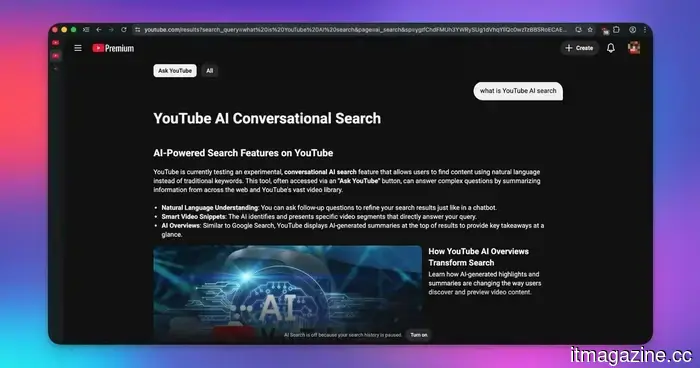 YouTube is evolving into an answer engine with the introduction of a new conversational search feature.
Subscribers of YouTube Premium in the US can now experience Ask YouTube, a conversational AI search feature that aggregates videos, Shorts, and text summaries in a single location.
Revolut is launching its inaugural physical store in Barcelona.
Revolut is set to launch its inaugural physical store in Barcelona, expected to open by 2027. This permanent location will serve as a test for a retail model that the fintech company aims to replicate worldwide.
YouTube is evolving into an answer engine with the introduction of a new conversational search feature.
Subscribers of YouTube Premium in the US can now experience Ask YouTube, a conversational AI search feature that aggregates videos, Shorts, and text summaries in a single location.
Revolut is launching its inaugural physical store in Barcelona.
Revolut is set to launch its inaugural physical store in Barcelona, expected to open by 2027. This permanent location will serve as a test for a retail model that the fintech company aims to replicate worldwide.
 Freepik has undergone a rebranding to become Magnific: a self-funded, profitable AI creative platform with an annual recurring revenue of $230 million.
Freepik has rebranded itself as Magnific, consolidating its AI creative platform under a single name. It boasts an annual recurring revenue of $230 million, over 1 million paying subscribers, and operates as a bootstrapped and profitable company.
Revolut is launching its inaugural physical store in Barcelona.
Revolut is set to launch its first physical store in Barcelona, expected to open by 2027. This permanent location will test a retail model that the fintech intends to replicate worldwide.
Freepik has undergone a rebranding to become Magnific: a self-funded, profitable AI creative platform with an annual recurring revenue of $230 million.
Freepik has rebranded itself as Magnific, consolidating its AI creative platform under a single name. It boasts an annual recurring revenue of $230 million, over 1 million paying subscribers, and operates as a bootstrapped and profitable company.
Revolut is launching its inaugural physical store in Barcelona.
Revolut is set to launch its first physical store in Barcelona, expected to open by 2027. This permanent location will test a retail model that the fintech intends to replicate worldwide.
Spotify seemingly lacks a definitive strategy for labeling music created by AI.
Spotify boasts 500 million listeners and a recommendation system that understands your emotions better than your therapist—yet, it seems to lack a clear strategy for informing you whether the music you're enjoying was created by a human or a chatbot on a Tuesday afternoon.