

Reasons for the shift of venture capital from software to deep tech.
For over twenty years, software has shaped the direction of venture capital. It was effective, scalable, and for a considerable time, unrivaled in its capacity to yield significant returns. Investors invested heavily in SaaS platforms, marketplaces, and digital infrastructure, trusting a model that emphasized speed, low marginal costs, and swift growth. I was part of that time, and like many others, I experienced its remarkable power firsthand.
However, I now observe a distinct change. Venture capital is increasingly focusing on deep tech builders, and it's not merely a niche investment. This is becoming a significant way of deploying capital. This shift is driven not by ideology but by structural changes.
One of the most significant transformations has been the breakdown of the long-held belief that hardware cannot deliver venture-scale returns. This belief influenced investment behaviors for years and dissuaded capital from moving into sectors needing time, infrastructure, and engineering expertise. Yet, this assumption has been confronted in a manner that is hard to overlook. Companies like SpaceX have proven that hardware-centric businesses can provide substantial and sustainable returns. Elon Musk reset the bar for what's achievable.
The consequences of this change are still unfolding. Even if outcomes like SpaceX are uncommon, their influence is crucial. They have altered how investors perceive risk, capital efficiency, and long-term value creation, and they have also shifted how founders think about building businesses.
Simultaneously, the economic dynamics of software have changed in ways that are less favorable than they once were. While the concept of zero marginal cost still exists, it only tells part of the story. Acquiring customers has become pricier, competition has intensified, and retaining customers now requires ongoing investments. In many instances, sustaining a market position demands a relentless influx of capital, necessitating continuous investment to stay visible and competitive.
The emergence of artificial intelligence has further accelerated this trend. AI has reduced the barriers to enter the software product market. While that is a powerful advantage, it also poses a new challenge. If a product can be replicated in just a weekend, then defensibility weakens. The focus on differentiation shifts from the product itself to distribution, marketing, and capital, which is not a sustainable edge for most businesses.
In contrast, deep tech functions within a different framework of constraints. It demands time, investment, and expertise. For many years, these aspects were regarded as liabilities. Today, they are increasingly recognized as strengths. The challenges associated with working in the physical realm create inherent barriers to entry. They require rigorous execution and compel teams to address genuine problems prior to scaling.
I have experienced this firsthand. During my tenure at SpaceX and in the companies I subsequently founded, I witnessed how these constraints influence outcomes. There are no shortcuts with physics. You cannot deploy incomplete systems in the real world and expect them to succeed. This level of discipline fosters a different company model—one that is more difficult to create yet also more challenging to replicate.
Moreover, there are structural advantages often overlooked. Once a deep tech company secures a foothold, it can tap into sources of capital that many software businesses cannot access, such as asset-backed lending, infrastructure financing, and long-term contracts. These mechanisms enable companies to scale in a more capital-efficient manner over time, even if the initial outlay is higher.
The talent landscape is also evolving. A decade ago, most top engineering talent gravitated towards software. Today, that trend is shifting. The impact of SpaceX and similar organizations has fostered a new generation of builders concentrating on aerospace, energy, manufacturing, and defense. This shift is reflected in the increasing demand, with forecasts suggesting the sector may require 3.8 million new workers by 2033, with 1.9 million roles potentially going unfilled.
Additionally, government support has played a significant role. Early-stage funding mechanisms, especially in areas related to national infrastructure and defense, have helped reduce some initial challenges linked to deep tech. While this does not simplify the complexity, it alters the situation enough to draw in more private capital.
What I find most compelling about this shift is that it is still in the early stages. Many generalist venture firms are just now beginning to invest in deep tech, and in many cases, it comprises only a small portion of their portfolios. Yet the trend is evident. More investors are entering this space, more founders are building within it, and more capital is flowing in.
Furthermore, global instability has highlighted the importance of physical systems. Concerns surrounding supply chains, energy production, and industrial capacity are no longer abstract; they are essential to economic resilience. This reality is prompting both governments and investors to reconsider where innovation needs to occur.
None of this implies that software is fading away. It remains vital. However, it is no longer the sole frontier. The next wave of transformative companies will not solely exist in the digital sphere; they will operate at the convergence of software and the physical world, addressing problems that necessitate both. After all, Silicon Valley
Other articles
 Logitech's latest G512 X gaming keyboard delivers exceptional performance alongside extensive customization options.
Logitech's newest gaming keyboard offers PC gamers additional options to customize, adjust, and showcase their setup, including the responsiveness of each key.
Logitech's latest G512 X gaming keyboard delivers exceptional performance alongside extensive customization options.
Logitech's newest gaming keyboard offers PC gamers additional options to customize, adjust, and showcase their setup, including the responsiveness of each key.
 Logitech’s latest G512 X gaming keyboard combines top-tier performance with extensive customization options.
Logitech's newest gaming keyboard offers PC gamers additional options to customize, adjust, and display their setup, including the responsiveness of each key.
Logitech’s latest G512 X gaming keyboard combines top-tier performance with extensive customization options.
Logitech's newest gaming keyboard offers PC gamers additional options to customize, adjust, and display their setup, including the responsiveness of each key.
 This adorable watch is disguised as a Game Boy Color. And indeed, it is capable of running games.
A uniquely crafted wristwatch incorporates genuine Game Boy Color hardware, enabling it to operate real cartridges, although the small screen and controls make it more remarkable than functional.
This adorable watch is disguised as a Game Boy Color. And indeed, it is capable of running games.
A uniquely crafted wristwatch incorporates genuine Game Boy Color hardware, enabling it to operate real cartridges, although the small screen and controls make it more remarkable than functional.
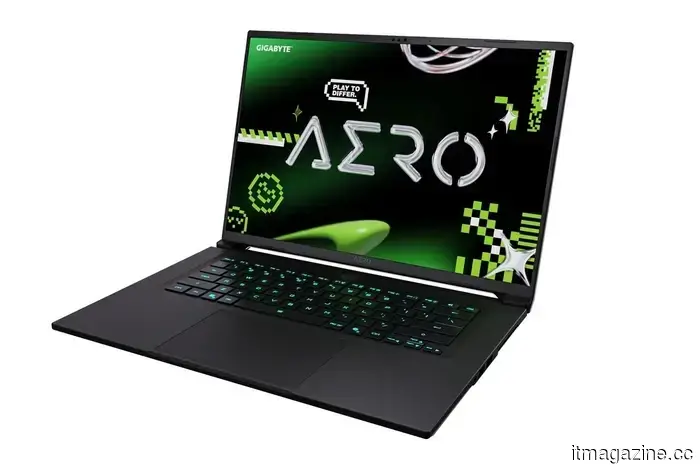 GIGABYTE will release a thin laptop with AI for sale.
GIGABYTE, a well-known manufacturer of computer hardware, has announced the AERO X16 laptop. The new product is positioned as an ultra-thin device for those who need mobility, modern neural networks, and the ability to create something. It combines everything that is currently in vogue in one case.
GIGABYTE will release a thin laptop with AI for sale.
GIGABYTE, a well-known manufacturer of computer hardware, has announced the AERO X16 laptop. The new product is positioned as an ultra-thin device for those who need mobility, modern neural networks, and the ability to create something. It combines everything that is currently in vogue in one case.
 Valve has announced that development for the Steam Deck 2 is progressing well, but has not provided any further details.
Valve has announced that the development of the Steam Deck 2 is progressing rapidly; however, the company is not sharing specific details yet as it anticipates a significant advancement in hardware.
Valve has announced that development for the Steam Deck 2 is progressing well, but has not provided any further details.
Valve has announced that the development of the Steam Deck 2 is progressing rapidly; however, the company is not sharing specific details yet as it anticipates a significant advancement in hardware.
 The release date for season 4 of Ted Lasso is scheduled for this summer, and the trailer appears promising.
In Season 4, Ted returns to Richmond, facing an entirely new challenge: coaching a women's football team in the second division.
The release date for season 4 of Ted Lasso is scheduled for this summer, and the trailer appears promising.
In Season 4, Ted returns to Richmond, facing an entirely new challenge: coaching a women's football team in the second division.
Reasons for the shift of venture capital from software to deep tech.
Venture capital is expanding its focus beyond software as deep technology, artificial intelligence, and innovations in the physical world reshape investment strategies and the creation of long-term value.