
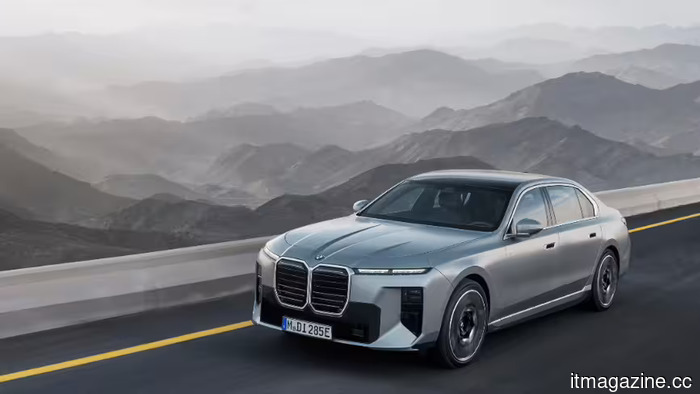
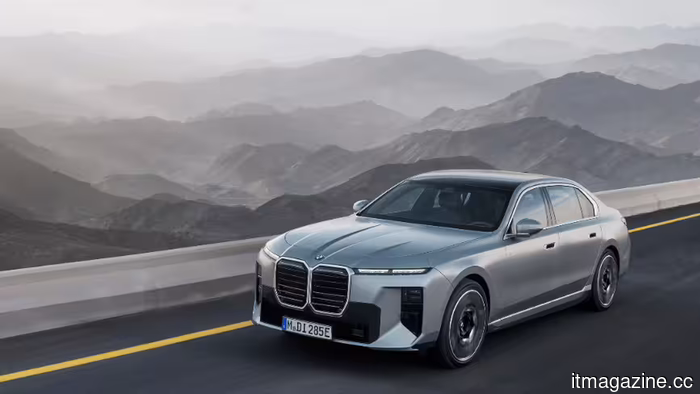
The facelifted BMW i7 introduces Gen6 battery cells from Rimac, offering a range of over 350 miles, and replaces Level 3 automation with a more affordable Symbiotic Drive.
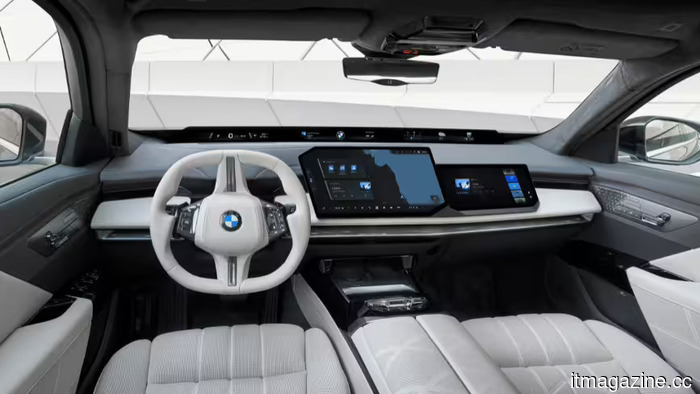
Summary: BMW unveiled the refreshed 2027 i7 simultaneously at Grand Central Terminal and Auto China, featuring Rimac's Gen6 cylindrical cells, motors free of rare-earth elements with SiC inverters, and a rapid charging capability of 250 kW. The i7 60 xDrive aims for over 350 miles EPA and 728 km WLTP; the i7 50 promises 611 km and the M70 aims for 686 km. BMW has completely removed Level 3 autonomous driving, substituting it with the more affordable Level 2 Symbiotic Drive system, and revamped the interior with Panoramic Vision, an 8K Theatre Screen, and Operating System X.
On Tuesday, BMW introduced the updated 2027 i7 at both Grand Central Terminal in New York and Auto China in Beijing, branding it “one of the most significant developments in a generation for the brand.” The core of this announcement involves a battery developed in collaboration with Rimac Technology using BMW’s sixth-generation cylindrical cells, marking their first use outside the dedicated Neue Klasse platform, alongside a charging architecture that reaches 250 kilowatts, an increase from 195. The i7 60 xDrive now features a usable capacity of 112.5 kilowatt-hours, up from 101.7, with a preliminary EPA range projected at over 350 miles, and up to 728 kilometers on the WLTP cycle. The entry-level i7 50 xDrive offers 611 kilometers WLTP, while the performance-oriented i7 M70 xDrive targets 686 kilometers. A ten-minute charge at a compatible DC fast charger can add up to 146 miles WLTP range, and charging from 10% to 80% takes only 28 minutes.
These figures are significant as the i7 has faced challenges in BMW’s electric vehicle lineup. Priced over $120,000, it previously struggled to compete against the range offered by a Tesla Model S, which costs significantly less. The introduction of the Gen6 battery and the partnership with Rimac serve as BMW’s response to this issue, especially given that European EV manufacturers are increasingly gaining traction against Tesla, which witnessed nearly a 60% drop in registrations in Germany in early 2025.
The key aspect of this update is the battery itself. BMW’s Gen6 cells adopt a cylindrical format of 4695, measuring 46 millimeters in diameter and 95 millimeters in height, replacing the prismatic cells of the outgoing i7. These cylindrical cells offer approximately 20% greater volumetric energy density, which permits BMW to boost usable capacity by over 10% without altering the battery pack's external dimensions. Notably, the existing G70 7 Series floor structure remains unchanged, avoiding the high costs associated with modifications for a mid-cycle update.
Rimac Technology, a Croatian company better known for its Nevera hypercar, has established two complete production lines and an end-to-end supply chain at its site near Zagreb, which BMW describes as one of Europe's largest industrial construction endeavors, to produce the battery packs. These packs are then shipped to BMW’s Dingolfing facility for final assembly. This partnership reflects a new direction for Rimac as a battery system supplier for a major OEM, which is distinct from its hypercar and autonomous taxi businesses. BMW has stated that the new Gen6 cells lower the CO2-equivalent footprint of the battery supply chain by 33% compared to Gen5, utilizing exclusively renewable energy and incorporating recycled lithium, cobalt, and nickel. Certain i7 variants feature wheels made from 70% recycled aluminum.
The electric motors themselves have undergone significant changes in parallel with the battery. The i7 adopts excited synchronous motors that do not rely on rare earth magnets, generating the magnetic field through windings powered by direct current. Additionally, silicon carbide inverters are integrated into the motor housing, allowing BMW to report a 20% efficiency increase across the entire powertrain, aided by optimized wheel bearings contributing up to a 7% improvement in overall vehicle efficiency. The i7 achieves a competitive drag coefficient of 0.24, placing it favorably among its counterparts. While these improvements may not grab headlines, they make a crucial difference in real-world driving ranges.
This marks the first instance of Gen6 cylindrical cells being used outside the Neue Klasse framework, which is noteworthy as it shows BMW can integrate its current and upcoming platforms with the same cell chemistry. The Neue Klasse iX3, slated for release this summer, will feature up to 400 miles of range and ultra-fast 400-kilowatt charging on an 800-volt architecture, using the same Gen6 cells packaged for specific purposes. The refreshed i7 demonstrates that these cells can be retrofitted into existing platforms, suggesting that other current-generation BMW EVs might also benefit from similar enhancements.
What the pricing entails
The i7 50 xDrive represents a new entry-level electric model with 449 horsepower,
Other articles
 A lawsuit against ChatGPT alleges that it provided guidance to a shooter on tactics and locations for an attack.
Florida's attorney general alleges that ChatGPT provided the FSU shooter with guidance on which firearm to select, what ammunition to purchase, and when to carry out the attack. OpenAI asserts that the chatbot acted appropriately.
Mozilla has addressed 271 Firefox vulnerabilities identified by Anthropic's Claude Mythos during a single assessment.
Firefox 150 includes 271 bug fixes identified by Claude Mythos Preview. Mozilla states that the defects are limited. The UK AI Security Institute indicates that the model can also operate independently.
A lawsuit against ChatGPT alleges that it provided guidance to a shooter on tactics and locations for an attack.
Florida's attorney general alleges that ChatGPT provided the FSU shooter with guidance on which firearm to select, what ammunition to purchase, and when to carry out the attack. OpenAI asserts that the chatbot acted appropriately.
Mozilla has addressed 271 Firefox vulnerabilities identified by Anthropic's Claude Mythos during a single assessment.
Firefox 150 includes 271 bug fixes identified by Claude Mythos Preview. Mozilla states that the defects are limited. The UK AI Security Institute indicates that the model can also operate independently.
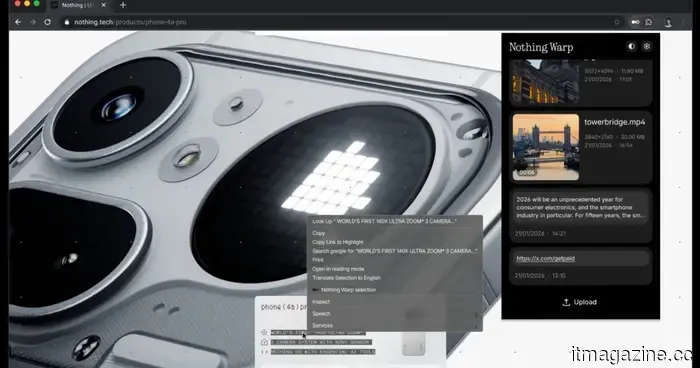 Nothing Warp has returned, but you'll have to go through some hoops to be able to use it.
Nothing has not brought back Warp following a brief suspension, but as the app is no longer available on the Play Store, users are now required to manually install it from Nothing’s community website.
Nothing Warp has returned, but you'll have to go through some hoops to be able to use it.
Nothing has not brought back Warp following a brief suspension, but as the app is no longer available on the Play Store, users are now required to manually install it from Nothing’s community website.
 Pichai kicks off Cloud Next 2026 with a $240 billion backlog, 750 million Gemini users, and a strategy to transform Search into an agent manager.
Google Cloud surpassed $70 billion in revenue, showing a 48% growth, with a backlog of $240 billion. Pichai mentioned that Search will evolve into an agent manager. Capital expenditures have doubled to $185 billion.
Pichai kicks off Cloud Next 2026 with a $240 billion backlog, 750 million Gemini users, and a strategy to transform Search into an agent manager.
Google Cloud surpassed $70 billion in revenue, showing a 48% growth, with a backlog of $240 billion. Pichai mentioned that Search will evolve into an agent manager. Capital expenditures have doubled to $185 billion.
 A lawsuit against ChatGPT alleges that it provided guidance to a shooter on methods and locations for carrying out the attack.
The attorney general of Florida alleges that ChatGPT provided guidance to the FSU shooter regarding which firearm to select, what ammunition to purchase, and when to carry out the attack. OpenAI asserts that the chatbot acted appropriately.
A lawsuit against ChatGPT alleges that it provided guidance to a shooter on methods and locations for carrying out the attack.
The attorney general of Florida alleges that ChatGPT provided guidance to the FSU shooter regarding which firearm to select, what ammunition to purchase, and when to carry out the attack. OpenAI asserts that the chatbot acted appropriately.
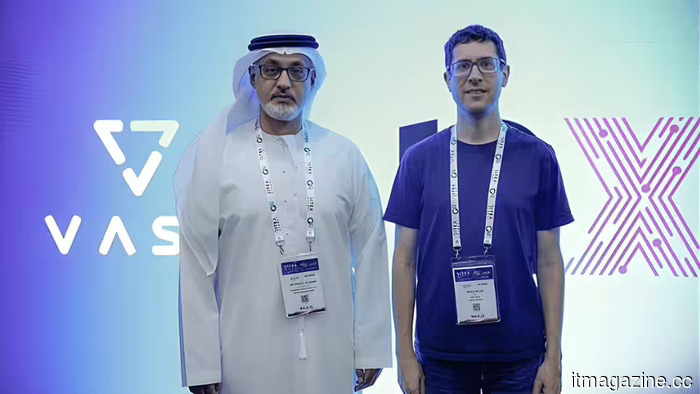 VAST Data has secured $1 billion in funding at a valuation of $30 billion, supported by Nvidia, as the demand for AI data infrastructure continues to grow.
VAST Data has increased its valuation to $30 billion in a $1 billion Series F funding round led by Drive Capital and Access Industries, with participation from Nvidia. The company's revenue is tripling annually.
VAST Data has secured $1 billion in funding at a valuation of $30 billion, supported by Nvidia, as the demand for AI data infrastructure continues to grow.
VAST Data has increased its valuation to $30 billion in a $1 billion Series F funding round led by Drive Capital and Access Industries, with participation from Nvidia. The company's revenue is tripling annually.
The facelifted BMW i7 introduces Gen6 battery cells from Rimac, offering a range of over 350 miles, and replaces Level 3 automation with a more affordable Symbiotic Drive.
The 2027 BMW i7 features Rimac-designed Gen6 cylindrical cells, has a capacity of 112.5 kWh, supports 250 kW charging, and offers an EPA range exceeding 350 miles. Production is set to begin in July at Dingolfing.