
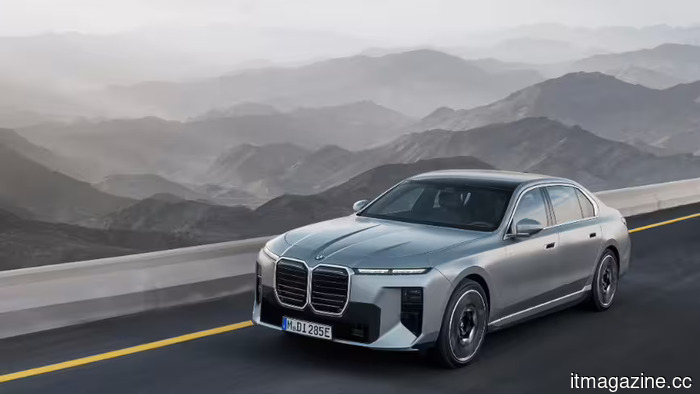
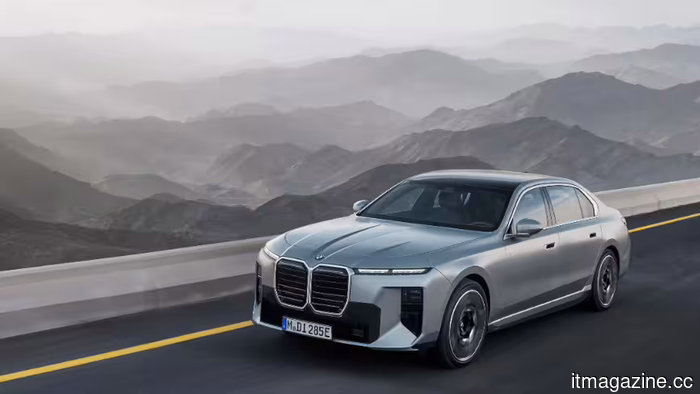
The BMW i7 facelift introduces Gen6 cells from Rimac, offers a range exceeding 350 miles, and replaces Level 3 with a more affordable Symbiotic Drive.
Summary: BMW unveiled the refreshed 2027 i7 at Grand Central Terminal and Auto China, showcasing Gen6 cylindrical cells developed by Rimac, motors free of rare-earth materials featuring SiC inverters, and a charging capability of 250 kW. The i7 60 xDrive aims for over 350 miles EPA and 728 km WLTP; the i7 50 achieves 611 km, while the M70 targets 686 km. BMW completely eliminated Level 3 autonomous driving, introducing the more affordable Level 2 Symbiotic Drive system instead, and revamped the interior featuring Panoramic Vision, an 8K Theatre Screen, and Operating System X.
On Tuesday, BMW introduced the facelifted 2027 i7 simultaneously at Grand Central Terminal in New York and Auto China in Beijing, branding it “one of the brand’s most significant reveals in a generation.” The key features include a new battery developed in partnership with Rimac Technology, utilizing BMW's sixth-generation cylindrical cells for the first time outside of the dedicated Neue Klasse platform and a charging system capable of reaching 250 kilowatts, an increase from 195. The i7 60 xDrive now has a usable capacity of 112.5 kilowatt-hours, up from 101.7, with an estimated preliminary EPA range exceeding 350 miles and achieving up to 728 kilometers on the WLTP cycle. The entry-level i7 50 xDrive offers a range of 611 kilometers WLTP, while the performance-oriented i7 M70 xDrive targets 686 kilometers. A ten-minute charge at a compatible DC fast charger adds approximately 146 miles of WLTP range, and charging from 10% to 80% takes 28 minutes.
These enhancements are crucial, as the i7 has been the weakest link in BMW’s electric lineup. With a starting price over $120,000, it struggled against the Tesla Model S, which is priced significantly lower. The introduction of the Gen6 battery and Rimac collaboration represents BMW's response to this challenge, coinciding with Europe's electric vehicle manufacturers gaining traction against Tesla, whose registrations in Germany saw a nearly 60% decline year-on-year in early 2025.
The battery is the focal point of this development. BMW's Gen6 cells adopt the 4695 cylindrical design, measuring 46 millimeters in diameter and 95 millimeters in height, replacing the previous Gen5 prismatic cells in the outgoing i7. These cylindrical cells provide roughly 20% greater volumetric energy density, enabling BMW to increase usable capacity by over 10% without altering the external dimensions of the battery pack. The existing structure of the G70 7 Series did not require modification, which would have been prohibitively costly for a mid-cycle update.
Rimac Technology, the Croatian firm recognized for the Nevera hypercar, established two complete production lines and a comprehensive supply chain at its facility near Zagreb, acknowledged by BMW as one of the largest industrial construction efforts of its kind in Europe, for manufacturing the battery packs. These packs are then transported to BMW's Dingolfing plant for final assembly. This collaboration marks a new role for Rimac as a battery system supplier to a major OEM, which is distinct from its hypercar and autonomous taxi projects. According to BMW, the Gen6 cells lower the battery supply chain’s CO2-equivalent footprint by 33% compared to Gen5, with production utilizing 100% renewable energy and incorporating recycled lithium, cobalt, and nickel. Certain i7 variants also feature wheels made from 70% recycled aluminum.
The electric motors have also undergone significant changes. The new i7 employs excited synchronous motors that do not require rare earth magnets, as the magnetic field is generated through windings powered by direct current. Integrated silicon carbide inverters within the motor housing deliver a 20% efficiency improvement across the powertrain, along with optimized wheel bearings that enhance overall vehicle efficiency by up to 7%. The i7 achieves a drag coefficient of 0.24, which is competitive within its segment. While these advancements may not capture headlines, they contribute to the differentiation in real-world range—making the difference between 300 miles and 350 miles.
This marks the inaugural use of Gen6 cylindrical cells outside the Neue Klasse architecture, which is significant because it indicates that BMW is linking its current electric vehicles to its future platforms using the same cell chemistry. The Neue Klasse iX3, set to be released this summer, will feature the same Gen6 cells in a custom-built pack, with a range of up to 400 miles and 400-kilowatt ultra-fast charging utilizing an 800-volt architecture. The i7 facelift confirms that these cells can be retrofitted into existing platforms, suggesting that other current-generation BMW EVs could also be upgraded similarly.
The i7 50 xDrive serves as a new entry-level electric variant, generating 449 horsepower and 487 pound-feet of torque
Other articles
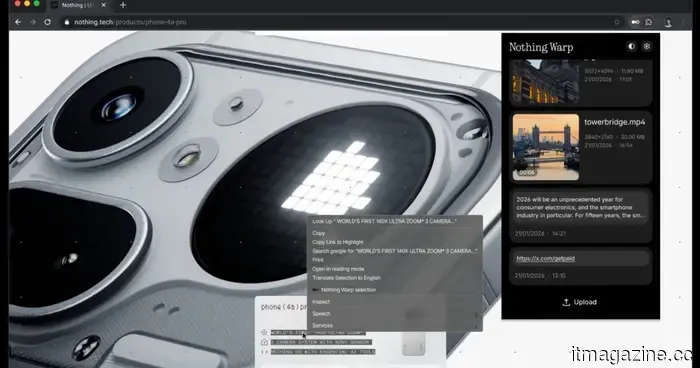 Nothing Warp has returned, but you'll have to go through some hoops to be able to use it.
Nothing has not brought back Warp following a brief suspension, but as the app is no longer available on the Play Store, users are now required to manually install it from Nothing’s community website.
Nothing Warp has returned, but you'll have to go through some hoops to be able to use it.
Nothing has not brought back Warp following a brief suspension, but as the app is no longer available on the Play Store, users are now required to manually install it from Nothing’s community website.
 Snapchat Place Loyalty introduces a competitive element to Snap Map.
Snapchat has launched Place Loyalty, a new feature on Snap Map that offers tiered badges for regular visits, making everyday gatherings something to proudly display.
Snapchat Place Loyalty introduces a competitive element to Snap Map.
Snapchat has launched Place Loyalty, a new feature on Snap Map that offers tiered badges for regular visits, making everyday gatherings something to proudly display.
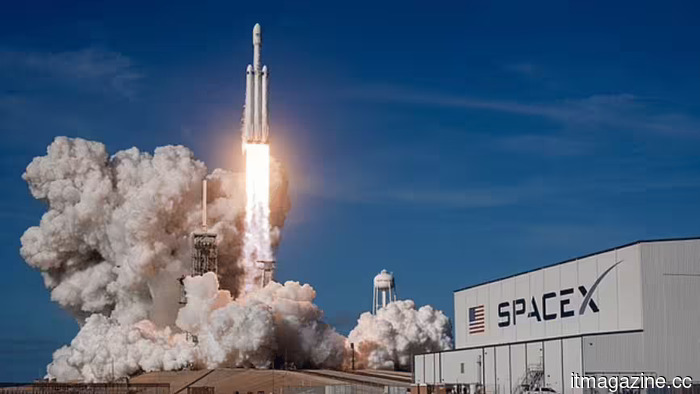 SpaceX S-1 cautions that orbital AI data centers could be unfeasible, just months after Musk referred to space-based AI as an obvious choice.
A pre-IPO filing by SpaceX indicates that space data centers rely on untested technology and might never be feasible. Musk mentioned at Davos that they would become the most cost-effective solution within the next three years.
Mozilla has addressed 271 Firefox vulnerabilities identified by Anthropic's Claude Mythos during a single assessment.
Firefox 150 includes 271 bug fixes identified by Claude Mythos Preview. Mozilla states that the defects are limited. The UK AI Security Institute indicates that the model can also operate independently.
SpaceX S-1 cautions that orbital AI data centers could be unfeasible, just months after Musk referred to space-based AI as an obvious choice.
A pre-IPO filing by SpaceX indicates that space data centers rely on untested technology and might never be feasible. Musk mentioned at Davos that they would become the most cost-effective solution within the next three years.
Mozilla has addressed 271 Firefox vulnerabilities identified by Anthropic's Claude Mythos during a single assessment.
Firefox 150 includes 271 bug fixes identified by Claude Mythos Preview. Mozilla states that the defects are limited. The UK AI Security Institute indicates that the model can also operate independently.
 Gemini can now generate documents, slides, meetings, and additional items in chat.
Google has incorporated Gemini into Chat, enabling users to generate documents, slides, and handle tasks directly within their conversations.
Gemini can now generate documents, slides, meetings, and additional items in chat.
Google has incorporated Gemini into Chat, enabling users to generate documents, slides, and handle tasks directly within their conversations.
 A lawsuit against ChatGPT alleges that it provided guidance to a shooter on methods and locations for carrying out the attack.
The attorney general of Florida alleges that ChatGPT provided guidance to the FSU shooter regarding which firearm to select, what ammunition to purchase, and when to carry out the attack. OpenAI asserts that the chatbot acted appropriately.
A lawsuit against ChatGPT alleges that it provided guidance to a shooter on methods and locations for carrying out the attack.
The attorney general of Florida alleges that ChatGPT provided guidance to the FSU shooter regarding which firearm to select, what ammunition to purchase, and when to carry out the attack. OpenAI asserts that the chatbot acted appropriately.
The BMW i7 facelift introduces Gen6 cells from Rimac, offers a range exceeding 350 miles, and replaces Level 3 with a more affordable Symbiotic Drive.
The 2027 BMW i7 is equipped with Rimac-designed Gen6 cylindrical cells, has a capacity of 112.5 kWh, supports 250 kW charging, and offers an EPA range exceeding 350 miles. Production will commence in July at Dingolfing.