
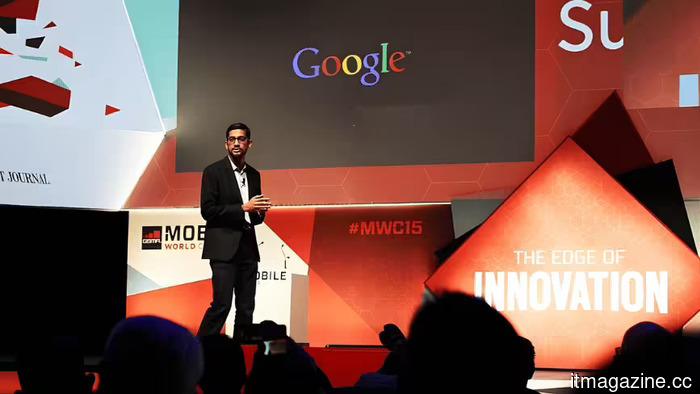
Pichai kicks off Cloud Next 2026 with a $240 billion backlog, 750 million Gemini users, and a strategy to transform Search into an agent manager.
Summary: Sundar Pichai kicked off Cloud Next 2026, revealing that Google Cloud has achieved $70 billion in annual revenue, representing a 48% growth rate, with a $240 billion backlog that has doubled within a year, and projected capital expenditures of $175-185 billion. The Gemini application boasts 750 million monthly active users, AI Overviews reach two billion, and the Gemini API processed 85 billion requests in January alone. Pichai framed the event around the evolution of Search from a retrieval tool into an “agent manager” and introduced the Universal Commerce Protocol in collaboration with Shopify, Target, and Walmart, emphasizing Google’s end-to-end integration as an unreplicable competitive advantage.
Sundar Pichai opened Google Cloud Next 2026 on Tuesday with figures that reshape the competitive landscape in enterprise AI. Google Cloud is now earning over $70 billion annually, reflecting a year-on-year growth of 48%, with a backlog of $240 billion—up 55%—and more than double the approximately $155 billion from the previous year. In 2025, Google Cloud secured more billion-dollar deals than the total of the previous three years combined. Current customers are exceeding their spending commitments by 30%, outpacing their contractual agreements. Google plans to invest $175 billion to $185 billion in capital expenditures for 2026, almost double the $91.4 billion spent last year. Pichai characterized this as a “fundamental rewiring of technology and an accelerant of human ingenuity,” and the financial figures seem to support that sentiment.
The keynote titled “The Agentic Cloud” served as more of a conceptual declaration than a product unveiling. Google is positioning itself as not merely a cloud provider with AI offerings, but as the operating system for what it terms the agentic enterprise: a framework where AI agents autonomously manage routine business operations, communicate across platforms, and engage with the physical world through commerce, search, and real-time data. The assertion is that Google uniquely controls every facet of this ecosystem—from the custom silicon for inference to the advanced models that drive reasoning, to the cloud platform hosting these agents, and the productivity suite and search engine interfacing with three billion users.
The scale of the operation is notable. The Gemini app reached 750 million monthly active users by the fourth quarter of 2025, increasing by 100 million from the prior quarter. Google’s AI-generated search summaries, known as AI Overviews, now reach two billion users worldwide and contribute to a 10% increase in global search queries. AI Overviews are now activated on about 48% of all monitored queries, a significant rise from 31% in February 2025—a 58% rise in one year. The Gemini API managed 85 billion requests in January 2026, reflecting a 142% growth from 35 billion in March 2025. Moreover, there are eight million paid Gemini Enterprise seats across 2,800 companies, with thirteen million developers utilizing Google’s generative models. According to Pichai, Gemini 3 Pro has experienced “the fastest adoption of any model in our history.”
These metrics reflect platform performance rather than cloud figures. Google argues that its edge over AWS, Azure, OpenAI, and Anthropic arises not from any lone product, but from its broader reach, query processing volume, and touchpoints with users. Search alone manages over a billion shopping interactions daily, with Workspace hosting over three billion users, and Android operating on billions of devices. The argument posits that as AI agents become the primary interface for work and commerce, the company with the most extensive operational surface area will prevail, as the agents will require a platform to operate, interfaces to connect, and users to serve.
The transformation of Search into the agent manager is a significant conceptual shift that Pichai articulated on a recent podcast: “A lot of what are just information-seeking queries will be agentic in Search. You’ll be completing tasks. You’ll have many threads running.” He described the transformation of Search from a retrieval engine to an “agent manager,” a layer coordinating AI agents to accomplish tasks on behalf of users instead of merely providing a selection of links.
The infrastructure for these changes is already underway. Google introduced the Universal Commerce Protocol at NRF in January, an open-source standard for agentic commerce developed alongside partners like Shopify, Etsy, Wayfair, Target, and Walmart. Over 20 other partners including Adyen, American Express, Best Buy, Flipkart, Macy’s, Mastercard, Stripe, The Home Depot, Visa, and Zalando have also endorsed it. UCP, constructed on REST and JSON-RPC protocols, features an Agent2Agent protocol, Model Context Protocol, and a new Agent Payments Protocol. It enables AI agents to consider any participating store as a programmable service, with merchants retaining their traditional roles. Pichai, identifying as “an indecisive shopper,” expressed his anticipation
Other articles
 Google introduces a $750M partner fund during Cloud Next 2026 to support agentic AI implementations across Accenture, Deloitte, and KPMG.
Google has allocated $750 million to speed up the development of agentic AI solutions by its partners. Accenture boasts over 450 agents, KPMG has committed $100 million, and partners are earning $7.05 for every $1 spent on the cloud.
Google introduces a $750M partner fund during Cloud Next 2026 to support agentic AI implementations across Accenture, Deloitte, and KPMG.
Google has allocated $750 million to speed up the development of agentic AI solutions by its partners. Accenture boasts over 450 agents, KPMG has committed $100 million, and partners are earning $7.05 for every $1 spent on the cloud.
 Batteries for electric vehicles that can fully charge in just over six minutes have arrived.
CATL has recently introduced a range of new battery technologies, one of which charges from 10% to 80% in just 3 minutes and 44 seconds.
Mozilla has addressed 271 Firefox vulnerabilities identified by Anthropic's Claude Mythos during a single assessment.
Firefox 150 includes 271 bug fixes identified by Claude Mythos Preview. Mozilla states that the defects are limited. The UK AI Security Institute indicates that the model can also operate independently.
Google transforms Chrome into an autonomous AI workplace tool, introducing features like Auto Browse, Skills, and enterprise DLP for $6 per month.
Chrome introduces Auto Browse, AI Skills, a Gemini side panel, and an enterprise DLP service priced at $6/month. Google claims that the browser has evolved from being merely a window to becoming a workplace AI platform.
Mozilla has addressed 271 vulnerabilities in Firefox that were identified by Anthropic's Claude Mythos during a single evaluation process.
Firefox 150 includes 271 bug fixes identified by Claude Mythos Preview. Mozilla states that the issues are limited. The UK AI Security Institute indicates that the model has the capability to conduct autonomous attacks as well.
Batteries for electric vehicles that can fully charge in just over six minutes have arrived.
CATL has recently introduced a range of new battery technologies, one of which charges from 10% to 80% in just 3 minutes and 44 seconds.
Mozilla has addressed 271 Firefox vulnerabilities identified by Anthropic's Claude Mythos during a single assessment.
Firefox 150 includes 271 bug fixes identified by Claude Mythos Preview. Mozilla states that the defects are limited. The UK AI Security Institute indicates that the model can also operate independently.
Google transforms Chrome into an autonomous AI workplace tool, introducing features like Auto Browse, Skills, and enterprise DLP for $6 per month.
Chrome introduces Auto Browse, AI Skills, a Gemini side panel, and an enterprise DLP service priced at $6/month. Google claims that the browser has evolved from being merely a window to becoming a workplace AI platform.
Mozilla has addressed 271 vulnerabilities in Firefox that were identified by Anthropic's Claude Mythos during a single evaluation process.
Firefox 150 includes 271 bug fixes identified by Claude Mythos Preview. Mozilla states that the issues are limited. The UK AI Security Institute indicates that the model has the capability to conduct autonomous attacks as well.
Pichai kicks off Cloud Next 2026 with a $240 billion backlog, 750 million Gemini users, and a strategy to transform Search into an agent manager.
Google Cloud surpassed $70 billion in revenue, showing a 48% growth, with a backlog of $240 billion. Pichai mentioned that Search will evolve into an agent manager. Capital expenditures have doubled to $185 billion.