
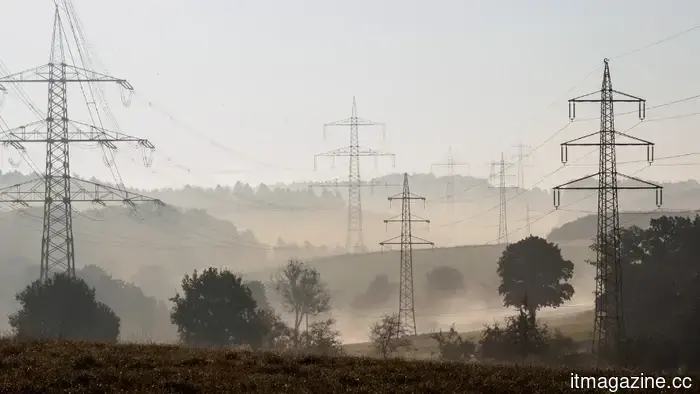
U.S. utility companies intend to invest $1.4 trillion by 2030 to support the growth of artificial intelligence.
A report examining capital spending plans from 51 investor-owned utilities reveals that the expected $1.4 trillion investment is twice the amount spent in the previous decade. Over 30 utilities identified data centres as a primary growth factor. Average residential electricity prices are already anticipated to increase by 5.1% this year.
US investor-owned utility firms plan to invest $1.4 trillion in electricity infrastructure from now until 2030, more than double the investments made in the last decade, as demand for electricity surges due to the data centre boom spurred by artificial intelligence. This is the key finding of a recent report from PowerLines.
This nonpartisan nonprofit consumer advocacy group reviewed capital expenditure plans from 51 investor-owned utilities that collectively serve 250 million customers in the US.
The $1.4 trillion figure shows an increase of over 20% from the utilities’ previous projections for 2025, with Fortune reporting a 27% rise from the $1.1 trillion forecasted a year ago.
A majority of these utilities highlighted data centres as a significant factor in their capital spending plans, with more than 30 specifically naming data centres as a crucial area for growth and investment through 2030.
In 2023, US data centres accounted for over 4% of the nation’s total electricity consumption, according to the MIT Energy Initiative; this share could increase to 9% by 2030, based on the same research.
Deloitte’s 2026 Power and Utilities outlook predicts that the demand from data centres alone could reach 176 gigawatts by 2035, a fivefold increase from 2024 levels.
Other factors contributing to the capital expenditure surge include aging infrastructure needing replacement, strengthening the grid against more severe weather events, increasing electrification of transportation and heating, and population growth. However, it is noted that much of the recent growth is not linked to AI; the data centre boom is expected to be the driving force moving forward.
The implications for consumers are the most debated aspect of this situation. Utilities generally recover their capital expenses through rate increases sanctioned by state regulators, and electricity bills have already risen by roughly 40% since 2021, according to Fortune.
A separate report from PowerLines earlier this year indicated that 56 million Americans will face higher utility bills due to rate hikes approved for 2025. The US Energy Information Administration forecasts further average residential electricity price increases of 5.1% in 2026.
If current trends persist, PowerLines estimates that residential customers could bear nearly half of the $1.4 trillion in planned utility capital expenditures, approximately $700 billion.
However, this outcome is not predetermined. PowerLines points out that large new electricity consumers such as data centres, if properly structured, could exert downward pressure on rates by enabling utilities to distribute fixed costs across a larger customer base.
Drew Maloney, president and CEO of the Edison Electric Institute, expressed this viewpoint: “When more customers join the system, including large new users, we can more broadly share fixed costs, thereby putting downward pressure on rates for all customers.”
The extent to which this occurs will depend on how state regulators allocate costs between residential and industrial customers as utilities manage an unprecedented investment cycle.
Additionally, the grid is facing capacity constraints that exacerbate the investment challenge. Data from the North American Electric Reliability Corporation, as cited by Morningstar, indicates load growth has risen from an earlier estimate of 6.1% to about 11.6% over the next decade.
Capacity auction prices in the PJM Interconnection, which manages the largest competitive wholesale electricity market in the US, have surged from historical averages below $100 per megawatt-day to capped levels exceeding $329 per megawatt-day for the 2026/27 and 2027/28 delivery years.
At the same time, around two terawatts of capacity are currently stuck in interconnection queues, nearly double the existing installed capacity, according to Deloitte.
Otros artículos
 Samsung is reportedly developing another TriFold phone, this time featuring a wide screen design.
As broad as it can be.
Samsung is reportedly developing another TriFold phone, this time featuring a wide screen design.
As broad as it can be.
 ChatGPT, Gemini, and other AI bots often provide poor medical advice about half the time.
A study published in BMJ Open discovered that five prominent AI chatbots frequently provided inaccurate health recommendations, with open-ended inquiries leading to the poorest responses and the quality of citations deteriorating upon examination.
ChatGPT, Gemini, and other AI bots often provide poor medical advice about half the time.
A study published in BMJ Open discovered that five prominent AI chatbots frequently provided inaccurate health recommendations, with open-ended inquiries leading to the poorest responses and the quality of citations deteriorating upon examination.
 Notta Introduces Meeting Recording Without Bots for Mac and Windows
Notta’s latest Bot-Free mode is transforming the way professionals capture and transcribe meetings—eliminating interruptions, waiting times, and those uncomfortable moments of “who invited that person?” If you've ever utilized an AI meeting assistant, you're familiar with the scenario. You're engaged in a conversation, the dialogue is starting to pick up speed, and suddenly, a bot enters the call. Everything comes to a halt. […]
Notta Introduces Meeting Recording Without Bots for Mac and Windows
Notta’s latest Bot-Free mode is transforming the way professionals capture and transcribe meetings—eliminating interruptions, waiting times, and those uncomfortable moments of “who invited that person?” If you've ever utilized an AI meeting assistant, you're familiar with the scenario. You're engaged in a conversation, the dialogue is starting to pick up speed, and suddenly, a bot enters the call. Everything comes to a halt. […]
 Microsoft implements new safety measures to protect users from remote desktop attacks.
Protect yourself before it's too late.
Microsoft implements new safety measures to protect users from remote desktop attacks.
Protect yourself before it's too late.
 Get a $75 discount on the Ray-Ban Meta smart glasses, featuring AI technology, open-ear audio, and a 12MP camera, all in a stylish frame that you'd choose to wear regardless.
Many wearable technologies require you to sacrifice your appearance for the desired features. However, the Ray-Ban Meta smart glasses do not. They are currently priced at $224.25, which is a $75 discount from their original price of $299. These glasses incorporate a 12MP ultra-wide camera, open-ear speakers, and AI assistance into a Wayfarer style frame that [...]
Get a $75 discount on the Ray-Ban Meta smart glasses, featuring AI technology, open-ear audio, and a 12MP camera, all in a stylish frame that you'd choose to wear regardless.
Many wearable technologies require you to sacrifice your appearance for the desired features. However, the Ray-Ban Meta smart glasses do not. They are currently priced at $224.25, which is a $75 discount from their original price of $299. These glasses incorporate a 12MP ultra-wide camera, open-ear speakers, and AI assistance into a Wayfarer style frame that [...]
 The pricing of Apple's iPhone 18 Pro may leave competitors struggling to keep up.
A recent rumor regarding the supply chain indicates that Apple is making significant efforts to prevent a substantial increase in the price of the iPhone 18 Pro, a decision that may add further strain on the already escalating prices of Android flagship devices.
The pricing of Apple's iPhone 18 Pro may leave competitors struggling to keep up.
A recent rumor regarding the supply chain indicates that Apple is making significant efforts to prevent a substantial increase in the price of the iPhone 18 Pro, a decision that may add further strain on the already escalating prices of Android flagship devices.
U.S. utility companies intend to invest $1.4 trillion by 2030 to support the growth of artificial intelligence.
U.S. utility companies intend to invest $1.4 trillion in electricity infrastructure, propelled by AI data centers. Residential customers might shoulder almost 50% of the expenses.