

Anthropic is in discussions to invest $200 million in a private equity initiative aimed at advancing Claude in the enterprise sector.
In summary: Anthropic is negotiating to establish a new joint venture with Blackstone, Hellman & Friedman, and Permira, which would integrate its Claude model in various private equity portfolio companies. The company plans to invest about $200 million of its own money into a vehicle that could raise up to $1 billion from buyout firms, utilizing a model inspired by Palantir's forward-deployed engineer strategy.
According to the Wall Street Journal, Anthropic is in discussions to invest approximately $200 million into a new private-equity-supported joint venture aimed at promoting enterprise adoption of its Claude models. This structure would see buyout firms like Blackstone, Hellman & Friedman, and Permira acquire equity stakes totaling around $1 billion, operating as a consulting and implementation arm to help businesses incorporate Claude into their operations.
No final agreements have been established, and no timeline has been specified. However, these discussions mark Anthropic's most assertive move to convert its model leadership into a distribution network, coinciding with rising competition from OpenAI for the enterprise clients that will ultimately shape the sustainability of economic frameworks in frontier AI.
What the venture aims to accomplish
Multiple sources indicate that the proposed joint venture is based on Palantir’s strategy of deploying engineers within client organizations, fostering not only adoption but also transforming workflows. Instead of depending solely on software subscriptions, Anthropic would combine access to its models with advisory and implementation services—hands-on support that can produce the recurring revenue crucial for AI companies to validate their infrastructure investments.
The strategic reasoning behind using private equity as a distribution channel is compelling. PE firms manage many portfolio companies, so forming a joint venture with Blackstone or Hellman & Friedman allows Anthropic to access entire portfolios through a single negotiation rather than approaching each enterprise individually. Each buyout firm essentially acts as a channel partner, incentivized financially to ensure Claude's adoption and possessing direct influence over its deployment in their portfolio companies.
Beyond this new venture, Blackstone has additional stakes in Anthropic, owning around $1 billion in equity after a $200 million investment made in February 2026 at a $350 billion valuation during Anthropic’s Series G round. This position gives Blackstone both strategic and financial motivations to see Claude widely implemented in corporate environments, presenting a potential conflict of interest or an alignment of incentives, depending on one’s perspective.
The OpenAI comparison
Anthropic isn't the only one pursuing this approach. OpenAI is also in discussions with firms such as Advent International, Bain Capital, Brookfield Asset Management, and TPG for a similar enterprise AI initiative, reportedly aiming to raise around $4 billion. The structural differences between these two initiatives are significant.
OpenAI is guaranteeing PE firms a minimum return of 17.5%, making the investment proposition more attractive to limited partners and investment committees that might otherwise view an AI joint venture as too risky. Alternatively, Anthropic is offering regular equity in the venture without a guaranteed return, suggesting either greater confidence in its commercial potential or reluctance to offset investor risk. This choice also reflects a cultural stance: a company focused on AI safety might not be comfortable structuring its equity around protections for investors over shared risks.
Axios accurately describes the competitive situation: “It’s a whole lot faster for OpenAI and Anthropic to partner with PE firms than to approach each of their portfolio companies independently.” The race for enterprise AI adoption indicates that distribution, rather than just model quality, will determine market share, leading both companies to conclude that private equity represents the quickest path to scalability.
Building on existing enterprise infrastructure
If finalized, this venture would represent Anthropic's third significant enterprise initiative launched within a single quarter. In March 2026, the company pledged $100 million to its Claude Partner Network, which is supported by Accenture, Deloitte, Cognizant, and Infosys, providing implementation assistance, technical architecture, and co-marketing for enterprise Claude integrations. Additionally, Xero has integrated Claude directly into its accounting platform, demonstrating the depth of Claude’s embedding into software products well beyond a chat interface.
As of April 2026, over 1,000 businesses are reportedly spending more than $1 million annually on Anthropic services, a rise from around 500 two months earlier. Enterprise customers now account for approximately 80% of Anthropic’s revenue, according to internal reports. The proposed PE venture aims to further concentrate this activity, targeting the segment of the enterprise market (private-equity-owned mid-market companies) often overlooked by the partners in the Claude Partner Network.
The IPO context
Context is crucial: Anthropic is said to be in talks with Goldman Sachs and JPMorgan Chase regarding a public offering anticipated for October 2026, aiming for a $60 billion fundraising target. With a post-money valuation of approximately $380 billion following its Series G round, a successful IPO will require Anthropic to showcase not only its model capabilities but also sustainable and scalable enterprise revenue. A joint venture that integrates Claude

Other articles
 Hermeus has secured $350 million, achieving a valuation of $1 billion.
Hermeus has secured $350 million at a valuation of $1 billion to further develop autonomous hypersonic aircraft. In March, a demonstrator the size of an F-16 completed a test flight.
Hermeus has secured $350 million, achieving a valuation of $1 billion.
Hermeus has secured $350 million at a valuation of $1 billion to further develop autonomous hypersonic aircraft. In March, a demonstrator the size of an F-16 completed a test flight.
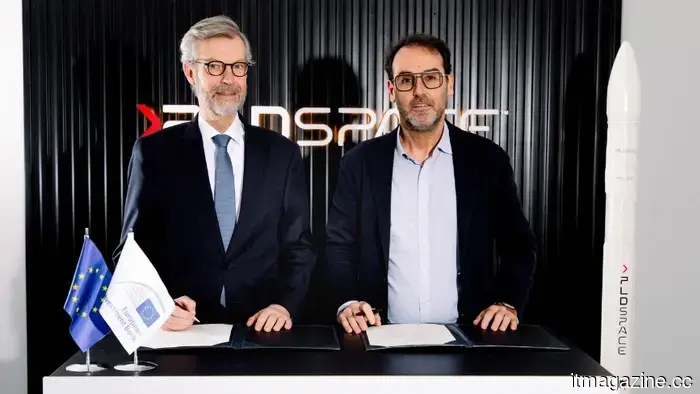 EIB provides PLD Space with a €30 million loan to complete the construction of its MIURA 5 rocket.
The EIB has finalized a €30 million venture debt loan agreement with PLD Space, marking its initial direct investment in a small satellite launch vehicle, in anticipation of the first test flight of MIURA 5.
EIB provides PLD Space with a €30 million loan to complete the construction of its MIURA 5 rocket.
The EIB has finalized a €30 million venture debt loan agreement with PLD Space, marking its initial direct investment in a small satellite launch vehicle, in anticipation of the first test flight of MIURA 5.
 AI has significantly accelerated coding but has also created its own set of challenges.
Nowadays, thanks to AI, everyone has become a coder. However, an increase in code results in more bugs and vulnerabilities, along with a shortage of engineers to address them.
AI has significantly accelerated coding but has also created its own set of challenges.
Nowadays, thanks to AI, everyone has become a coder. However, an increase in code results in more bugs and vulnerabilities, along with a shortage of engineers to address them.
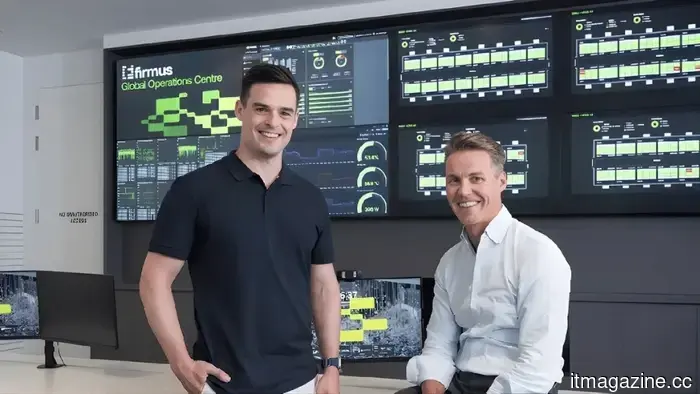 Nvidia-supported Firmus aims for a $2 billion IPO on the ASX following a $505 million capital raise and $10 billion in debt from Blackstone.
Firmus is on track for a $2 billion IPO on the ASX after securing $505 million at a valuation of $5.5 billion, along with a $10 billion debt package from Blackstone to establish 1.6GW of AI factories throughout Australia.
Nvidia-supported Firmus aims for a $2 billion IPO on the ASX following a $505 million capital raise and $10 billion in debt from Blackstone.
Firmus is on track for a $2 billion IPO on the ASX after securing $505 million at a valuation of $5.5 billion, along with a $10 billion debt package from Blackstone to establish 1.6GW of AI factories throughout Australia.
 QR code traffic scams may seem clever, but they raise significant concerns.
Fresh phishing schemes are employing QR codes in fraudulent traffic violation messages to acquire personal and financial information.
QR code traffic scams may seem clever, but they raise significant concerns.
Fresh phishing schemes are employing QR codes in fraudulent traffic violation messages to acquire personal and financial information.
 HexemBio secures $10.4 million for its stem cell rejuvenation treatment.
HexemBio has been established with a seed funding round spearheaded by Draper Associates to develop a blood stem cell rejuvenation treatment supported by Robert Langer.
HexemBio secures $10.4 million for its stem cell rejuvenation treatment.
HexemBio has been established with a seed funding round spearheaded by Draper Associates to develop a blood stem cell rejuvenation treatment supported by Robert Langer.
Anthropic is in discussions to invest $200 million in a private equity initiative aimed at advancing Claude in the enterprise sector.
Anthropic is in discussions for a joint venture with Blackstone, H&F, and Permira to implement Claude within their private equity portfolio companies as it competes with OpenAI for a share of the enterprise market.