
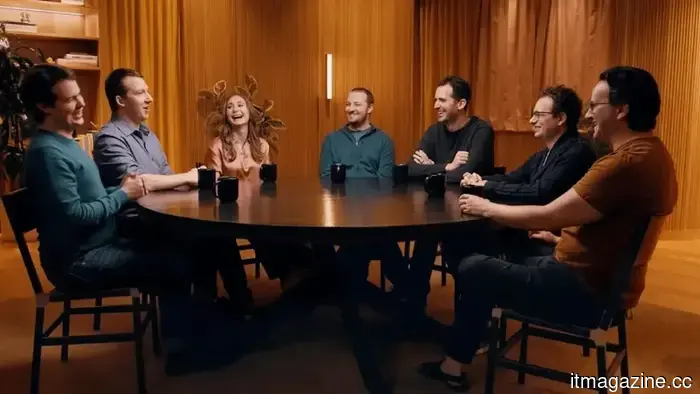
Anthropic is in discussions to invest $200 million in a private equity venture aimed at promoting Claude for enterprise use.
In summary: Anthropic is negotiating to establish a new joint venture with Blackstone, Hellman & Friedman, and Permira to integrate Claude into private equity portfolio companies, investing about $200 million of its own funds into a vehicle that could potentially raise up to $1 billion from buyout firms. This model is inspired by Palantir’s forward-deployed engineer approach.
According to the Wall Street Journal, Anthropic is in discussions to invest roughly $200 million in a new private equity-backed joint venture aimed at promoting enterprise adoption of its Claude models. This proposed structure would allow buyout firms like Blackstone, Hellman & Friedman, and Permira to take equity stakes totaling around $1 billion in the venture, which would function as a consulting and implementation unit to assist businesses in incorporating Claude into their operations.
No final agreements have been reached and no timeline has been established. However, these discussions signify the most ambitious step Anthropic has taken to leverage its model leadership into a distribution network during a time of increasing rivalry with OpenAI for enterprise clients, who will ultimately influence the sustainability of frontier AI economics.
What the venture would actually do
The proposed joint venture is reportedly modeled after Palantir's approach of deploying engineers within customer organizations to facilitate not only adoption but also workflow transformation. Instead of relying solely on software subscriptions, Anthropic would combine model access with advisory and implementation services, which are essential for generating the sticky, recurring revenue necessary for AI companies to justify their infrastructure investments.
The strategic rationale for utilizing private equity as a distribution layer is compelling. Private equity firms have control over thousands of portfolio companies, allowing Anthropic to access entire portfolios through a single negotiation rather than approaching each enterprise separately. Each buyout firm becomes a channel partner with both a financial motivation to promote Claude's adoption and direct influence over the companies where it is implemented.
Blackstone already has a vested interest beyond this new venture, holding about $1 billion in Anthropic equity after investing $200 million at a $350 billion valuation in February 2026 during Anthropic's Series G round. This situation gives Blackstone both strategic and financial incentives to widely embed Claude in corporate environments, which could be seen as either a conflict of interest or an alignment of incentives, depending on one's perspective.
The OpenAI comparison
Anthropic is not the only organization pursuing this model; OpenAI is concurrently in talks with Advent International, Bain Capital, Brookfield Asset Management, and TPG for a similar enterprise AI venture, aiming to raise about $4 billion. The structural differences between the two proposals are noteworthy.
OpenAI is guaranteeing private equity firms a minimum return of 17.5%, an incentive designed to simplify the investment proposition for limited partners and investment committees that might otherwise view an AI joint venture as too speculative. In contrast, Anthropic is offering standard equity in the venture without a guaranteed return floor. This distinction signals that Anthropic is either more confident in the potential commercial upside or less inclined to offset investor risks. It also reflects a cultural stance: a company founded primarily on AI safety principles may be hesitant to structure its equity in a way that prioritizes investor protection over collective risk-sharing.
The description of the competitive landscape by Axios highlights the situation clearly: "It’s a whole lot faster for OpenAI and Anthropic to partner with PE firms than to approach each of their portfolio companies independently." The adoption of enterprise AI has become a race where distribution, rather than just model quality, will determine market share. Both companies have concluded that private equity offers the quickest route to scale.
Building on existing enterprise infrastructure
Should the new venture materialize, it would mark Anthropic's third significant enterprise initiative launched within a single quarter. In March 2026, the company committed $100 million to its $100 million Claude Partner Network, supported by Accenture, Deloitte, Cognizant, and Infosys, which provides implementation assistance, technical architects, and co-marketing for enterprise Claude deployments. Additionally, Xero has directly integrated Claude into its accounting platform, exemplifying how deeply Claude is becoming embedded in software products beyond just a chat interface.
By April 2026, over 1,000 businesses were spending more than $1 million annually on Anthropic services, an increase from approximately 500 two months prior. Enterprise customers now account for around 80% of Anthropic’s revenue, based on the company's internal data. The planned private equity venture aims to expedite this concentration and reach the segment of the enterprise market (private-equity-owned mid-market companies) that the Claude Partner Network's large-system-integrator partners do not typically cover.
The IPO frame
Context is important: Anthropic is reportedly in discussions with Goldman Sachs and JPMorgan Chase regarding a public listing targeted for October 2026, with an anticipated fundraising of $60 billion. With a $380 billion valuation post-money on the Series G, a successful IPO necessitates Anthropic to demonstrate not only model capability but also sustainable, scalable enterprise revenue. A
Otros artículos
 Windows 11 sta aggiungendo flag delle funzionalità, e sono cautamente ottimista
Windows 11 potrebbe presto includere i flag delle funzionalità, consentendo agli utenti di attivare aggiornamenti sperimentali senza dover attendere i rilascio graduali.
Windows 11 sta aggiungendo flag delle funzionalità, e sono cautamente ottimista
Windows 11 potrebbe presto includere i flag delle funzionalità, consentendo agli utenti di attivare aggiornamenti sperimentali senza dover attendere i rilascio graduali.
 L'IA ha potenziato la programmazione, ma ha sollevato un problema di confusione tutto suo.
Ora tutti sono programmatori, grazie all'IA. Ma più codice significa più bug, più vulnerabilità e non ci sono abbastanza ingegneri per individuarli.
Natter raccoglie 23 milioni di dollari per sostituire i sondaggi aziendali
Natter ha chiuso un finanziamento di 23 milioni di dollari nella Serie A per scalare la sua piattaforma di conversazione aziendale moderata dall'IA. Una sessione video di 7 minuti offre più approfondimenti di un sondaggio tipico.
L'IA ha potenziato la programmazione, ma ha sollevato un problema di confusione tutto suo.
Ora tutti sono programmatori, grazie all'IA. Ma più codice significa più bug, più vulnerabilità e non ci sono abbastanza ingegneri per individuarli.
Natter raccoglie 23 milioni di dollari per sostituire i sondaggi aziendali
Natter ha chiuso un finanziamento di 23 milioni di dollari nella Serie A per scalare la sua piattaforma di conversazione aziendale moderata dall'IA. Una sessione video di 7 minuti offre più approfondimenti di un sondaggio tipico.
 La versione limitata di Google Pixel 10a in Isai Blue è assolutamente stupenda.
Caro Google, per favore porta questo colore in altri paesi.
La versione limitata di Google Pixel 10a in Isai Blue è assolutamente stupenda.
Caro Google, per favore porta questo colore in altri paesi.
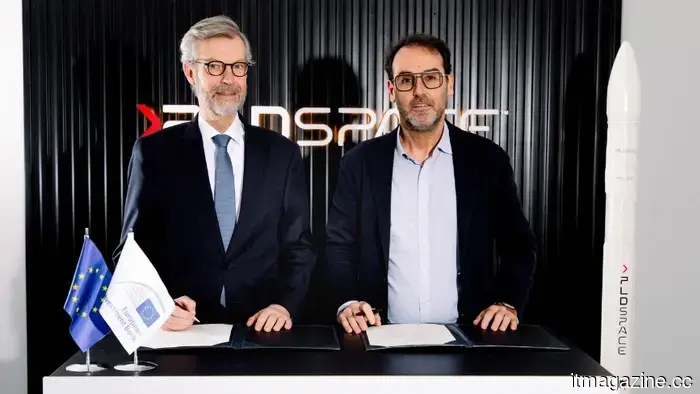 EIB presta a PLD Space 30 milioni di euro per completare la costruzione del suo razzo MIURA 5
EIB ha firmato un prestito di venture debt di 30 milioni di euro con PLD Space, il suo primo investimento diretto in un lanciatore di piccoli satelliti, in vista del volo di prova inaugurale di MIURA 5.
EIB presta a PLD Space 30 milioni di euro per completare la costruzione del suo razzo MIURA 5
EIB ha firmato un prestito di venture debt di 30 milioni di euro con PLD Space, il suo primo investimento diretto in un lanciatore di piccoli satelliti, in vista del volo di prova inaugurale di MIURA 5.
 Hermeus ha raccolto 350 milioni di dollari, con una valutazione di 1 miliardo di dollari.
Hermeus ha raccolto 350 milioni di dollari, con una valutazione di 1 miliardo di dollari, per continuare a costruire aerei ipersonici autonomi. Un dimostratore delle dimensioni di un F-16 ha volato a marzo.
Hermeus ha raccolto 350 milioni di dollari, con una valutazione di 1 miliardo di dollari.
Hermeus ha raccolto 350 milioni di dollari, con una valutazione di 1 miliardo di dollari, per continuare a costruire aerei ipersonici autonomi. Un dimostratore delle dimensioni di un F-16 ha volato a marzo.
Anthropic is in discussions to invest $200 million in a private equity venture aimed at promoting Claude for enterprise use.
Anthropic is in discussions for a joint venture with Blackstone, H&F, and Permira to integrate Claude into their private equity portfolio companies, as they compete with OpenAI for market share in the enterprise sector.