
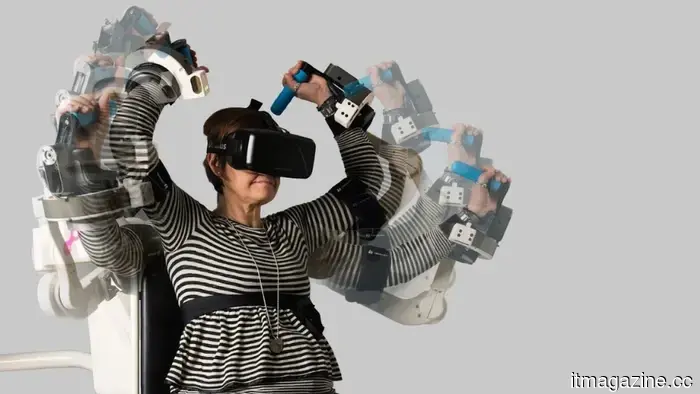
Wearable Robotics secures €5 million to enhance its arm exoskeleton.
The Sant’Anna spin-off based in Pisa has rolled out its ALEX RS bilateral upper-limb exoskeleton in 20 countries since its establishment in 2014. CDP Venture Capital spearheaded the Series A funding round, while SIMEST contributed to international expansion financing through the Italian Ministry of Foreign Affairs.
Wearable Robotics, an Italian company specializing in rehabilitation technology stemming from the Sant’Anna School of Advanced Studies in Pisa, has secured €5 million in a Series A funding round to enhance its international growth and complete its product range.
The funding round was led by CDP Venture Capital via its Accelerators Fund, with contributions from MITO Technology, LIFTT, SIMEST, RoboIT, and Toscana Next, which is a co-investment fund operated by CDP Venture Capital and supported by major banking foundations in Tuscany. Lucia Lencioni is the CEO of the company.
Founded in 2014, Wearable Robotics develops wearable robotic rehabilitation devices that incorporate augmented and virtual reality systems for neuromotor recovery. Its main product, ALEX RS, is a bilateral upper-limb exoskeleton intended for post-stroke rehabilitation, capable of addressing 92% of the natural range of motion of the human arm.
The device has received CE certification as a Class IIa medical device, and over 50 units have been utilized in clinical hospitals and rehabilitation centers across 20 countries.
Wearable Robotics holds a portfolio of eight proprietary patents that cover areas such as kinematics, sensors, actuation systems, and exoskeleton design. Its biomedical division operates under the name Nexum Robotics.
SIMEST’s involvement is noteworthy, as this Italian state-supported institution provides financial backing to Italian companies seeking international expansion under a mandate from the Ministry of Foreign Affairs and International Cooperation, indicating a targeted focus on North America.
The diversified investor consortium, combining the startup infrastructure of CDP Venture Capital, LIFTT’s emphasis on deep tech (as noted in a LIFTT portfolio document confirming support for Wearable Robotics since 2023), and RoboIT’s national technology transfer mission for robotics, illustrates a unified Italian public-private effort behind one of Europe’s more clinically validated rehabilitation robotics companies.
The €5 million raised will be used to complete the product portfolio, gain regulatory approvals in new markets, expand commercial and distribution networks, and optimize production capacity. The rehabilitation robotics sector has significant commercial potential, with Wearable Robotics estimating that 200 million patients worldwide require neuromotor rehabilitation following strokes, traumatic brain injuries, and spinal cord injuries.
According to the company, traditional physical therapy only achieves complete mobility recovery in about 10% of patients, highlighting the need for robotic rehabilitation systems designed to provide more intensive, measurable, and personalized treatment to bridge this gap.
Other articles
 The Artemis II moon crew has just entered the most crucial phase to date.
NASA's Artemis II crew had a fantastic beginning on Wednesday when their Orion spacecraft successfully entered Earth orbit after a stunning launch from the Kennedy Space Center in Florida. Following a day of system checks on the spacecraft, NASA astronauts Reid Wiseman, Victor Glover, and Christina Koch, along with Jeremy Hansen from the Canadian Space Agency (CSA), […]
The Artemis II moon crew has just entered the most crucial phase to date.
NASA's Artemis II crew had a fantastic beginning on Wednesday when their Orion spacecraft successfully entered Earth orbit after a stunning launch from the Kennedy Space Center in Florida. Following a day of system checks on the spacecraft, NASA astronauts Reid Wiseman, Victor Glover, and Christina Koch, along with Jeremy Hansen from the Canadian Space Agency (CSA), […]
 Microsoft is shifting its focus from borrowing AI to creating its own.
Microsoft aims to reduce its dependence on OpenAI and develop its own advanced AI models by 2027, a shift that could alter the way you interact with Teams, Copilot, and other services.
Microsoft is shifting its focus from borrowing AI to creating its own.
Microsoft aims to reduce its dependence on OpenAI and develop its own advanced AI models by 2027, a shift that could alter the way you interact with Teams, Copilot, and other services.
 Amazon, affected by the war, is introducing a fuel surcharge that may increase your shopping costs.
Beginning April 17, Amazon will impose a 3.5% fuel surcharge on fees for third-party sellers, a decision prompted by rising oil prices linked to the continuing conflict in the Middle East. Customers may also soon experience the effects of this change.
Amazon, affected by the war, is introducing a fuel surcharge that may increase your shopping costs.
Beginning April 17, Amazon will impose a 3.5% fuel surcharge on fees for third-party sellers, a decision prompted by rising oil prices linked to the continuing conflict in the Middle East. Customers may also soon experience the effects of this change.
 Samsung enhances Quick Panel personalization in One UI 8.5.
A new day brings fresh opportunities to personalize your phone.
Samsung enhances Quick Panel personalization in One UI 8.5.
A new day brings fresh opportunities to personalize your phone.
 Amazon, impacted by the war, is implementing a fuel surcharge that may increase your shopping costs.
Starting April 17, Amazon will implement a 3.5% fuel surcharge on fees for third-party sellers, a move prompted by rising oil prices associated with the ongoing conflict in the Middle East. Customers may soon experience the effects as well.
Amazon, impacted by the war, is implementing a fuel surcharge that may increase your shopping costs.
Starting April 17, Amazon will implement a 3.5% fuel surcharge on fees for third-party sellers, a move prompted by rising oil prices associated with the ongoing conflict in the Middle East. Customers may soon experience the effects as well.
 IREX introduces AI fire detection that operates on current camera networks.
IREX has enhanced its FireTrack AI to identify fire and smoke in real time by utilizing current CCTV systems, thereby increasing both accuracy and response time.
IREX introduces AI fire detection that operates on current camera networks.
IREX has enhanced its FireTrack AI to identify fire and smoke in real time by utilizing current CCTV systems, thereby increasing both accuracy and response time.
Wearable Robotics secures €5 million to enhance its arm exoskeleton.
Wearable Robotics secures €5M in funding, with CDP Venture Capital leading the investment, for its ALEX RS bilateral arm exoskeleton, which is currently utilized in 20 countries.