
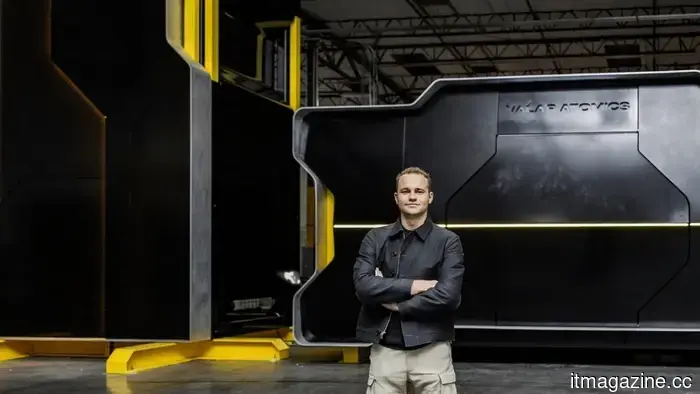
Valar Atomics secures $450 million at a valuation of $2 billion to supply AI with small nuclear reactors.
Isaiah Taylor was just sixteen when he concluded that the nuclear industry faced a size issue. It wasn’t that reactors were overly dangerous or costly, although they certainly are, but rather that they were simply too large. The massive, multi-gigawatt structures from the Cold War era that still populate the American landscape were made for a grid that transmitted power in one direction: from far-off plants to distant cities. They were never intended to be situated behind a tech giant's fence, supplying power to a cluster of GPU racks that double their demand every eighteen months.
Now 27, Taylor started Valar Atomics in 2023 with the vision of creating something different. On Tuesday, the El Segundo, California-based startup announced it had secured $450 million at a valuation of $2 billion, as reported by Bloomberg. This funding round included $340 million in equity and $110 million in debt, coming just five months after a $130 million Series A that assessed the company at a fraction of its current value.
Its investors resemble a who's who of the American defense technology sector, which has recently begun making significant financial commitments. Palmer Luckey, the founder of Anduril Industries, known for pursuing a $4 billion raise at a $60 billion valuation, is among them. Shyam Sankar, Palantir Technologies' chief technology officer, also invested. The earlier Series A was spearheaded by Snowpoint Ventures, co-founded by Doug Philippone, Palantir’s former global defense head, along with Day One Ventures and Dream Ventures. Former AT&T CEO and Lockheed Martin board member John Donovan also took part.
Valar's proposal centers on what it refers to as “gigasites,” extensive industrial campuses designed to accommodate hundreds or even thousands of small, high-temperature gas-cooled reactors working together. Each reactor utilizes helium as a coolant and TRISO fuel encased in graphite, which allows them to operate at much higher temperatures than traditional light-water reactors. The company claims these clusters can provide dense, reliable, carbon-free energy tailored to the energy demands of AI data centers, industrial manufacturers, and regions with grid constraints.
This ambitious solution addresses a pressing question: where will the electricity come from? The International Energy Agency anticipates that data center energy consumption will double by 2026. Goldman Sachs estimates that around 85 to 90 gigawatts of new nuclear capacity will eventually be necessary to bridge this gap. Recently, Microsoft, Amazon, and Google have all entered nuclear power agreements, but the reactors required for these contracts do not yet exist at a commercial scale.
Valar asserts a significant lead in the field. In November 2025, the company reported that its NOVA Core achieved zero-power criticality at Los Alamos National Laboratory’s National Criticality Experiments Research Centre, thereby becoming what the Breakthrough Institute called the first company to reach this achievement under the U.S. Department of Energy’s Nuclear Reactor Pilot Program. Zero-power criticality, which involves a self-sustaining chain reaction of uranium-235 that doesn't reach full operating temperatures, is a crucial validation milestone, though not a full-fledged power plant; nonetheless, it surpasses the public demonstrations of most of Valar's competitors.
The company is now readying its Ward250 reactor, a high-temperature gas-cooled unit with a thermal output of 100 kilowatts, for operational testing at the Utah San Rafael Energy Research Centre. In February 2026, the reactor was transported from California to Utah using three C-17 Globemaster military cargo planes in a joint effort by the Departments of Defense and Energy—an operation that also served as a proof of concept for rapid reactor deployment. Valar aims to have the reactor operational by July 4, 2026, which is the deadline set by the DOE for three reactors in its pilot program to achieve criticality.
Taylor's path has been unconventional even within the deep-tech sector. A self-taught programmer who started his first business as a teenager, he hails from a family with connections to nuclear science: his great-grandfather, Ward Schaap, was a physicist who worked on the Manhattan Project. The Ward250 reactor is named after Schaap. Taylor has built a leadership team including Mark Mitchell, the former president of Ultra Safe Nuclear Corporation, and Muhammad Shahzad, the former president and CFO of Relativity Space.
The competitive landscape is densely populated and well-funded. TerraPower, backed by Bill Gates, began constructing a sodium-cooled reactor in Wyoming last year. Kairos Power is creating a molten-salt demonstration plant in Tennessee, while X-energy has joined forces with Dow Chemical for an industrial HTGR. Oklo, which went public via a SPAC in 2024, is working on a fast-neutron microreactor. None of these companies, however, has yet delivered commercial power from an advanced design.
Valar has also adopted a confrontational stance towards regulation that few emerging companies would dare to
Other articles
 I inquired with Asus regarding their router that resembles an alien spacecraft. Its ROG lineage extends beyond just gaming.
The ROG Rapture GT-BE19000AI Wi-Fi router is an eye-catching device. However, in addition to its steep price and gaming features, it offers a range of benefits that will satisfy even the most discerning users, along with some unexpected advantages.
I inquired with Asus regarding their router that resembles an alien spacecraft. Its ROG lineage extends beyond just gaming.
The ROG Rapture GT-BE19000AI Wi-Fi router is an eye-catching device. However, in addition to its steep price and gaming features, it offers a range of benefits that will satisfy even the most discerning users, along with some unexpected advantages.
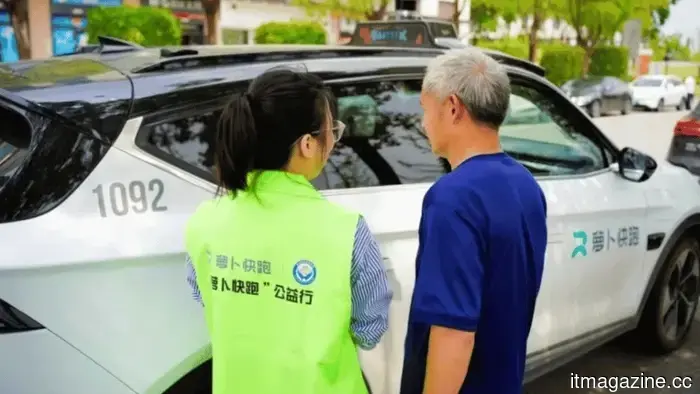 In Wuhan, a mass fleet failure resulted in over 100 Baidu robotaxis becoming immobilized in the middle of traffic.
A system error led to over 100 Baidu Apollo Go robotaxis halting in the middle of traffic in Wuhan, leaving passengers stranded and prompting new concerns regarding correlated fleet risk.
In Wuhan, a mass fleet failure resulted in over 100 Baidu robotaxis becoming immobilized in the middle of traffic.
A system error led to over 100 Baidu Apollo Go robotaxis halting in the middle of traffic in Wuhan, leaving passengers stranded and prompting new concerns regarding correlated fleet risk.
 Apple provides security updates for older iPhones that are vulnerable to hacking threats.
Apple has ultimately concluded that older iPhones warrant some attention as well.
Apple provides security updates for older iPhones that are vulnerable to hacking threats.
Apple has ultimately concluded that older iPhones warrant some attention as well.
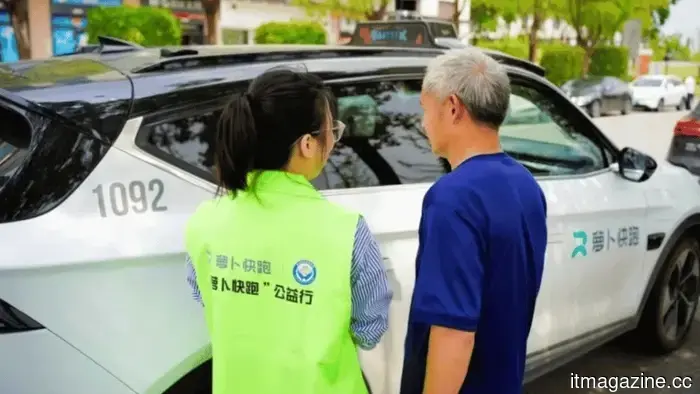 In Wuhan, more than 100 Baidu robotaxis became immobilized simultaneously in a significant fleet malfunction.
A system failure led to over 100 Baidu Apollo Go robotaxis halting in the middle of traffic in Wuhan, leaving passengers stranded and bringing forth new concerns regarding correlated fleet risk.
In Wuhan, more than 100 Baidu robotaxis became immobilized simultaneously in a significant fleet malfunction.
A system failure led to over 100 Baidu Apollo Go robotaxis halting in the middle of traffic in Wuhan, leaving passengers stranded and bringing forth new concerns regarding correlated fleet risk.
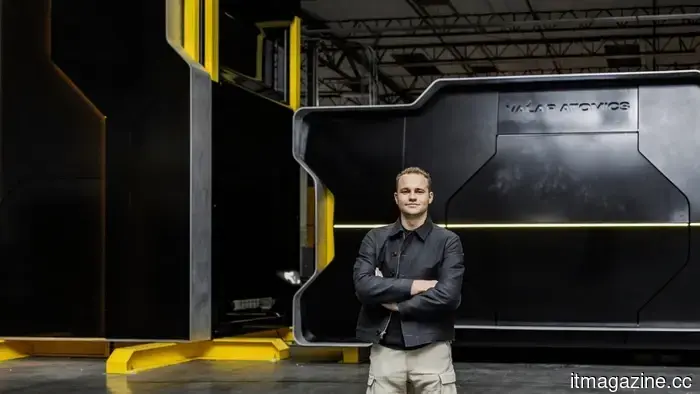 Valar Atomics secures $450 million at a $2 billion valuation to fuel AI through small nuclear reactors.
Valar Atomics, supported by Palmer Luckey, has secured $450 million at a valuation of $2 billion to develop groups of small reactors for AI data centers, just five months after reaching nuclear criticality.
Valar Atomics secures $450 million at a $2 billion valuation to fuel AI through small nuclear reactors.
Valar Atomics, supported by Palmer Luckey, has secured $450 million at a valuation of $2 billion to develop groups of small reactors for AI data centers, just five months after reaching nuclear criticality.
 Klarna clinches a $1.7 billion agreement to facilitate $40 billion in lending as its stock plummets 76% since its IPO.
Klarna revealed its largest risk transfer agreement with Värde Partners, enabling $40 billion in lending capital to be released. Six months following its debut on the NYSE at $40, the shares are now trading around $12.
Klarna clinches a $1.7 billion agreement to facilitate $40 billion in lending as its stock plummets 76% since its IPO.
Klarna revealed its largest risk transfer agreement with Värde Partners, enabling $40 billion in lending capital to be released. Six months following its debut on the NYSE at $40, the shares are now trading around $12.
Valar Atomics secures $450 million at a valuation of $2 billion to supply AI with small nuclear reactors.
Valar Atomics, supported by Palmer Luckey, secured $450 million at a valuation of $2 billion to develop clusters of small reactors for AI data centers, just five months after reaching nuclear criticality.