

I inquired with Asus regarding their router that resembles an alien spacecraft. Its ROG lineage extends beyond just gaming.
“Wow.”
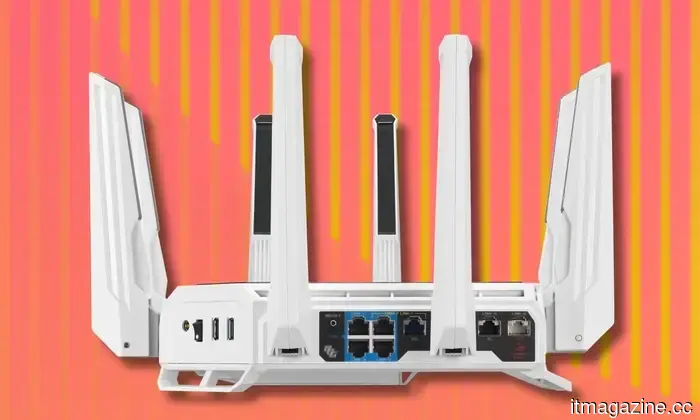
That was my initial response when I saw Asus’ Republic of Gamers division unveil the ROG Rapture GT-BE19000AI Wi-Fi router. Its design was unlike anything I'd encountered before, particularly for a router. I've attracted plenty of attention in my work cafe while using the RGB display of the impressive ROG Strix Scar 18 gaming laptop, but applying such a bold aesthetic to networking hardware feels like an excessive display of engineering prowess.
Moreover, a price tag of $900 added to the mystery for me. This isn’t the first futuristic-looking router from Asus ROG, but the Rapture GT-BE19000AI elevates things to an entirely different level. Before diving into the review, I met with Juan J. Guerrero, Partnerships Manager at Asus (NA), to grasp what the extravagant router truly offers and whether it can surpass its claim of being “the world’s first AI gaming router.”
A router featuring a dual-chip, quad-core architecture. But why?
So, why would a router carry a 2.6GHz quad-core chip, 4GB of RAM, 32GB of internal storage, and an additional dedicated AI chip (also quad-core)? Guerrero explained that this relates not just to peak performance but also numerous other conveniences provided by the router. In addition to increased throughput, users benefit from improved USB performance, enhanced 10G connectivity, and more.
This is closely linked to the dual-chip architecture as well. “Multitasking is a myth. The more you multitask, the worse your performance typically becomes because you can really only concentrate on one task at a time, right?” the Asus manager said. He emphasized the issue of overhead, noting that managing networking traffic, background processes, security, data transfers, and interference checks can overwhelm a single-chip, slow-core setup, negatively impacting network performance.
Asus / Digital Trends
A significant example is WiFi Insight, which depends on the dedicated AI chip. It scans for surrounding RF signals, like those from microwaves, and logs them. Depending on the interference level, it will automatically switch the network band to maintain optimal performance.
“Generally, users don’t have access to this kind of data. They wouldn’t be aware of what was affecting their network. They often just knew something was wrong without understanding why,” Guerrero explained.
The AI core relates to another current trend — local processing, which Asus calls Private Edge AI. It functions like a customer support AI trained to address operational and troubleshooting questions. However, no data from your interactions leaves the device or is sent to an external cloud. Additionally, it operates faster than traditional internet-based exchange.
Asus developed its own local LLM, training it on internal documentation to ensure accurate information rather than relying on potentially unreliable internet-sourced solutions. Unlike AI bots such as ChatGPT and Gemini that can misinterpret or confuse information, Asus’ AI securely manages your inquiries using its own training materials.
AFC, the hidden performance enhancer
Interestingly, Asus’ official documentation mentions AFC (Automated Frequency Coordination) only briefly, but it’s a key feature. “AFC is a new protocol or standard endorsed by the FCC,” Guerrero explained. Certain network bands are reserved for government use but often remain unutilized.
Asus / Digital Trends
Once AFC is activated, the router scans its surroundings. If available bands are detected, it uses them to enhance 6GHz network performance. Referring to internal tests with an iPhone 16 Pro connected to the router, Guerrero mentioned, “Without AFC engaged, it was around 425-450 megabits, and when AFC was activated, it nearly doubled to about 900 megabits.”
That represents a substantial boost. Naturally, performance varies based on your location and the number of obstacles between the router and the connected device, but the gain is impressive, even at distances of 40-60 feet. Notably, Asus is currently the only manufacturer offering networking equipment that supports AFC.
It acts as a connectivity hub
The Rapture GT-BE19000AI’s spider-like design is unmistakably ROG, but its rear port selection is surprising. It features dual 10G ports, four 2.5G LAN ports, and numerous USB ports, all high-speed. Providing maximum versatility is a primary goal, but there’s something intriguing at work here.
The standout feature is USB WAN, which I find particularly exciting. In simple terms, it allows you to connect a phone directly to the router and use the cellular network as a hotspot. Typically, this feature is restricted by subscription fees or requires separate mesh equipment, but it’s built into the Asus ROG Rapture GT-BE19000AI and accessible for free.
“You can connect any phone — iPhone or Android, it doesn’t matter. There’s no app or complicated software required. Just plug the USB cable into the router’s USB port, and when activated, it enables your


Other articles
 Valar Atomics secures $450 million at a $2 billion valuation to fuel AI through small nuclear reactors.
Valar Atomics, supported by Palmer Luckey, has secured $450 million at a valuation of $2 billion to develop groups of small reactors for AI data centers, just five months after reaching nuclear criticality.
Valar Atomics secures $450 million at a $2 billion valuation to fuel AI through small nuclear reactors.
Valar Atomics, supported by Palmer Luckey, has secured $450 million at a valuation of $2 billion to develop groups of small reactors for AI data centers, just five months after reaching nuclear criticality.
 Klarna clinches a $1.7 billion agreement to facilitate $40 billion in lending as its stock plummets 76% since its IPO.
Klarna revealed its largest risk transfer agreement with Värde Partners, enabling $40 billion in lending capital to be released. Six months following its debut on the NYSE at $40, the shares are now trading around $12.
Klarna clinches a $1.7 billion agreement to facilitate $40 billion in lending as its stock plummets 76% since its IPO.
Klarna revealed its largest risk transfer agreement with Värde Partners, enabling $40 billion in lending capital to be released. Six months following its debut on the NYSE at $40, the shares are now trading around $12.
 Apple provides security updates for older iPhones that are vulnerable to hacking threats.
Apple has ultimately concluded that older iPhones warrant some attention as well.
Apple provides security updates for older iPhones that are vulnerable to hacking threats.
Apple has ultimately concluded that older iPhones warrant some attention as well.
 In Wuhan, more than 100 Baidu robotaxis became immobilized simultaneously in a significant fleet malfunction.
A system failure led to over 100 Baidu Apollo Go robotaxis halting in the middle of traffic in Wuhan, leaving passengers stranded and bringing forth new concerns regarding correlated fleet risk.
In Wuhan, more than 100 Baidu robotaxis became immobilized simultaneously in a significant fleet malfunction.
A system failure led to over 100 Baidu Apollo Go robotaxis halting in the middle of traffic in Wuhan, leaving passengers stranded and bringing forth new concerns regarding correlated fleet risk.
 In Wuhan, a mass fleet failure resulted in over 100 Baidu robotaxis becoming immobilized in the middle of traffic.
A system error led to over 100 Baidu Apollo Go robotaxis halting in the middle of traffic in Wuhan, leaving passengers stranded and prompting new concerns regarding correlated fleet risk.
In Wuhan, a mass fleet failure resulted in over 100 Baidu robotaxis becoming immobilized in the middle of traffic.
A system error led to over 100 Baidu Apollo Go robotaxis halting in the middle of traffic in Wuhan, leaving passengers stranded and prompting new concerns regarding correlated fleet risk.
 Valar Atomics secures $450 million at a valuation of $2 billion to supply AI with small nuclear reactors.
Valar Atomics, supported by Palmer Luckey, secured $450 million at a valuation of $2 billion to develop clusters of small reactors for AI data centers, just five months after reaching nuclear criticality.
Valar Atomics secures $450 million at a valuation of $2 billion to supply AI with small nuclear reactors.
Valar Atomics, supported by Palmer Luckey, secured $450 million at a valuation of $2 billion to develop clusters of small reactors for AI data centers, just five months after reaching nuclear criticality.
I inquired with Asus regarding their router that resembles an alien spacecraft. Its ROG lineage extends beyond just gaming.
The ROG Rapture GT-BE19000AI Wi-Fi router is an eye-catching device. However, in addition to its steep price and gaming features, it offers a range of benefits that will satisfy even the most discerning users, along with some unexpected advantages.