

Chromebooks are losing popularity in US schools for unexpected reasons.
Teachers indicate that the issue isn't with the device itself... but rather how students utilize it.
For many years, Chromebooks were regarded as the ideal tool for classrooms: cost-effective, straightforward, and easy to oversee. However, schools throughout the US are beginning to reevaluate their approach. It appears that the challenge lies not in the hardware but in its application.
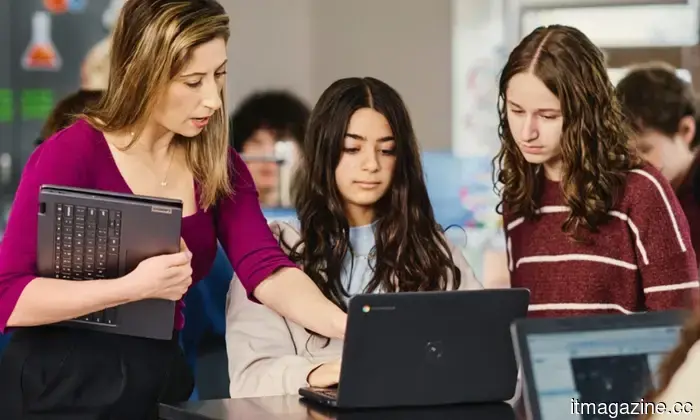
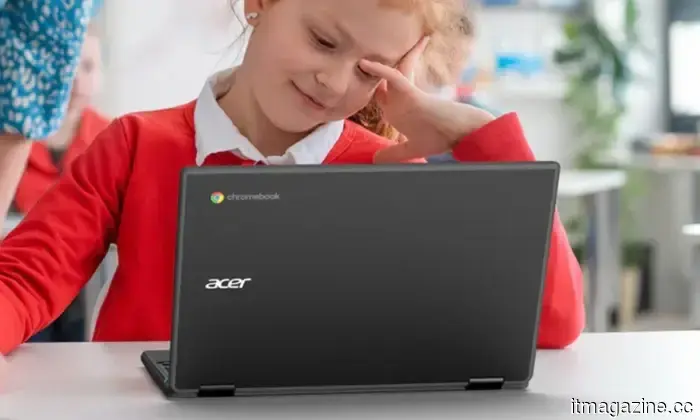
According to a recent report by The New York Times, schools have found that even after prohibiting smartphones, students were still becoming distracted, this time using their school-issued Chromebooks to watch videos, play games, or even engage in bullying through school accounts. In one instance, a middle school in Kansas went so far as to collect all student Chromebooks and restricted their usage to certain classroom activities, requiring students to return to handwritten notes for most assignments.
Why are schools reconsidering now?
For more than a decade, tech companies promoted the concept of "one laptop per student," claiming it would enhance engagement and improve educational results. However, recent studies indicate that extensive use of digital tools has not led to significant advancements in academic outcomes or graduation rates. In fact, organizations like UNESCO have cautioned that a heavy dependence on technology may distract students and impede learning, which is a reality that schools are now witnessing firsthand.
Additionally, teachers and parents are increasingly worried about screen time, attention spans, and social interactions. Many have observed that students interact less and find it more challenging to concentrate when devices are constantly present. Consequently, some schools are trying a more balanced approach by reserving Chromebooks for specific tasks such as coding or research, while reinstating paper-based learning, group discussions, and offline activities.
So… are Chromebooks being sidelined?
Not exactly, but they are certainly being encouraged to take a back seat more frequently. Schools are not completely abandoning technology; instead, they are resetting its usage, regarding Chromebooks as tools rather than constant desk companions. Ultimately, this might be the more significant takeaway. An increase in screen time hasn’t guaranteed enhanced learning, and occasionally, reverting to traditional methods may yield better results.





Other articles
 Smart glasses were already unsettling, and now they're being used to assist people in cheating.
Smart glasses powered by AI are generating new worries as reports emerge of users using them to cheat on exams, in addition to existing privacy concerns.
Smart glasses were already unsettling, and now they're being used to assist people in cheating.
Smart glasses powered by AI are generating new worries as reports emerge of users using them to cheat on exams, in addition to existing privacy concerns.
 Battery tests on the Galaxy S26 reveal that Qualcomm's chipset outperforms Samsung's own processor.
Samsung's Exynos 2600 is the first smartphone chip to be manufactured using a 2nm process, which is quite remarkable. However, it still falls short of surpassing Qualcomm's Snapdragon 8 Elite Gen 5 in terms of battery efficiency.
Battery tests on the Galaxy S26 reveal that Qualcomm's chipset outperforms Samsung's own processor.
Samsung's Exynos 2600 is the first smartphone chip to be manufactured using a 2nm process, which is quite remarkable. However, it still falls short of surpassing Qualcomm's Snapdragon 8 Elite Gen 5 in terms of battery efficiency.
 AI is becoming remarkably proficient, yet studies indicate that the notion of AI creativity is merely an illusion.
Recent studies indicate that AI can reach the level of average human creativity, but genuine originality and exceptional creativity continue to be uniquely human traits.
AI is becoming remarkably proficient, yet studies indicate that the notion of AI creativity is merely an illusion.
Recent studies indicate that AI can reach the level of average human creativity, but genuine originality and exceptional creativity continue to be uniquely human traits.
 Avatar Legends: The Fighting Game is set to be released in July, and it appears quite impressive.
Avatar Legends: The Fighting Game is set to launch on July 2, featuring a stylish 2D fighting experience with elemental battles, cross-play capabilities, and a roster of 12 characters.
Avatar Legends: The Fighting Game is set to be released in July, and it appears quite impressive.
Avatar Legends: The Fighting Game is set to launch on July 2, featuring a stylish 2D fighting experience with elemental battles, cross-play capabilities, and a roster of 12 characters.
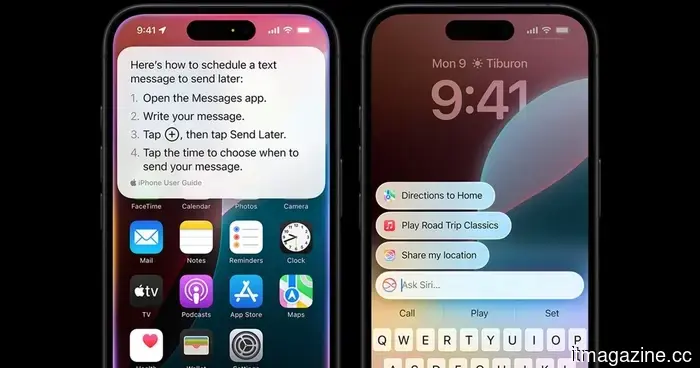 Apple may develop an AI app store for the next version of Siri.
Apple's approach to AI seems to be following a well-known path, similar to what contributed to the iPhone's success. According to a recent Bloomberg report, Apple is developing a new "Extensions" system for iOS 27 that would enable third-party AI assistants, such as Google Gemini and Anthropic’s Claude, to integrate directly with Siri. More […]
Apple may develop an AI app store for the next version of Siri.
Apple's approach to AI seems to be following a well-known path, similar to what contributed to the iPhone's success. According to a recent Bloomberg report, Apple is developing a new "Extensions" system for iOS 27 that would enable third-party AI assistants, such as Google Gemini and Anthropic’s Claude, to integrate directly with Siri. More […]
 Starcloud has secured $170 million at a valuation of $1.1 billion to develop data centers in space.
 This funding will support the startup's upcoming two satellites.
Starcloud has secured $170 million at a valuation of $1.1 billion to develop data centers in space.
Starcloud has secured $170 million at a valuation of $1.1 billion to develop data centers in space. This funding will support the startup's upcoming two satellites.
Chromebooks are losing popularity in US schools for unexpected reasons.
U.S. schools are reducing Chromebook usage because of distractions, behavioral problems, and worries that excessive technology might negatively impact learning results.