
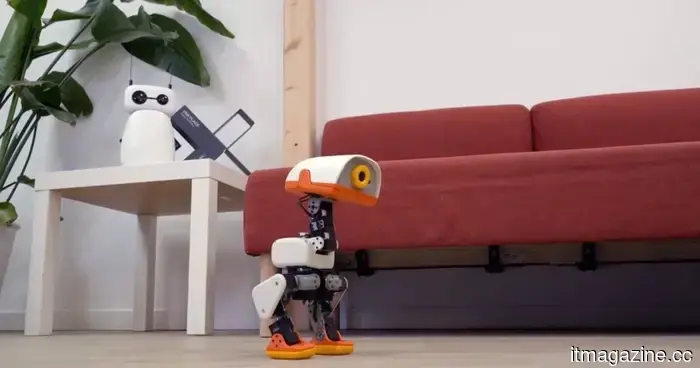
Pollen Robotics' Microduck is designed to reduce the fragility and cost of training physical AI significantly.
Microduck is a small bipedal robot priced at $399, designed for developers to explore physical AI in an affordable manner, allowing them to train and experiment with new robotic behaviors without the risk of damaging costly equipment.
Pollen Robotics, in collaboration with Hugging Face, has introduced a quirky new robot: Microduck. Standing at 25cm tall, this waddling biped brings AI off your screen and onto your work desk. Preorders start today, with initial deliveries expected before Christmas 2026.
In contrast to its predecessor, the Reachy Mini, Microduck is focused entirely on action. It operates with 15 motors and features an articulated beak for object manipulation, a camera, a depth sensor, two IMUs, and enough stability to walk, crouch, and even roller skate.
Designed to withstand falls
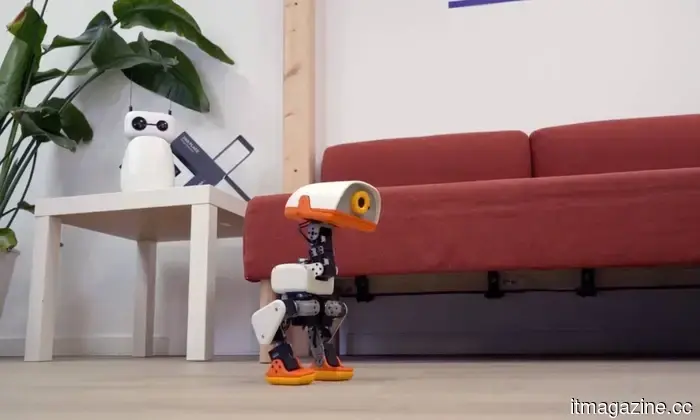
Developing movement models in the physical world usually requires expensive equipment and costly repairs when issues arise. Microduck changes that scenario. Measuring approximately 10 inches by 5.5 inches and weighing under two pounds, it is compact enough that a fall results in a soft thump instead of an expensive calamity.
Even better, it can right itself after most tumbles, so you won’t need to supervise it constantly while trying out new behaviors. Pollen Robotics mentions that the duck-like design and waddling motion were not initially planned; they naturally resulted from the robot's proportions, and the company embraced it.
Despite its toy-like look, Microduck is not specifically aimed at children. It targets developers interested in training their own physical behaviors, functioning as an accessible platform for sim-to-real machine learning.
More than just a toy for your desk
Out of the box, Microduck offers gamepad controls, laser-following capabilities, and seven pre-trained movements, with each unit generating its own sound when it powers on for the first time. While it may seem more like a desk toy than a developer kit, the underlying features are designed for developers to train their own behaviors.
Pollen Robotics has made the SDK, the robot’s software, along with its reinforcement learning and sim-to-real tools available on GitHub. The intention is to foster collaboration in physical hardware development akin to open-source software, enabling developers to share trained neural network models, training methodologies, and custom environments just as they do with language models.
Microduck comes in four colors: Cream, Graphite, Lavender, and Sky, and is now available for pre-order at $399, excluding taxes and shipping. For those eager to start training without waiting for the physical device, Pollen Robotics has also launched an interactive browser-based simulator to begin testing code immediately.
Pranob is an experienced technology journalist with over eight years in consumer technology coverage.
In other news, Gemini Omni can now extend video lengths to 40 seconds and enhance them to 4K resolution.
Creating a brief AI video is relatively straightforward; however, making several shots appear cohesive within the same video is a greater challenge. Google is addressing this with Gemini Omni 1.1 Flash, its latest generative video model designed to offer creators and developers enhanced control over the continuity of scenes.
The most significant update is Gemini’s ability to retain up to 10 seconds of preceding footage for context when asked to continue a scene, rather than relying solely on the last second. This improvement should help maintain consistency in characters, settings, and overall scene direction, rather than simply guessing the next steps.
Another important discussion is why it's essential for children to think like engineers, especially in today's AI-driven world.
One of the most valuable experiences you can provide your children is the chance to face failure. This notion may seem radical and somewhat uncomfortable, particularly as parenting often revolves around shielding children from setbacks. However, by intervening each time they encounter difficulties, we might inadvertently deprive them of the opportunities to cultivate the skills necessary for navigating an increasingly unpredictable world.
This issue has become pressing as artificial intelligence alters our perceptions of work. In a previous discussion about the future, I examined the implications of AI taking over tasks that once required extensive training. The challenge extends beyond simply forecasting which jobs might vanish; it involves understanding how to equip individuals for a job market where today's valuable skills may not hold the same importance in a decade or two.
Lastly, Claude now has the ability to remember the information you share while communicating, which can be carried over into Claude Cowork, allowing users to view, edit, or delete specific memories.
One of the most frustrating aspects of working with an AI assistant is the need to re-explain everything repeatedly. Claude is working to resolve this. Starting today, the memory utilized in chat is also accessible in Claude Cowork, meaning the context established over months of interactions can follow you when assigning tasks to Claude.
This functionality allows Claude to maintain awareness of your projects, priorities, and preferences without requiring extensive re-briefing. For instance, if you explain your team's definition of metrics in chat, Cowork can




Other articles
 Anthropic is testing a new standard for Claude to interact with factory and laboratory equipment.
Anthropic's Model Hardware Standard allows suppliers to define how an AI can control a machine. From January 2027, Europe will regulate safety functions related to AI in machinery.
Anthropic is testing a new standard for Claude to interact with factory and laboratory equipment.
Anthropic's Model Hardware Standard allows suppliers to define how an AI can control a machine. From January 2027, Europe will regulate safety functions related to AI in machinery.
 SK Hynix has started construction on a $4 billion memory packaging facility in Indiana.
SK Hynix has begun construction on a $4 billion advanced packaging facility in Indiana. Europe granted state aid for a similar plant but then forfeited it.
SK Hynix has started construction on a $4 billion memory packaging facility in Indiana.
SK Hynix has begun construction on a $4 billion advanced packaging facility in Indiana. Europe granted state aid for a similar plant but then forfeited it.
 The Importance of Developing an Engineer's Mindset in Children During the AI Era
As AI transforms the skills and careers of the future, children may require more than just technical skills. Rachele Harmuth from CrunchLabs discusses how thinking like an engineer can foster curiosity, confidence, and resilience in children.
The Importance of Developing an Engineer's Mindset in Children During the AI Era
As AI transforms the skills and careers of the future, children may require more than just technical skills. Rachele Harmuth from CrunchLabs discusses how thinking like an engineer can foster curiosity, confidence, and resilience in children.
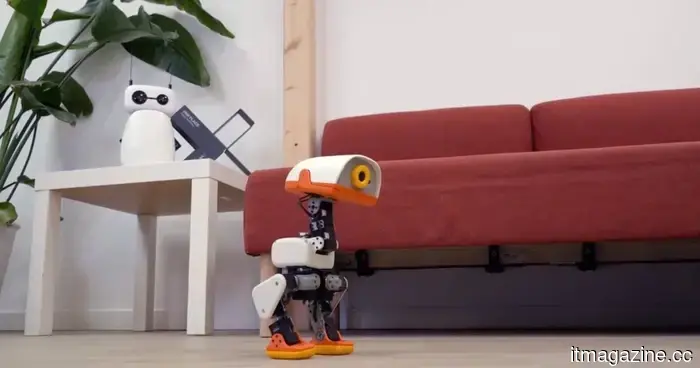 Pollen Robotics’ Microduck is designed to simplify and reduce the costs of training physical AI systems, making the process less delicate.
Pollen Robotics' Microduck is a small biped priced at $399, created to facilitate more accessible physical AI training. It allows developers to test new robotic behaviors on a durable platform that can withstand an occasional fall.
Pollen Robotics’ Microduck is designed to simplify and reduce the costs of training physical AI systems, making the process less delicate.
Pollen Robotics' Microduck is a small biped priced at $399, created to facilitate more accessible physical AI training. It allows developers to test new robotic behaviors on a durable platform that can withstand an occasional fall.
 As artificial intelligence transforms the business landscape, the role of the fractional CTO is becoming increasingly relevant.
Only 21% of businesses have developed mature AI governance, while 74% anticipate utilizing agents by 2027 (Deloitte). Daniel Kirichanski, founder of Prime Path Global, contends that fractional CTO leadership addresses the divide between AI aspirations and organizational preparedness.
As artificial intelligence transforms the business landscape, the role of the fractional CTO is becoming increasingly relevant.
Only 21% of businesses have developed mature AI governance, while 74% anticipate utilizing agents by 2027 (Deloitte). Daniel Kirichanski, founder of Prime Path Global, contends that fractional CTO leadership addresses the divide between AI aspirations and organizational preparedness.
 Switching to Metro by T-Mobile might land you a new phone along with significant savings.
Your existing phone could be due for an upgrade or may still be fully functional. A more suitable wireless plan should align with your actual requirements. Metro by T-Mobile presents various options to facilitate switching carriers without obligating you to follow the same route.
Switching to Metro by T-Mobile might land you a new phone along with significant savings.
Your existing phone could be due for an upgrade or may still be fully functional. A more suitable wireless plan should align with your actual requirements. Metro by T-Mobile presents various options to facilitate switching carriers without obligating you to follow the same route.
Pollen Robotics' Microduck is designed to reduce the fragility and cost of training physical AI significantly.
Pollen Robotics' Microduck is a small biped priced at $399, created to facilitate physical AI training. It allows developers to test new robotic behaviors on a resilient platform that can withstand occasional falls.