
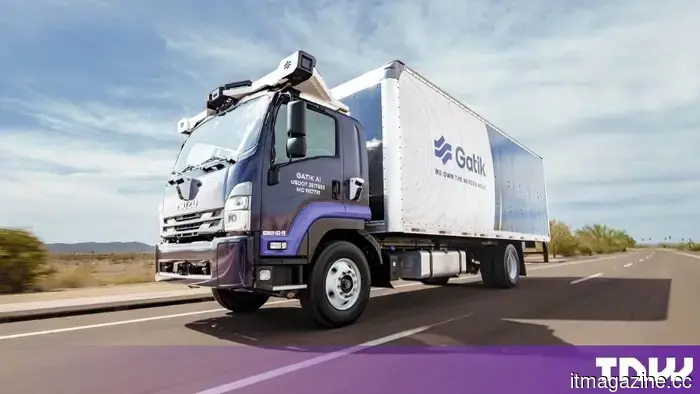
Gatik has secured $200 million to increase the number of driverless box trucks operating on roads in the United States.
Gatik has secured $200 million in a Series D funding round led by Qatar Investment Authority and Koch Disruptive Technologies, marking the largest financing in the company's history. Millennium Management, ARK Invest, and Intact Private Capital also participated, bringing Gatik’s total capital raised to approximately $500 million since it emerged from stealth mode in 2019. The company chose not to disclose its valuation.
On Tuesday, David Welch interviewed the CEO for Bloomberg, and the Santa Clara-based company announced the funding round in a press release on the same day.
According to the company, it has already secured over $600 million in contracted revenue, having completed 85,000 fully driverless deliveries with a 99% on-time performance. CEO and co-founder Gautam Narang stated to Bloomberg in January that the company had signed contracts totaling $600 million over five years, and he indicated that the backlog of orders has since increased, though he did not specify by how much or whether Gatik is currently profitable.
Gatik specializes in the middle mile logistics, transporting freight between distribution centers and retail stores without engaging in long-haul transport, robotaxi services, or sidewalk deliveries. As outlined by Kirsten Korosec at TechCrunch, Gatik originally focused on fixed routes of under ten miles but has since expanded to dynamic routes that feature numerous pick-up and drop-off locations, covering distances of up to 400 miles.
The trucks used by Gatik are manufactured by Isuzu Motors, and the company provides its own driving system called the Gatik Driver. Narang explained to TechCrunch that this third-generation fleet operates continuously on surface streets and highways, capable of functioning in light rain and snow.
Walmart was Gatik's inaugural customer, which was announced in 2019, followed by partnerships with PepsiCo, Kroger, and Tyson Foods. The deal with PepsiCo, finalized in June, is the largest publicly disclosed contract, involving 41 driverless box trucks transporting Frito-Lay products from distribution centers to stores across Dallas, Phoenix, and Northwest Arkansas, representing Gatik's most significant commercial operation to date.
Gatik also provides services for Loblaw in Ontario, where a safety driver remains in the vehicle. The trucks are operational nearly all the time, transporting ambient, refrigerated, and frozen items. As stated in the release, the company caters to Fortune 50 retail, grocery, and consumer packaged goods brands.
Gatik reports having a substantial number of driverless trucks currently in operation, with plans to scale up to thousands in the upcoming years. A spokesperson informed Reuters that the goal is to surpass 100 trucks by the end of 2026. Narang indicated to Forbes in January that the fleet size would grow from fewer than twelve trucks to hundreds by the end of this year.
The driverless routes are active in the Dallas and Fort Worth areas, Phoenix, and Northwest Arkansas. Gatik eliminated its safety drivers from commercial routes last year, enabling these operations. The press release describes these routes as high-frequency regional networks that are time-sensitive and complex in nature.
Regarding the purpose of the funding, Narang indicated that it will be used to acquire more trucks, expand the customer base, and enter additional cities. Gatik plans to recruit more engineers and operational staff in addition to its current workforce of 350, and will look to grow in new markets as well as deepen its presence in existing ones.
Narang remarked, "These are very sophisticated long-term financial investors that typically come on board when a business's viability and economic fundamentals are established." He emphasized that the focus is more on scaling the existing business rather than building a new one.
Investors expressed enthusiasm as well. Cathie Wood, head of ARK Invest, noted that the sector of autonomous freight is reaching a pivotal moment with the convergence of AI and robotics. Abdulla Al-Kuwari, overseeing industrial investments at QIA, mentioned that their fund is supporting firms that are shaping the future of freight infrastructure. Byron Knight, president of Koch Disruptive Technologies, stated that autonomy is transitioning from a promising technology phase to genuine commercial operations. Celeste Dauner from the same company added that their support of Gatik began in 2021, observing its progress in scaling around focused applications. Justin Smith-Lorenzetti of Intact Private Capital mentioned their firm's commitment has tripled with this funding, while ARK’s Tasha Keeney expressed that autonomous trucking is expected to significantly reduce freight costs.
Currently, Gatik's operations are limited to Texas, Arizona, Arkansas, and Canada, with potential markets listed as California, Michigan, Nebraska, Iowa, and Ontario. Narang mentioned that scaling means increasing the number of trucks, customers, and cities, with the possibility of future expansion outside North America. Reuters reported a surge of interest in driverless commercial freight in both North America and Europe, although no European routes have been announced, and the company has not specified which market might be next. Waymo recently
Other articles
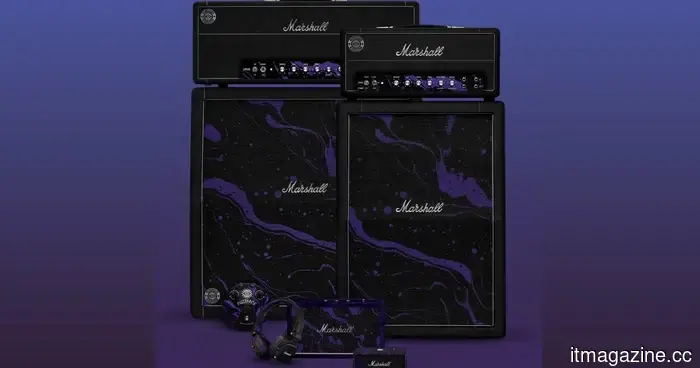 Jimi Hendrix’s Purple Haze dominates Marshall’s assortment of speakers, headphones, and amplifiers.
Marshall has broadened its Jimi Hendrix anniversary collection to include psychedelic editions of the Major V headphones, Emberton III speaker, and a $2,500 tube amplifier.
Jimi Hendrix’s Purple Haze dominates Marshall’s assortment of speakers, headphones, and amplifiers.
Marshall has broadened its Jimi Hendrix anniversary collection to include psychedelic editions of the Major V headphones, Emberton III speaker, and a $2,500 tube amplifier.
 Amazon is shutting down Mechanical Turk, the human labor service it marketed as artificial intelligence.
Amazon will shut down Mechanical Turk on September 30. A study conducted in 2023 revealed that as many as 46% of its workers were already utilizing AI to complete the tasks.
Amazon is shutting down Mechanical Turk, the human labor service it marketed as artificial intelligence.
Amazon will shut down Mechanical Turk on September 30. A study conducted in 2023 revealed that as many as 46% of its workers were already utilizing AI to complete the tasks.
 Xbox is providing a digital future for physical game discs.
For many years, the trend in gaming has appeared straightforward: digital formats are on the rise while physical copies are gradually becoming obsolete. However, Microsoft is opting for a different strategy with a new Xbox feature that may provide more flexibility for disc ownership. Xbox has revealed a new feature named “Your Discs. Now Also Digital.” that will […]
Xbox is providing a digital future for physical game discs.
For many years, the trend in gaming has appeared straightforward: digital formats are on the rise while physical copies are gradually becoming obsolete. However, Microsoft is opting for a different strategy with a new Xbox feature that may provide more flexibility for disc ownership. Xbox has revealed a new feature named “Your Discs. Now Also Digital.” that will […]
 Pennsylvania filed a lawsuit against Snap using an account it created when it was 13 years old.
Pennsylvania's lawsuit against Snap is based on a 13-year-old testimony from an investigator, which describes the Friend Solar System as a tactic for manipulation.
Pennsylvania filed a lawsuit against Snap using an account it created when it was 13 years old.
Pennsylvania's lawsuit against Snap is based on a 13-year-old testimony from an investigator, which describes the Friend Solar System as a tactic for manipulation.
 Samsung may be experimenting with large batteries for the Galaxy S27 Ultra.
According to reports, Samsung is experimenting with five prototypes of the Galaxy S27 Ultra, with battery capacities varying from 5,700mAh to as high as 6,000mAh.
Samsung may be experimenting with large batteries for the Galaxy S27 Ultra.
According to reports, Samsung is experimenting with five prototypes of the Galaxy S27 Ultra, with battery capacities varying from 5,700mAh to as high as 6,000mAh.
 Meta is withholding $5.3 billion unless TikTok and YouTube adhere to its regulations for teens.
Meta has stated that it will only release the remaining 30% of its $18 billion settlement if TikTok and YouTube implement its regulations for teenagers.
Meta is withholding $5.3 billion unless TikTok and YouTube adhere to its regulations for teens.
Meta has stated that it will only release the remaining 30% of its $18 billion settlement if TikTok and YouTube implement its regulations for teenagers.
Gatik has secured $200 million to increase the number of driverless box trucks operating on roads in the United States.
Gatik's largest funding round to date was led by the Qatar Investment Authority and Koch Disruptive Technologies, bringing the total amount raised to approximately $500 million.