
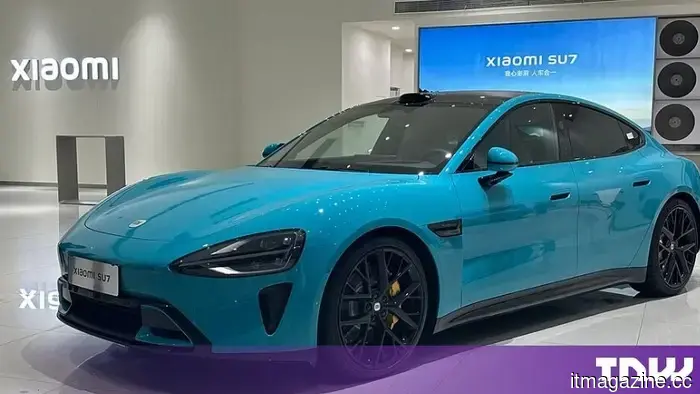
Xiaomi introduces a bespoke 3nm chip designed for smart driving.
Xiaomi has introduced the Xring D100, a proprietary 3nm chip for intelligent driving, set to replace Nvidia hardware in its vehicles starting in 2027. The company has invested over 21 billion yuan, approximately $3.1 billion, since reviving its chip initiative.
By designing out Nvidia, Xiaomi has launched the Xring D100 to enhance its intelligent driving capabilities, supplanting the Nvidia Drive systems that have powered models like the SU7 and YU7 until now.
The specifications are quite ambitious, featuring a 20-core CPU and a 16-core NPU built on a 3-nanometre process, with support for up to 160GB of unified memory, which Xiaomi claims is sufficient to run a 200-billion-parameter model directly within the vehicle.
Xiaomi is not alone in this endeavor; other Chinese companies such as BYD, Nio, and Xpeng are also developing their own silicon, and Alibaba has created its own AI chip to lessen similar dependencies.
However, one key metric is missing: Xiaomi has not disclosed a figure for trillions of operations per second, which is essential for assessing whether all that capacity translates into actual performance.
The financial commitment is significant. Xiaomi reports more than 21 billion yuan in investment, around $3.1 billion, since it restarted its chip program, and it now has a chip team of nearly 3,000 employees.
Commercial deployment will begin in 2027. The D100 will be launched alongside the O100 accelerator and the O3 mobile processor, which will first appear in a foldable phone and will be produced by TSMC using the same 3nm technology.
The vehicles represent the more impactful component of this development. Nvidia has been the driving force behind every Xiaomi electric vehicle to date, but that will change in 2027.
This shift highlights Xiaomi's move towards independence from Nvidia, rather than a reliance on Taiwan. Companies like Tesla, Rivian, and Xiaomi have all created their own driving chips, all of which are manufactured in the same location.
Europe is unable to produce this chip at all. Its primary new facility, ESMC in Dresden, is expected to handle 28 and 22-nanometre planar CMOS along with 16 and 12-nanometre FinFET processes, as outlined in TSMC's plans.
This facility is not minor; it has a cost exceeding €10 billion and has received €5 billion in approved state aid from Germany, with shared ownership by Bosch, Infineon, and NXP, three prominent firms in the automotive chip sector worldwide.
Moreover, it is several generations behind the 3nm technology. Xiaomi's electric vehicle division reported a loss of 2.6 billion yuan last quarter but continues to invest in silicon, while Europe's semiconductor industry continues to request a Chips Act 2.0.
Other articles
 Apple introduces the M6 and M5 Ultra chips, showcasing a significant increase in AI performance.
Apple has introduced its inaugural 2nm chip and its first quad-die M-series component, featuring 512GB of unified memory to support the operation of large models entirely on the device.
Apple introduces the M6 and M5 Ultra chips, showcasing a significant increase in AI performance.
Apple has introduced its inaugural 2nm chip and its first quad-die M-series component, featuring 512GB of unified memory to support the operation of large models entirely on the device.
 According to OpenAI, the Jalapeno chip surpassed the GB300 in both power and speed.
OpenAI has stated that its Jalapeno chip exceeded Nvidia's GB300 in terms of power efficiency and response speed, based on tests it performed against an older model.
According to OpenAI, the Jalapeno chip surpassed the GB300 in both power and speed.
OpenAI has stated that its Jalapeno chip exceeded Nvidia's GB300 in terms of power efficiency and response speed, based on tests it performed against an older model.
 Parents can now track their teenager's Uber ride in real time using the driver's phone.
Uber is allowing parents to monitor their teenagers' rides in real-time through the driver's phone, with no option for other passengers to opt-out and no information available regarding end-to-end encryption.
Parents can now track their teenager's Uber ride in real time using the driver's phone.
Uber is allowing parents to monitor their teenagers' rides in real-time through the driver's phone, with no option for other passengers to opt-out and no information available regarding end-to-end encryption.
 Waymo is set to arrive in Munich, with plans for commercial service aimed at late 2027.
Waymo plans to start mapping and manually driving in Munich within the next few weeks, with the goal of launching commercial autonomous ride-hailing services in Germany by the end of 2027.
Waymo is set to arrive in Munich, with plans for commercial service aimed at late 2027.
Waymo plans to start mapping and manually driving in Munich within the next few weeks, with the goal of launching commercial autonomous ride-hailing services in Germany by the end of 2027.
Xiaomi introduces a bespoke 3nm chip designed for smart driving.
Xiaomi's Xring D100 will take the place of Nvidia chips in its vehicles starting in 2027, utilizing a 3nm process that no European fabrication facility is able to manufacture at present.