
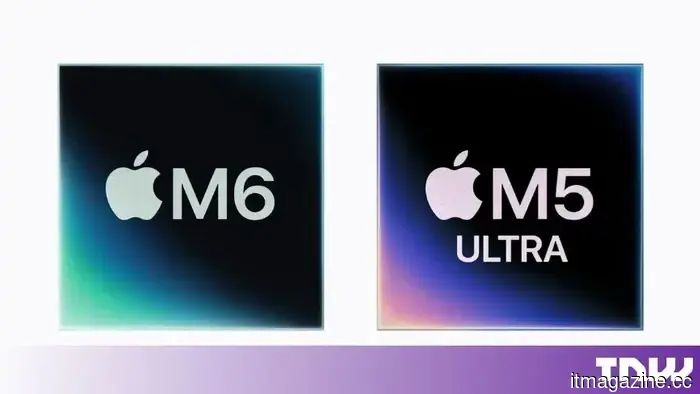
Apple introduces the M6 and M5 Ultra chips, showcasing a significant increase in AI performance.
Apple has unveiled the M6 chip in a new Mac mini and the M5 Ultra in the updated Mac Studio, marking its entry into 2nm technology and the debut of its first quad-die M-series design, respectively. The M5 Ultra allows for up to 512GB of unified memory with a bandwidth of 1.2TB/s.
The question surrounding the Mac mini has been resolved. TNW reported earlier that it was uncertain whether the device would feature an M5 or an M6 chip, and Apple clarified this by introducing the M6, its first 2-nanometer chip.
The specifications indicate an upgrade. It boasts a 12-core CPU composed of two super cores, four performance cores, and six efficiency cores, a 12-core GPU, and what Apple refers to as a Dual 16-core Neural Engine.
Apple's claims are significant, stating that the M6 offers the fastest single-threaded performance globally, around 30% greater peak GPU compute for AI compared to the M5, and up to 170GB/s memory bandwidth.
Details of the launch were highlighted in a report from June, where TNW noted that Apple would showcase a base M6 without Pro or Max versions, utilizing an M5 Ultra as an interim solution in the new Mac Studio, which has turned out to be accurate.
The Ultra model is particularly noteworthy, as it represents the first quad-die M-series component, connecting two dual-die M5 Max chips via UltraFusion at over 4.4TB/s between them.
Its specifications include 36 CPU cores and 80 GPU cores, with the capacity for 512GB of unified memory at 1.2TB/s, which Apple claims is significantly higher bandwidth than the M3 Ultra.
One key point from the announcement stands out: Apple asserts that the machine is capable of running models with hundreds of billions of parameters entirely on-device.
The memory capacity presents a challenge in a market currently facing a DRAM shortage, which has led to empty Mac shelves and rising prices across the industry.
For European consumers, the implications are more legal than technical. A locally running model ensures that prompts, documents, and customer data remain on-site.
This addresses a concern highlighted by TNW, which revolves around the political aspect of European organizations processing sensitive information on infrastructure beyond their control.
However, it is important to note that sovereignty is not the main issue, as the chip is designed by an American company and manufactured in Taiwan. Therefore, local inference is determined by the location of the data, not by the provider of the computing power.
Nonetheless, for entities like hospitals, law firms, or government agencies that are restricted from placing their files in external clouds, a desktop-sized unit capable of handling extensive models is among the most practical offerings Apple has introduced in years.
Other articles
 Xiaomi introduces a bespoke 3nm chip designed for smart driving.
Xiaomi's Xring D100 will take the place of Nvidia chips in its vehicles starting in 2027, utilizing a 3nm process that no European fabrication facility is able to manufacture at present.
Xiaomi introduces a bespoke 3nm chip designed for smart driving.
Xiaomi's Xring D100 will take the place of Nvidia chips in its vehicles starting in 2027, utilizing a 3nm process that no European fabrication facility is able to manufacture at present.
 Waymo is set to arrive in Munich, with plans for commercial service aimed at late 2027.
Waymo plans to start mapping and manually driving in Munich within the next few weeks, with the goal of launching commercial autonomous ride-hailing services in Germany by the end of 2027.
Waymo is set to arrive in Munich, with plans for commercial service aimed at late 2027.
Waymo plans to start mapping and manually driving in Munich within the next few weeks, with the goal of launching commercial autonomous ride-hailing services in Germany by the end of 2027.
 Android 17 has finally introduced the Pixel feature that my motion-sensitive self has been anticipating.
The new Motion Assist feature from Android 17 is being rolled out to Pixel 11 phones, incorporating animated screen cues aimed at alleviating the sensory mismatch that leads to motion sickness.
Android 17 has finally introduced the Pixel feature that my motion-sensitive self has been anticipating.
The new Motion Assist feature from Android 17 is being rolled out to Pixel 11 phones, incorporating animated screen cues aimed at alleviating the sensory mismatch that leads to motion sickness.
 ChatGPT Plus is once again experiencing throttling, and it seems to be for your benefit.
OpenAI is reinstating five-hour usage limits for ChatGPT Work and Codex on Plus accounts, concluding a period of about six weeks during which only weekly limits were in effect.
ChatGPT Plus is once again experiencing throttling, and it seems to be for your benefit.
OpenAI is reinstating five-hour usage limits for ChatGPT Work and Codex on Plus accounts, concluding a period of about six weeks during which only weekly limits were in effect.
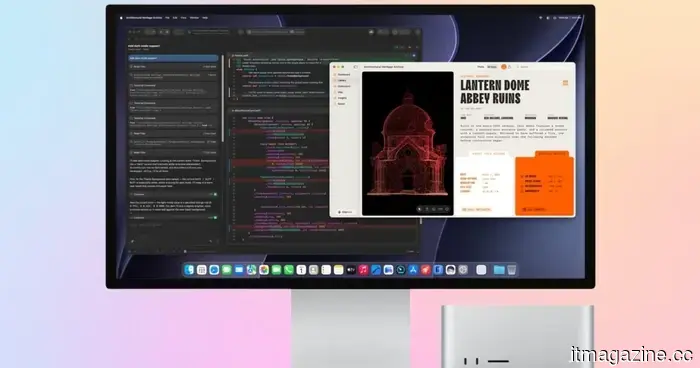 Apple's M5 Ultra Mac Studio receives a significant AI enhancement, Thunderbolt 5, and a new networking chip.
Apple's latest Mac Studio features the M5 Max and M5 Ultra chips, offers up to 512GB of RAM, and includes Wi-Fi 7. Prices start at $2,499, with shipping scheduled for September 22.
Apple's M5 Ultra Mac Studio receives a significant AI enhancement, Thunderbolt 5, and a new networking chip.
Apple's latest Mac Studio features the M5 Max and M5 Ultra chips, offers up to 512GB of RAM, and includes Wi-Fi 7. Prices start at $2,499, with shipping scheduled for September 22.
 ChatGPT Plus is experiencing throttling once more, and it's supposedly for your own benefit.
OpenAI is reinstating five-hour usage limits for ChatGPT Work and Codex on Plus accounts, concluding a period of about six weeks during which only weekly limits were in effect.
ChatGPT Plus is experiencing throttling once more, and it's supposedly for your own benefit.
OpenAI is reinstating five-hour usage limits for ChatGPT Work and Codex on Plus accounts, concluding a period of about six weeks during which only weekly limits were in effect.
Apple introduces the M6 and M5 Ultra chips, showcasing a significant increase in AI performance.
Apple has introduced its inaugural 2nm chip and its first quad-die M-series component, featuring 512GB of unified memory to support the operation of large models entirely on the device.