
Anthropic integrates Claude chat and Cowork memory, which is enabled by default.
What you communicate to Claude in a chat window is now accessible to Claude Cowork. Any knowledge Cowork acquires will reciprocate back. Anthropic integrated the two memory systems on Tuesday. Regardless of the platform you use with Claude, it starts with what it already understands about you, as announced by the company.
This feature is enabled by default for consumers on the Free, Pro, and Max plans across web, desktop, and mobile.
The second update is particularly noteworthy: Claude now incorporates topics into its memory during the conversation itself, rather than waiting until the discussion concludes to summarize it. For example, if you mention that a deadline has been moved to September, the next conversation will be aware of that without needing you to say “remember this.”
This change occurs at the point when the system captures data and eliminates the pause at the end of a conversation, which was previously when users might decide that the discussion wasn't worth retaining.
In practice, if you request Cowork to draft an update for your manager, it recognizes who that is and how she prefers her updates to be written, which is an example given by Anthropic. Likewise, if you brainstorm a conference agenda in chat, Cowork will know the headcount, city, and speakers when preparing the budget document.
Sarah Perez succinctly expressed for TechCrunch that the update makes Claude feel like a single continuous assistant rather than two separate products.
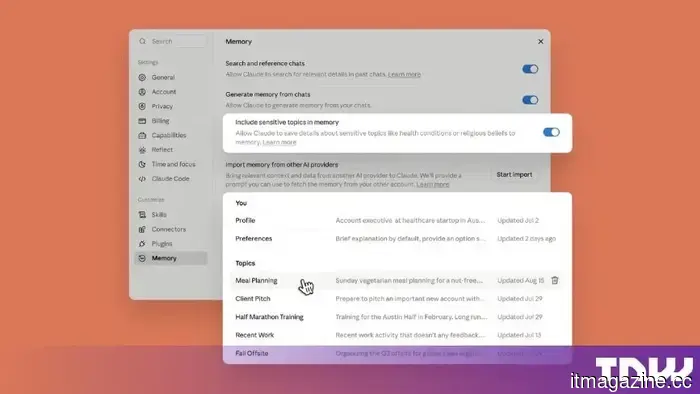
Users can view what Claude remembers, with all retained information listed as files under Topics in the memory settings. Users have the ability to read, edit, or delete each entry, and any corrections apply universally afterward.
Memory can be paused or reset at any time using two toggles: one for creating memory from chats and another for sensitive subjects.
Regarding sensitive topics, by default, Claude does not retain information related to health, race, ethnicity, religion, politics, or gender identity. The company specifies these categories and includes others that are similar. Users have the option to enable these categories, as what some may find sensitive, others may deem useful; for instance, a gluten allergy that could enhance recipe recommendations.
The sensitive-topic switch remains off unless manually activated, and it does not have retroactive effects. Each time Claude saves information in these categories, it notifies the user. David Gewirtz pointed out an important concern at ZDNET: if someone needs assistance, a warning each time these topics are discussed might not be comforting.
Certain categories remain excluded, even with the sensitive switch activated, including social security numbers, government IDs, criminal history, immigration status, and anything that violates Anthropic’s acceptable use policy. Claude informs the user when it cannot update memory concerning those restrictions.
Claude Code is not included in this update, which was not mentioned in the announcement. Gewirtz inquired and learned that this update focuses on Cowork and chat, leaving the coding tool as an isolated memory segment, indicating that the consolidation is not yet complete.
Cowork, which Anthropic launched earlier this year, has since expanded, including a move onto mobile devices in July.
Igor Bonifacic observed the timing for Engadget that a recent modification integrated Cowork into the Claude for Chrome extension, meaning conversations held in the browser's side panel now contribute to a user’s history. Browsers are sensitive when it comes to adding retention, especially since Chrome has faced criticism for silently installing features without user consent.
Bonifacic wrote that Claude has had memory capabilities since last summer, though those memories remained fragmented, a situation attributed to both design and technical structure.
Cowork is not merely a chatbot; it performs tasks, including in the cloud, and operates on a user's device. Research in July discovered that Claude Cowork could access credentials on a Mac after circumventing its local virtual machine.
This highlights why memory management differs from typical chat functions. A system capable of action and now possessing extensive user context over months is significantly more complex than either component was separately.
In terms of default settings, consumers have memory activated, whereas Team and Enterprise customers do not. Administrators determine the feature's availability for the organization, and individual users will not have it enabled until they choose to activate it.
Gewirtz reported the enterprise perspective slightly differently, noting that memory is off by default for organizations and contingent on eligibility. Regardless, this distinction is intentional, assigning the responsibility of decision-making to a compliance team rather than individual employees.
This difference is particularly impactful in Europe, where companies must document what personal data their tools retain. A European regulator recently fined Uber 825 million euros for issues related to automated decision-making, underscoring the regulatory landscape rather than commenting on this particular feature.
Memory is pivotal in differentiating assistants, as the context a system retains makes switching providers costly. A competitor, Cursor, is already developing a rival to Cowork. Both OpenAI and Anthropic have been merging separate desktop applications into unified
Other articles
 OpenAI claims that its Jalapeno AI chip provides quicker responses compared to competitors such as Nvidia.
OpenAI published benchmark results indicating that its Jalapeno chip, developed in partnership with Broadcom, provides up to 1.9 times more AI performance per watt and has a latency that is 3.6 times lower than that of Nvidia's leading chips.
OpenAI claims that its Jalapeno AI chip provides quicker responses compared to competitors such as Nvidia.
OpenAI published benchmark results indicating that its Jalapeno chip, developed in partnership with Broadcom, provides up to 1.9 times more AI performance per watt and has a latency that is 3.6 times lower than that of Nvidia's leading chips.
 OpenAI has confirmed that its head of data centers has departed as the company shifts its focus to leasing.
OpenAI has confirmed the departure of Chris Malone, its director of data centres. As reported by the WSJ, others are now taking charge of an enhanced leasing initiative.
OpenAI has confirmed that its head of data centers has departed as the company shifts its focus to leasing.
OpenAI has confirmed the departure of Chris Malone, its director of data centres. As reported by the WSJ, others are now taking charge of an enhanced leasing initiative.
 Stability AI secures $76 million in funding from Universal, Warner, Sony Music, and EA.
According to the company, Universal, Warner, and Sony Music have participated in Stability AI's $76 million Series B funding round, along with Electronic Arts and AMD Ventures.
Stability AI secures $76 million in funding from Universal, Warner, Sony Music, and EA.
According to the company, Universal, Warner, and Sony Music have participated in Stability AI's $76 million Series B funding round, along with Electronic Arts and AMD Ventures.
 Gears of War: E-Day appears to be grimmer and more ruthless than before.
Marcus Fenix has encountered some frightening adversaries, but E-Day seems poised to complicate his life once more.
Gears of War: E-Day appears to be grimmer and more ruthless than before.
Marcus Fenix has encountered some frightening adversaries, but E-Day seems poised to complicate his life once more.
 The jury was informed that Meta declined to activate a teen safety feature by default.
A former data scientist from Meta informed an Oakland jury that a suggestion to set Instagram's break reminder as the default option was dismissed due to essential metrics.
The jury was informed that Meta declined to activate a teen safety feature by default.
A former data scientist from Meta informed an Oakland jury that a suggestion to set Instagram's break reminder as the default option was dismissed due to essential metrics.
 Apple raised the prices of Macs, but the new Polishing Cloth will help you save a nice $10.
Apple has reduced the price of its widely recognized polishing cloth to $9, despite the fact that the new Mac mini and Mac Studio have seen a significant price increase. How does this add up?
Apple raised the prices of Macs, but the new Polishing Cloth will help you save a nice $10.
Apple has reduced the price of its widely recognized polishing cloth to $9, despite the fact that the new Mac mini and Mac Studio have seen a significant price increase. How does this add up?
Anthropic integrates Claude chat and Cowork memory, which is enabled by default.
Anthropic has integrated Claude chat with Cowork memory. The company states that this feature is enabled by default, while discussions on sensitive topics require opting in.