
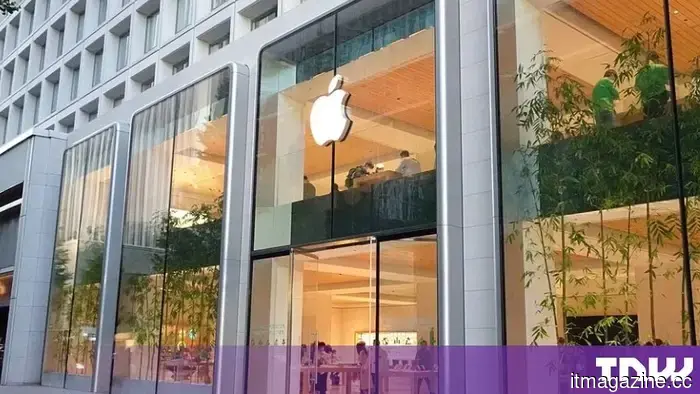
Apple contributed 40% of its worldwide tax liability to a single nation.
Apple paid Ireland $17.1 billion in taxes during the last financial year, which accounts for about 40% of its total corporate income tax payments worldwide. This information was derived from a company filing that details Apple's taxes broken down by country, as reported by Reuters from Dublin. In the year ending September 2025, Apple paid a total of $43.2 billion in income taxes globally.
For eight years, Ireland tried not to accept the majority of this amount, contesting the bill in court alongside Apple.
Reasons for the high amount
Apple has stated that the tax figure for Ireland is "significantly higher" than the income taxes it earned there. This discrepancy arises from a court mandate. The payment includes €13 billion in back taxes that the European Union's highest court instructed Apple to pay to Ireland in 2024. Excluding that amount, the remaining total reflects an ordinary tax year. The 40% figure is a singular outcome of a long-standing legal case finally reaching its conclusion.
Apple did not disclose what the Irish amount would have been without the court order, nor did the filing differentiate between the two figures.
Why this is transparent
Apple has not previously provided a country-specific tax breakdown. New EU regulations now require large companies to disclose their financials per country, as noted by MacRumors, which led to this revelation. The Financial Times was the first to report on these filings.
The regulations are as significant as the figures themselves; a number that used to rely on estimates is now officially documented.
Ireland's efforts to avoid the payment
Margrethe Vestager, the European Commission's competition chief at the time, accused Ireland in 2016 of giving Apple illegal tax advantages and unfairly attracting investment away from other countries. Ireland battled alongside Apple over the bill for eight years, as reported by Reuters, aiming to uphold its status as a preferred location for American multinationals in Europe, along with the taxes they contribute. The ruling determined that Ireland provided Apple with unlawful aid, resulting in a tax rate of less than 1%, according to AppleInsider. This arrangement allowed Apple's Irish subsidiaries to attribute most profits to head offices that had no tax residency.
Tax experts referred to this structure as the "Double Irish." Although Ireland eliminated it years ago, the resulting liabilities persisted in the courts.
Progression of the case
The Commission initiated its investigation in 2013 and 2014, scrutinizing Irish tax decisions made in 1991 and 2007. In August 2016, it concluded that Apple received illegal state aid and mandated repayment of approximately €13.1 billion plus interest. Ireland placed the complete amount in an escrow account in 2018 while awaiting the outcome of appeals, as neither party wanted the funds to be disbursed.
In July 2020, the EU General Court annulled the Commission's ruling. However, the European Court of Justice overturned this annulment in September 2024 and sided with the Commission. Ireland announced in 2025 that it received nearly €14.25 billion when the escrow account concluded seven years later, with interest accounting for the difference from the original amount.
A different 40%
TNW reported in June on a similar percentage from Ireland's fiscal watchdog, which refers to different metrics. The Irish Fiscal Advisory Council cautioned that just two companies, believed to be Apple and Microsoft, contributed nearly 40% of all corporate taxes collected in Ireland in 2024, roughly amounting to €11 billion. Another firm, thought to be Eli Lilly, increased this share to 46%.
Thus, one 40% reflects Apple's liability to Ireland, while the other illustrates Ireland's reliance on Apple and one other corporation.
Ireland is home to hubs for sixteen of the world's twenty largest technology firms and employs over 100,000 individuals in the sector. The fiscal council has repeatedly warned that such a concentrated corporate tax base poses a risk to the country's finances.
Apple's stance
Apple has consistently maintained that it paid what it owed and adhered to both Irish and international law, never accepting the Commission's portrayal of the arrangement. The company also stated that most of its profits were taxed in the United States upon repatriation and employs over 5,000 people in Ireland.
Comparison the filing suggests
Country-by-country reporting makes these figures verifiable, given the technology sector's diverse tax records. TNW recently reported that Palantir, which holds £670 million worth of contracts in the UK, paid only £2 million in UK corporation tax in 2024.
Apple's other interactions with Brussels have not fared as well. It lost a court challenge regarding gatekeeper status under the Digital Markets Act in July and revised its EU App Store fees this month to resolve a separate DMA dispute. Meanwhile, Ireland continues to promote itself as a low-tax destination, attracting new companies like OpenAI, which added 250 jobs in Dublin last month.
Unresolved aspects of the filing
Other articles
 Micron is investing $10 billion in a laboratory, wagering that the memory cycle has shifted.
Micron is investing $10 billion into a research facility in Boise over the next ten years. According to its CEO, AI has altered the value of memory. The company's shares dropped by 29% in July.
Micron is investing $10 billion in a laboratory, wagering that the memory cycle has shifted.
Micron is investing $10 billion into a research facility in Boise over the next ten years. According to its CEO, AI has altered the value of memory. The company's shares dropped by 29% in July.
 Research indicates that animated warnings can assist distracted drivers in more consistently identifying hazards.
A recent study indicates that a small animated figure that gestures towards potential dangers could assist distracted drivers in noticing hazards they might overlook.
Research indicates that animated warnings can assist distracted drivers in more consistently identifying hazards.
A recent study indicates that a small animated figure that gestures towards potential dangers could assist distracted drivers in noticing hazards they might overlook.
 Meta pays Microsoft several hundred million dollars annually to lease AI models.
According to Bloomberg, Meta invests several hundred million dollars annually on renting AI models from Microsoft's Azure. Both companies have refrained from commenting on the matter.
Meta pays Microsoft several hundred million dollars annually to lease AI models.
According to Bloomberg, Meta invests several hundred million dollars annually on renting AI models from Microsoft's Azure. Both companies have refrained from commenting on the matter.
 Anthropic's business initiative has acquired its second consulting firm in a span of four months.
Ode, the $1.5 billion venture created by Anthropic in partnership with Blackstone, has acquired Casper Studios. This marks its second consultancy purchase since May, though the financial details were not disclosed.
Anthropic's business initiative has acquired its second consulting firm in a span of four months.
Ode, the $1.5 billion venture created by Anthropic in partnership with Blackstone, has acquired Casper Studios. This marks its second consultancy purchase since May, though the financial details were not disclosed.
 Meta pays Microsoft several hundred million dollars annually to lease AI models.
According to Bloomberg, Meta invests hundreds of millions annually in renting AI models via Microsoft's Azure. Both companies have refrained from making any comments.
Meta pays Microsoft several hundred million dollars annually to lease AI models.
According to Bloomberg, Meta invests hundreds of millions annually in renting AI models via Microsoft's Azure. Both companies have refrained from making any comments.
 Astromech secured $20 million at a valuation of $3.8 billion to predict how biology fails.
Ben Lamm and George Church secured $20 million at a valuation of $3.8 billion for Astromech, an AI system that analyzes 3.8 billion years of evolutionary data to forecast potential failures in biology.
Astromech secured $20 million at a valuation of $3.8 billion to predict how biology fails.
Ben Lamm and George Church secured $20 million at a valuation of $3.8 billion for Astromech, an AI system that analyzes 3.8 billion years of evolutionary data to forecast potential failures in biology.
Apple contributed 40% of its worldwide tax liability to a single nation.
Last year, Apple paid Ireland $17.1 billion, which constitutes approximately 40% of its global tax obligations. The majority of this amount is due to the back taxes that Ireland resisted collecting for eight years.