
AI does not have to take the place of humans to diminish human ability.
TL;DRAI enhances productivity (25% reduction in email time, 26% increase in completed tasks), yet MIT EEG studies indicate that writers using LLM assistance exhibited lower brain engagement and performed poorly when the tool was no longer available. Dr. Vishal Kapoor refers to this phenomenon as cognitive erosion, advocating for an “AI-fed, human-led” approach: think carefully before prompting, and do not delegate the initial question or final decision. He suggests that AI implementation should be limited based on task type, particularly in educational and original research contexts.
Artificial intelligence is rapidly becoming one of the most effective means of eliminating friction in knowledge work. A 2025 field experiment called Shifting Work Patterns with Generative AI surveyed 6,000 workers and found that access to generative AI led to a decrease in email time, with some users reducing their weekly email hours by 25%. Another study, The Effects of Generative AI on High-Skilled Work, which included 4,867 software developers, discovered that AI support resulted in a 26.08% increase in task completion.
Productivity has emerged as the clearest metric in discussions about AI due to its visibility and instant appeal to businesses, whereas cognitive capacity is more difficult to quantify. A quicker document indicates how fast a task was completed, but it does not show whether the individual who produced it has weakened their ability to formulate an argument independently.
Researchers at MIT's Media Lab noted similar findings using EEG monitors on subjects writing essays with and without a chatbot's assistance. Those who engaged with an LLM created drafts more quickly but displayed significantly lower brain engagement, and once the tool was withdrawn, they performed worse than their peers who worked unaided.
The researchers coined the term cognitive debt to describe this slowly accumulating deficit that only becomes evident once the support is removed.
Cognitive offloading—the transfer of a mental task to an external tool—is not a new concept; tools like calculators and search engines have performed similar functions. What sets generative AI apart, according to researchers, is that it does not merely retrieve data or perform calculations but rather processes information on behalf of the user, delivering conclusions rather than providing raw material for the individual to analyze. Over time, this reliance may lead to a workflow skilled in prompting yet underdeveloped in reasoning, memory, imagination, and judgment, which prompting was originally intended to enhance.
Dr. Vishal Kapoor, a researcher and strategist at leading multinational banks, posits that the productivity discussion must also consider the mental state of the human worker. He is concerned about cognitive erosion stemming from excessive dependence on AI, a risk that remains challenging to measure despite increasing evidence surrounding cognitive offloading.
"It’s crucial that we discuss this now," Dr. Kapoor asserts. "We are utilizing AI extensively without any consideration for cognitive erosion."
Dr. Kapoor is not advocating for a retreat from AI. He uses it extensively and has developed a philosophy he describes as "AI-fed, human-led," prioritizing human reasoning in the process while leveraging AI to enhance productivity. His own experiences underscored this concern; after relying on AI for reasoning, he observed a decline in his cognitive performance on a brain training tool, measuring a drop of approximately 40 to 50 points on a 1,000-point scale.
He interprets this observation as a cautionary signal regarding the dangers of routinely outsourcing reasoning.
"When AI becomes central to the process, reasoning tends to be the first casualty," Dr. Kapoor notes. He also emphasizes memory and imagination as faculties that may suffer as individuals increasingly depend on machines for information retrieval and possibility generation.
The discipline he suggests is one he fears is fading: think before prompting. Dr. Kapoor illustrates this with an example in research. A passive user might simply ask AI to look up information about a country and await the response. In contrast, a human-led approach involves coming to the query with insights, a hypothesis, and a specific gap, then utilizing AI to explore the missing evidence and critically assess the reasoning. "Do not outsource the first question or the final decision," he insists.
Dr. Kapoor believes this method is vital within organizations, as AI can magnify flawed judgment just as effectively as sound judgment. A workforce trained to utilize AI without retaining independent reasoning could achieve high productivity while losing the skills necessary to scrutinize an output, identify a flawed assumption, or make decisions under uncertain conditions.
He asserts that policy plays a crucial role in avoiding the structural establishment of such trade-offs. AI adoption, he argues, should be categorized based on the nature of the task, with particular caution in education and original research. "The goal of education is to nurture the human mind. If the human brain is not developed as part of that learning, then what is the point of that education?" he questions.
His argument places accountability at the heart of AI governance. While machines can process information remarkably quickly, humans bring responsibility, values, discernment, and philosophies to decision-making. These attributes are

Other articles
 The upcoming Beats headphones from Apple have surfaced in leaks, and I have an indication of which product they are associated with.
The Beats 360 headphones have been fully unveiled on various retail websites, revealing pricing, six new color options, and specification details.
The upcoming Beats headphones from Apple have surfaced in leaks, and I have an indication of which product they are associated with.
The Beats 360 headphones have been fully unveiled on various retail websites, revealing pricing, six new color options, and specification details.
 For the first time, New York has surpassed San Francisco in the number of tech workers.
According to CBRE's 2026 report, New York surpassed the Bay Area in tech employment, largely due to San Francisco losing 23,900 jobs. Nonetheless, it remains at the top of the rankings.
For the first time, New York has surpassed San Francisco in the number of tech workers.
According to CBRE's 2026 report, New York surpassed the Bay Area in tech employment, largely due to San Francisco losing 23,900 jobs. Nonetheless, it remains at the top of the rankings.
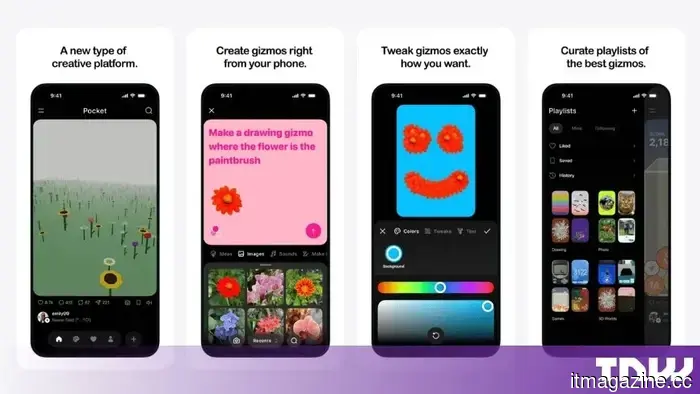 Meta introduced Pocket in the United States, and the app from which it originated ceased operations on the same day.
Meta's Pocket app has launched nationwide in the US. It was developed by the Gizmo team that Meta brought on board in March, and the original Gizmo app was discontinued on the same day.
Meta introduced Pocket in the United States, and the app from which it originated ceased operations on the same day.
Meta's Pocket app has launched nationwide in the US. It was developed by the Gizmo team that Meta brought on board in March, and the original Gizmo app was discontinued on the same day.
 Apple Music will categorize AI-generated songs, and the associated tags are now required.
Apple Music will require its AI Transparency Tags and plans to display Made With AI labels later this year. However, it hasn't specified how it will enforce these requirements.
Apple Music will categorize AI-generated songs, and the associated tags are now required.
Apple Music will require its AI Transparency Tags and plans to display Made With AI labels later this year. However, it hasn't specified how it will enforce these requirements.
 Patreon acknowledges that the issue of discoverability for smaller creators is a result of its own shortcomings.
Patreon's discovery network has favored larger creators. Jack Conte acknowledges that this is a flaw on Patreon's part, and indicates that the algorithm will now assess posts rather than creators.
Patreon acknowledges that the issue of discoverability for smaller creators is a result of its own shortcomings.
Patreon's discovery network has favored larger creators. Jack Conte acknowledges that this is a flaw on Patreon's part, and indicates that the algorithm will now assess posts rather than creators.
 Walmart has started accepting tap-to-pay after previously declining to do so for eleven years.
Walmart will begin accepting tap-to-pay transactions on August 24, eleven years after discontinuing support for Apple Pay. The announcement does not specifically mention Apple Pay or Google Pay.
Walmart has started accepting tap-to-pay after previously declining to do so for eleven years.
Walmart will begin accepting tap-to-pay transactions on August 24, eleven years after discontinuing support for Apple Pay. The announcement does not specifically mention Apple Pay or Google Pay.
AI does not have to take the place of humans to diminish human ability.
Researchers at MIT discovered that writers aided by large language models demonstrated reduced brain engagement and performed more poorly after the tool was taken away. Dr. Vishal Kapoor suggests that organizations should evaluate not only what AI automates but also whether their employees are still capable of reasoning independently without it.