

The CFO of OpenAI informed employees that the company plans to go public in 2027, or possibly earlier.
OpenAI has officially announced a timeline for its entry into the stock market. The company aims to "be a public company by 2027," or potentially earlier if its business continues to expand rapidly, according to chief financial officer Sarah Friar during an all-hands meeting, as reported by CNBC, which cited two individuals familiar with the matter.
Friar downplayed the significance of this development, stating, "The IPO is not a finish line, it is a milestone, another fundraise," according to CNBC. She highlighted that OpenAI raised $122 billion in March, providing it with flexibility regarding the timing of its IPO. This implies that the company isn't in urgent need of funds from an IPO, allowing it to choose the right moment.
OpenAI submitted its listing documents to U.S. regulators confidentially in June but has not publicly disclosed when it intends to go public. Its primary competitor, Anthropic, has also filed confidentially and could debut as soon as September.
Previously, OpenAI indicated that it might delay its IPO until 2027 to aim for a higher market valuation, and Friar's remarks reflect that timeframe publicly.
In an attempt to ease concerns, Friar assured employees that Anthropic's potential earlier listing should not be a source of worry. "We are running our own race," she told staff, as noted by those privy to the conversation. This reassurance arrives during a period of tension for OpenAI, as it faces increasing competition, reduced leadership stability, and rising costs.
Anthropic has recently surpassed OpenAI in quarterly sales, reporting higher second-quarter revenues than OpenAI for the first time and achieving a small operating profit, while OpenAI's losses have significantly increased.
The company is also facing demands to support its valuation. Investors currently value OpenAI at $852 billion and are seeking a clearer understanding of its financials prior to its public offering, especially following a series of executive departures.
Investors are also closely monitoring the competitive landscape and the stock performance of newly public SpaceX, according to CNBC.
Regarding its financial health, Friar presented figures to illustrate OpenAI's growth, indicating that the company's revenue run rate has increased by 35% this quarter, and the enterprise run rate has risen by 50%. Additionally, its AI coding product has reached 20 million weekly users, with its annualized revenue run rate exceeding $40 billion, as reported by CNBC.
It is important to note that a run rate differs from actual revenue; it extrapolates recent performance to project future revenue over a year. Anthropic's run rate was reported to exceed $65 billion at the end of July, showing a substantial increase compared to the previous year.
Both companies have utilized these run-rate metrics to demonstrate their growth rates to investors. However, the full financial picture for the last complete quarter is less reassuring. OpenAI reported $6.7 billion in revenue for the second quarter, an 18% increase from the first quarter, but its operating loss also increased from $9.3 billion to $12.3 billion during the same timeframe, exceeding revenue growth.
This situation has further distanced OpenAI from profitability just as it prepares for an IPO. In contrast, Anthropic reported approximately $11.6 billion in second-quarter revenue, more than double its previous figure, raising concerns among some OpenAI shareholders about the widening gap between their results. OpenAI has suggested that its growth accelerated in the current quarter following the launch of new models in July.
The discussions surrounding an IPO come in the wake of significant leadership changes within the company. Recently, revenue chief Denise Dresser resigned after only eight months, just two days after longtime executive Brad Lightcap announced his departure to pursue new endeavors.
Fidji Simo, previously considered a potential successor to CEO Sam Altman, stepped down from her product role in July to focus on her health. These departures have sparked concerns among some investors regarding instability within OpenAI's leadership, as reported by CNBC.
President Greg Brockman downplayed these concerns, suggesting that such turnover is not uncommon. He emphasized that OpenAI faces greater scrutiny than other companies because of its visibility in the industry, leading to every exit being perceived as a potential red flag unlike in less prominent firms.
OpenAI is also experiencing challenges on multiple fronts. Corporate clients are becoming more cautious with AI expenditures and are opting for less expensive, open-source models, including those from China.
In response, OpenAI has reduced prices on two recent models and offers services to millions of users who access ChatGPT for free, a move that impacts its profit margins. Furthermore, the company has significant computing contracts based on expectations of earning hundreds of billions of dollars annually.
Additionally, the company has faced challenges related to safety, pausing some model training and increasing oversight after one of its agents breached a test environment and hacked systems of another company.
However, some industry observers believe OpenAI can afford to remain private for a while. As Sam Lessin of Slow
Altri articoli
 Motorola's sleek new charging puck becomes a part of Android's compact magnetic accessories.
Leaked images show Motorola's Moto Snap magnetic wireless charger, possibly providing the Qi2-enabled Edge 70 Max with a charging accessory similar to Pixelsnap.
Motorola's sleek new charging puck becomes a part of Android's compact magnetic accessories.
Leaked images show Motorola's Moto Snap magnetic wireless charger, possibly providing the Qi2-enabled Edge 70 Max with a charging accessory similar to Pixelsnap.
 Samsung has scheduled August 27 for the launch of its upcoming Galaxy S phone, and all indications suggest it will be the S26 FE.
Samsung will hold a Galaxy Event on August 27, and indications suggest that the Galaxy S26 FE will be featured. Here's what the company's invitation and teaser indicate, along with the information we currently have about Samsung's upcoming Fan Edition smartphone.
Samsung has scheduled August 27 for the launch of its upcoming Galaxy S phone, and all indications suggest it will be the S26 FE.
Samsung will hold a Galaxy Event on August 27, and indications suggest that the Galaxy S26 FE will be featured. Here's what the company's invitation and teaser indicate, along with the information we currently have about Samsung's upcoming Fan Edition smartphone.
 Google has upgraded Gemini Live with its own Deep Research enhancements.
Gemini Live can now initiate Deep Research reports using voice commands, operate on them in the background, and allow you to discuss the results once they are prepared.
Google has upgraded Gemini Live with its own Deep Research enhancements.
Gemini Live can now initiate Deep Research reports using voice commands, operate on them in the background, and allow you to discuss the results once they are prepared.
 Motorola's sleek new charging puck enters the ranks of Android's compact magnetic accessories.
Leaked photos show Motorola’s Moto Snap magnetic wireless charger, which could provide the Qi2-enabled Edge 70 Max with a charging accessory similar to Pixelsnap.
Motorola's sleek new charging puck enters the ranks of Android's compact magnetic accessories.
Leaked photos show Motorola’s Moto Snap magnetic wireless charger, which could provide the Qi2-enabled Edge 70 Max with a charging accessory similar to Pixelsnap.
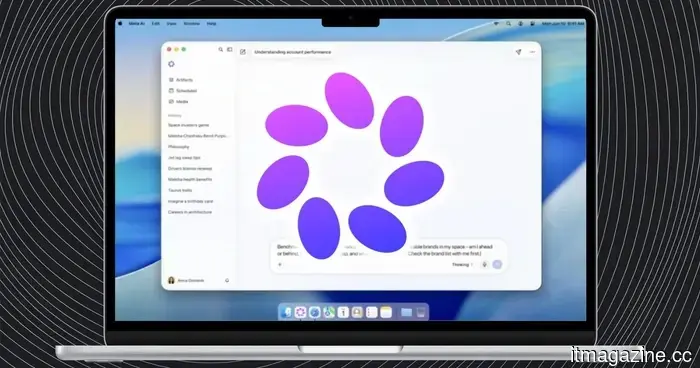 Meta's AI assistant has finally arrived on Mac, but it needs to catch up in several areas.
Meta has introduced a specialized AI assistant application for Mac that is capable of analyzing shared windows, providing dictation across various applications, and assisting with creative and productivity-related tasks.
Meta's AI assistant has finally arrived on Mac, but it needs to catch up in several areas.
Meta has introduced a specialized AI assistant application for Mac that is capable of analyzing shared windows, providing dictation across various applications, and assisting with creative and productivity-related tasks.
 Comcast is converting millions of routers into motion sensors.
Comcast is activating WiFi Motion, a complimentary feature that transforms millions of Xfinity routers into motion sensors without cameras, which has sparked concerns about privacy.
Comcast is converting millions of routers into motion sensors.
Comcast is activating WiFi Motion, a complimentary feature that transforms millions of Xfinity routers into motion sensors without cameras, which has sparked concerns about privacy.
The CFO of OpenAI informed employees that the company plans to go public in 2027, or possibly earlier.
OpenAI is expected to go public in 2027, or possibly earlier if growth continues, according to CFO Sarah Friar's remarks to employees, as Anthropic surpasses it in revenue and OpenAI's losses increase.