
Slack introduces Slack Code, a platform for teams and AI agents to collaborate.
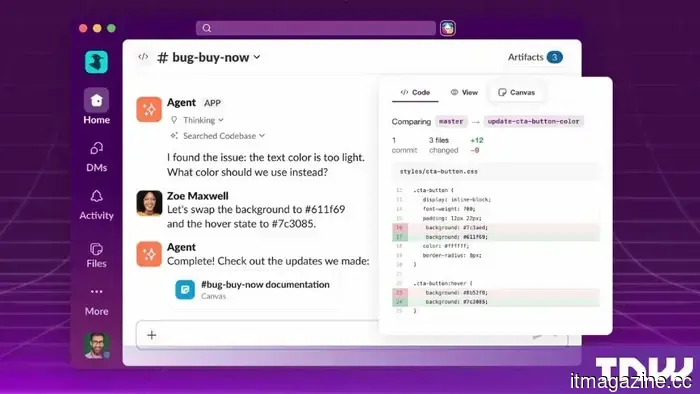
On Thursday, Slack introduced a coding product called Slack Code, which features project-specific channels designed for teams and AI agents to collaboratively write, review, and deliver software. This activity takes place within the chat application itself, eliminating the need for a separate browser tab.
The mechanism is straightforward: by tagging a coding agent in any conversation, a dedicated code channel is created. Everyone in that channel can track the progress through various tabs: one for the conversation, another for the plan, a third for the code diffs, and a final tab for live output previews. Once tasks are completed, the channel archives itself while maintaining a record as an audit log.
According to Slack's announcement, users can "audit code diffs, preview the agent's output in real time, provide feedback, and approve work before it's finalized." The diff view remains consistent, showing old lines crossed out with new lines adjacent. The difference is that the entire channel can see the changes, instead of just one reviewer in a separate tool.
Slack Code is now accessible on any Slack plan, as reported by Jess Weatherbed of The Verge. Access to each partner agent requires a separate purchase, which is where the revenue potential lies.
Marc Benioff mentioned this development back in May. This isn't a surprise delivery; TNW reported in May that Salesforce anticipated spending $300 million on Anthropic tokens this year, and that Benioff was interested in integrating coding within Slack. Now, three months later, it's here.
A demo video was shared by Benioff on X on Wednesday evening, as noted by Gizmodo’s Webb Wright. Salesforce acquired Slack in 2020 and has dedicated this year to transforming the app into the front end for its agent strategy, beginning with Slackbot in the spring.
ChatGPT is now among the founding partners, alongside Claude. The list of partners shows that Slack Code launches with agents from Anthropic, Cognition, GitHub, Vercel, and OpenAI. However, this partnership has a complicated past, as some Salesforce staff were already perplexed by the company promoting Anthropic within Slack while Agentforce seeks the same budgets. Salesforce's response has been to invite more external agents rather than reduce them.
Anthropic rolled out Claude Tag within Slack in June, and its product lead described today's launch as a natural progression. Cat Wu, head of Claude product at Anthropic, stated, “So much engineering work already starts as a conversation in Slack with Claude Tag. Slack Code gives teams a dedicated channel where the people, the context, and Claude work together from the start.”
GitHub framed this as a division of tasks, with Mario Rodriguez, the chief product officer, saying, “Humans set direction, agents close the loop.”
High-risk activities require human approval. Before any code is merged into production, the agent prepares its work for an expert to approve within the channel. Company spokesperson Gianna Dimick told Gizmodo that “Slack Code also requires human sign-off on high-stakes actions like merging code to production.” These processes are governed by Slack’s existing enterprise security framework.
This safeguard exists for a reason, as coding agents have previously caused codebases to be wiped during live sessions, with Gizmodo highlighting two such occurrences. Agents operating in code channels follow Slack’s permissions and admin controls, ensuring no new identities need to be provisioned by IT.
Anyone in a channel has the ability to pause, redirect, or halt an agent's task mid-process. A new Agents tab displays all agents and sessions across the app, flagging blocked threads and providing a kill switch.
Slack promotes its reach alongside speed. Its example starts with a product manager identifying a bug report, tagging an agent to review and merge a fix without an engineer initially needing to intervene. Katie Steigman, Slack’s vice president of product, stated in the demo video, “In the Code channel, the whole team and the agent work together on the build. Nobody’s out of the loop; nobody needs an extra meeting.”
Rob Seaman, executive vice president and general manager of Slack, articulated the value proposition: “AI only creates value when it’s part of how a team actually works, not something people go do alone in another tab.”
Software engineering is just the beginning; Slack asserts that the APIs for code channels will be available to the broader developer community, allowing for custom agents to join channels for marketing initiatives or legal document reviews.
A separate “Add to Slack” feature allows teams to easily integrate agents built on platforms like Lovable, n8n, LangChain, Superhuman, and others with just a few clicks. Slack has streamlined the OAuth process and the manifest setup required for this.
The workspace is becoming increasingly crowded. Slack faces competition in offering agents as colleagues, with Block launching Buzz in July, a workspace designed for collaboration between humans and AI agents, while Viktor secured $75 million from Accel in May to develop an AI coworker for Slack and Teams.
Other articles
 Octopus Charge consolidates 210,000 US charging stations into a single app, excluding Tesla, Ionna, and Electrify America.
Octopus Energy has introduced Octopus Charge in North America, featuring 210,000 chargers. In Europe, the service boasts 1.5 million chargers, which is attributed to regulatory requirements.
Octopus Charge consolidates 210,000 US charging stations into a single app, excluding Tesla, Ionna, and Electrify America.
Octopus Energy has introduced Octopus Charge in North America, featuring 210,000 chargers. In Europe, the service boasts 1.5 million chargers, which is attributed to regulatory requirements.
 Waymo developed its own chip for robotaxis and released its list of suppliers.
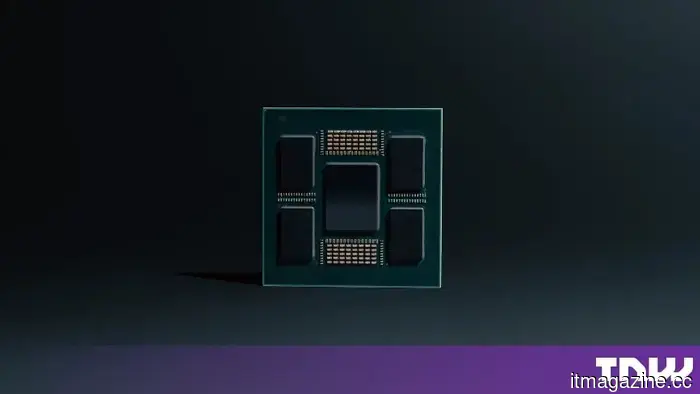
Waymo released details about its robotaxi computing architecture, which includes a custom 5nm chip and its seven suppliers. Nvidia and AMD remain included in the list.
Waymo developed its own chip for robotaxis and released its list of suppliers.
Waymo released details about its robotaxi computing architecture, which includes a custom 5nm chip and its seven suppliers. Nvidia and AMD remain included in the list.
 Two senators have set a deadline of 1 September for TikTok to clarify its safety evaluation.
Two senators set a deadline of 1 September for TikTok to respond to 13 inquiries regarding the safety experiment conducted on 15 million users in the United States.
Two senators have set a deadline of 1 September for TikTok to clarify its safety evaluation.
Two senators set a deadline of 1 September for TikTok to respond to 13 inquiries regarding the safety experiment conducted on 15 million users in the United States.
 Baidu's Apollo Go has launched on Uber in Dubai, and operates without a safety driver.
Uber introduced Baidu's Apollo Go in Dubai without a safety driver, just one day following the launch of its first European autonomous vehicle rides in Zagreb, where a safety driver was present.
Baidu's Apollo Go has launched on Uber in Dubai, and operates without a safety driver.
Uber introduced Baidu's Apollo Go in Dubai without a safety driver, just one day following the launch of its first European autonomous vehicle rides in Zagreb, where a safety driver was present.
 Cinemas, educational institutions, and ICE are all prohibiting Meta smart glasses.
Cinemas, US educational institutions, and ICE are all imposing limitations on Meta smart glasses, each for reasons that are unrelated. The regulation in cinemas goes back to 2014.
Cinemas, educational institutions, and ICE are all prohibiting Meta smart glasses.
Cinemas, US educational institutions, and ICE are all imposing limitations on Meta smart glasses, each for reasons that are unrelated. The regulation in cinemas goes back to 2014.
 Alibaba's profit dropped by 75% as its quarterly expenditures on AI reached $10 billion.
Alibaba's expenditure on AI reached $9.98 billion in the June quarter, while profits declined by 75%. However, the cloud division, for which it incurs costs, achieved a segment profit increase of 133%.
Alibaba's profit dropped by 75% as its quarterly expenditures on AI reached $10 billion.
Alibaba's expenditure on AI reached $9.98 billion in the June quarter, while profits declined by 75%. However, the cloud division, for which it incurs costs, achieved a segment profit increase of 133%.
Slack introduces Slack Code, a platform for teams and AI agents to collaborate.
Slack Code enables teams and AI agents to write, review, and deploy code within a single channel. Claude, ChatGPT, Devin, and Copilot are the founding partners of this initiative.