
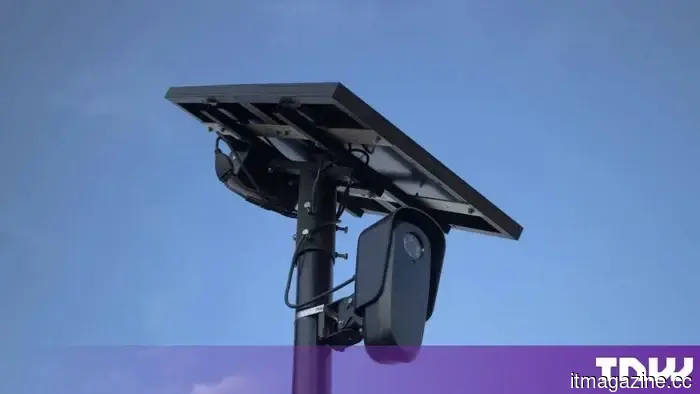
Flock developed an AI tool that allows law enforcement to identify individuals based on their driving behavior.
The surveillance company Flock Safety has claimed for years that its cameras “cannot recognize, identify, or track individuals.” However, a recent investigation reveals that it has developed a tool that can do both. According to WIRED, this artificial intelligence system enables police to search for individuals and vehicles based solely on their movement patterns, without needing a license plate, name, or any initial crime to investigate.
WIRED reporters Dhruv Mehrotra and Dell Cameron reconstructed the tool using files revealed through Flock's login pages. They noted that the code included prompts, search forms, and intended workflows but did not disclose the model’s underlying instructions or server checks.
Initially named Nightshift, the system is now referred to as OS Investigate. The tool can link vehicle scans with police case files and arrest records, as reported by WIRED. It can also incorporate 911 dispatch logs, ballistics results, and commercial identity databases, transforming Flock’s camera network from a historical record of vehicle movements to a system for generating suspect leads.
Behavior-based searches can begin with standard police inquiries, noted WIRED. For instance, an officer may input a license plate to find vehicles seen in that vicinity. Conversely, there are prompts that reverse this logic; one looks for potential witnesses by identifying vehicles frequently observed in a neighborhood over the past two weeks, while another highlights vehicles that visited multiple shops within three days.
Of the prompts analyzed by WIRED, 19 focus on behavioral patterns, with 14 requiring neither a license plate, name, nor physical description. Officers provide a location, time frame, and behavior, and the tool generates a list of people or vehicles that match. It can also link names, addresses, relatives, phone numbers, and online accounts to a license plate. One prompt identifies individuals arrested more than twice in two years and generates a detailed report on three of them.
It’s important to note that these outputs serve as leads rather than definitive proof. An inferred connection between two vehicles does not imply that their owners know one another, and repeated visits to a shopping area do not constitute evidence of criminal activity. Critics argue that a ready-made prompt can cause a tenuous statistical correlation to appear as a routine database output.
Experts and representatives from Flock have expressed their views as well. Chad Marlow, an attorney with the American Civil Liberties Union, warned WIRED about the risks of officers fishing for criminal activity. He stated that the phrasing of a prompt can significantly influence the results, explaining that “the difference between a police officer saying ‘Do you see any criminal patterns’ or ‘Find me criminal patterns’ will yield two different outcomes.” He further noted that the absence of limits on prompts allows police to “lead the AI.” Former officer Noel Pichardo expressed a more direct concern, stating that it indicates Flock “literally tracks people.”
Flock communicated that the tool is still under development. Paris Lewbel, a spokesperson, informed WIRED that OS Investigate is being developed with a select group of law enforcement partners and is distinct from the company’s license plate product, suggesting that its capabilities may evolve before a broader launch. The company did not contest the features described by WIRED.
The timing of this report coincides with increasing scrutiny of how police utilize Flock’s current tools. The Washington Post revealed that at least 50 law enforcement officials faced accusations or charges for misusing license plate reading technology, with Flock cameras involved in 46 of those incidents, including cases of officers allegedly stalking former partners.
On August 13, Flock introduced new safeguards, reducing its standard data retention period to seven days, implementing automatic lockouts for unusual activities, and requiring officers to link case codes to searches by 2026. These controls were designed specifically for searches initiated by individuals. OS Investigate introduces automated lead generation and editable prompts, which critics argue may not be adequately monitored by the oversight designed for manual searches.
Additionally, another initiative aims to provide the public access to related records. A website called “Have I Been Flocked” allows drivers to check if their license plate has been run through the system. It relies on audit logs collected by its organizers through public records requests to more than 6,500 agencies, but they caution that the data may be incomplete and often redacted.
OS Investigate aligns with a direction that Flock has pursued for several years. The company has expanded from static license plate readers into video surveillance, gunshot detection, drones, and 911 software; OS Investigate is the interface that enables cross-referencing of all these tools. CEO Garrett Langley stated on the All-In podcast this week that drones have become the company’s fastest-growing segment.
Investor backing remains strong. Flock secured $275 million in March 2025 at a $7.5 billion valuation, led by Andreessen Horowitz, with Business Insider estimating its latest valuation at $8.4 billion. Its cameras are now installed in over 6,000 communities
Other articles
 TikTok may soon enable users to send money directly through direct messages.
Secret code within TikTok's iPhone application suggests the existence of a direct messaging payment feature supported by TikTok Pay, the service currently utilized for TikTok Shop transactions in certain Asian regions.
TikTok may soon enable users to send money directly through direct messages.
Secret code within TikTok's iPhone application suggests the existence of a direct messaging payment feature supported by TikTok Pay, the service currently utilized for TikTok Shop transactions in certain Asian regions.
 Uber has launched its initial autonomous vehicle rides in Europe, starting in Zagreb, where a safety driver is present.
Uber has introduced autonomous rides in Europe for the first time in Zagreb, utilizing technology from Pony.ai and Verne. A safety operator remains present in the vehicle.
Uber has launched its initial autonomous vehicle rides in Europe, starting in Zagreb, where a safety driver is present.
Uber has introduced autonomous rides in Europe for the first time in Zagreb, utilizing technology from Pony.ai and Verne. A safety operator remains present in the vehicle.
 The sideloading solution that Google pledged months ago is now being released.
Google's enhanced sideloading process is now being implemented, allowing advanced users to bypass ADB. However, you'll have to toggle a setting, confirm your identity, and wait for a period of 24 hours before using it.
The sideloading solution that Google pledged months ago is now being released.
Google's enhanced sideloading process is now being implemented, allowing advanced users to bypass ADB. However, you'll have to toggle a setting, confirm your identity, and wait for a period of 24 hours before using it.
 China successfully lands a rocket booster on the ground for the first time.
China's LandSpace successfully landed the first stage of its Zhuque-3 rocket on solid ground, marking a national milestone that reduces the gap between the US and SpaceX in the realm of reusable rockets.
China successfully lands a rocket booster on the ground for the first time.
China's LandSpace successfully landed the first stage of its Zhuque-3 rocket on solid ground, marking a national milestone that reduces the gap between the US and SpaceX in the realm of reusable rockets.
 Stripe finalizes its OpenRouter agreement for an estimated $7.5 billion or more.
Stripe has officially announced its acquisition of the AI model router OpenRouter. While the purchase price was not revealed, the New York Times reports it to be $7.5 billion, whereas Axios cites it as exceeding $8 billion.
Stripe finalizes its OpenRouter agreement for an estimated $7.5 billion or more.
Stripe has officially announced its acquisition of the AI model router OpenRouter. While the purchase price was not revealed, the New York Times reports it to be $7.5 billion, whereas Axios cites it as exceeding $8 billion.
 Google is offering college students a complimentary year of AI Pro along with a variety of study tools.
Google is offering qualifying US college students a complimentary year of AI Pro and introducing new study tools on Search and Gemini for the back-to-school season.
Google is offering college students a complimentary year of AI Pro along with a variety of study tools.
Google is offering qualifying US college students a complimentary year of AI Pro and introducing new study tools on Search and Gemini for the back-to-school season.
Flock developed an AI tool that allows law enforcement to identify individuals based on their driving behavior.
A WIRED investigation reveals that Flock's AI tool OS Investigate enables law enforcement to track individuals based on their movements without requiring a license plate, name, or any criminal activity.