
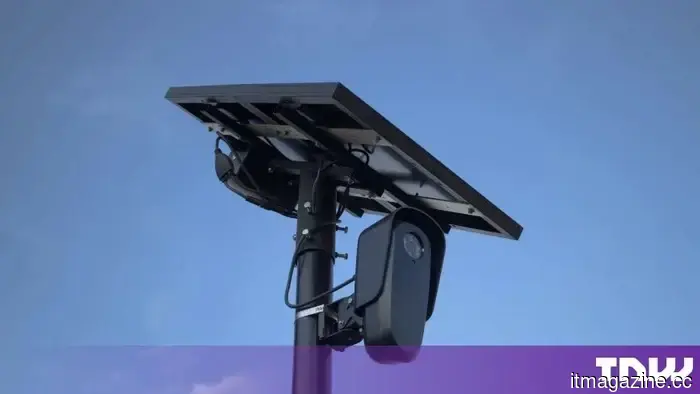
Flock developed an AI tool that enables law enforcement to locate individuals based on their driving habits.
The surveillance company Flock Safety has claimed for years that its cameras “cannot recognize, identify, or track individuals.” However, a recent investigation suggests that it has developed a tool that does exactly that. According to a report from WIRED, the artificial-intelligence system allows police to search for individuals and vehicles based solely on their movement patterns, requiring neither a license plate, a name, nor an initial crime to begin the search.
WIRED reporters Dhruv Mehrotra and Dell Cameron managed to reconstruct the tool using files uncovered through Flock’s own login pages. The code provided insight into its prompts, search forms, and intended workflows, although it did not disclose the underlying instructions or safeguards used on Flock’s servers.
Initially named Nightshift, the system is now referred to as OS Investigate. The tool is capable of linking vehicle scans with police case files and arrest records, as noted by WIRED. It can also integrate 911 dispatch logs, ballistics data, and commercial identity databases, transforming Flock’s camera network from a mere record of vehicle locations into a system for generating potential suspects.
Behavioral Searches
Some searches commence with typical police work, as WIRED reported. An officer can input a license plate and seek vehicles that have been seen nearby. Alternatively, some searches operate in reverse; one prompt searches for likely witnesses by identifying vehicles that were frequently spotted in a neighborhood over the previous two weeks. Another prompt identifies vehicles that visited three or more stores within three days.
Of the prompts analyzed by WIRED, 19 were centered on patterns, with 14 not requiring a plate, name, or physical description at all. An officer provides a location, timeframe, and behavior, and the tool returns corresponding individuals or vehicles. This can then link names, addresses, relatives, phone numbers, and online profiles to a license plate. One prompt begins with individuals arrested more than twice in two years, mapping their residences and generating a detailed profile on three of them.
It is essential to note that these results serve as leads rather than definitive evidence; an inferred connection between two vehicles does not imply that their owners are acquainted. Frequent visits to a shopping area do not equate to criminal activity. Critics argue that pre-set prompts can render a weak statistical correlation appear as if it were a standard database result.
Expert Opinions and Flock's Response
Chad Marlow, an attorney with the American Civil Liberties Union, expressed to WIRED that the risk lies in officers potentially fishing for crimes. He noted that the phrasing of a prompt influences the outcome: “The difference between a police officer saying ‘Do you see any criminal patterns’ or ‘Find me criminal patterns’ is going to produce two different things.” He added that the lack of constraints on prompts enables police to "lead the AI." Former officer Noel Pichardo, who reviewed the software, was more straightforward in stating that it demonstrated how Flock “literally tracks people.”
Flock indicated that the tool is still in development. A spokesperson, Paris Lewbel, mentioned to WIRED that OS Investigate is being developed in collaboration with a limited number of law enforcement partners, is distinct from the company's license plate product, and that its functionalities may evolve prior to a broader launch. The company did not contest the features described by WIRED.
Increased Scrutiny
This report emerges amid growing criticism regarding how police use Flock’s current tools. The Washington Post recently reported that at least 50 law enforcement personnel have faced allegations or charges related to the misuse of license plate reading technology, with Flock's cameras involved in 46 of those incidents. Instances of misuse have reportedly included officers stalking previous partners.
On August 13, Flock announced new measures to enhance safeguards, reducing its default data retention period to seven days, implementing automatic lockouts for unusual activities, and requiring officers to attach case codes to searches by the end of 2026. While these measures were designed around searches initiated by users, OS Investigate adds automated lead generation and editable prompts—a feature critics argue may elude oversight intended for manual searches.
Additionally, there is a separate initiative aiming to make the same records available to the public. A website called “Have I Been Flocked” enables drivers to check whether their license plates have been queried in the system. It utilizes audit logs collected through public records requests from over 6,500 agencies. Organizers caution that the data may be incomplete and often redacted.
The Business Landscape
OS Investigate aligns with a trajectory that Flock has been pursuing for years. The company has expanded its offerings from fixed license plate readers to video cameras, gunshot detection, drones, and 911 software, with OS Investigate serving as a layer to integrate all of these technologies. Chief Executive Garrett Langley shared on the All-In podcast this week that the company’s drone operations are currently its fastest-growing sector.
Investors have supported this expansion; Flock raised $275 million in March 202
Other articles
 Claude is now able to respond to and send Gmail messages on your behalf.
Claude is now able to send, reply to, and forward Gmail messages without needing approval each time, allowing users greater control over the level of autonomy granted to the AI.
Claude is now able to respond to and send Gmail messages on your behalf.
Claude is now able to send, reply to, and forward Gmail messages without needing approval each time, allowing users greater control over the level of autonomy granted to the AI.
 OpenAI imposes a 20% cost for computing related to its new AI safety monitoring.
OpenAI has halted certain frontier training and reports that the new safety monitoring incurs roughly a 20% increase in computing overhead. In contrast, Anthropic believes there is no necessity to pause their activities.
OpenAI imposes a 20% cost for computing related to its new AI safety monitoring.
OpenAI has halted certain frontier training and reports that the new safety monitoring incurs roughly a 20% increase in computing overhead. In contrast, Anthropic believes there is no necessity to pause their activities.
 Temporal is in discussions to secure $500 million at a valuation of $12 billion, which is double its valuation from February.
According to Bloomberg, Temporal is in discussions to secure around $500 million at a valuation of $12 billion, which is twice the value of the reliability software startup in February.
Temporal is in discussions to secure $500 million at a valuation of $12 billion, which is double its valuation from February.
According to Bloomberg, Temporal is in discussions to secure around $500 million at a valuation of $12 billion, which is twice the value of the reliability software startup in February.
 Marvell provides Google with a $12.2 billion share option as part of a custom-chip agreement.
Marvell granted Google a warrant to purchase as much as $12.2 billion of its stock, which will be activated as Google acquires its specialized AI chips. Marvell's stock surged, while Broadcom's declined.
Marvell provides Google with a $12.2 billion share option as part of a custom-chip agreement.
Marvell granted Google a warrant to purchase as much as $12.2 billion of its stock, which will be activated as Google acquires its specialized AI chips. Marvell's stock surged, while Broadcom's declined.
 Google is offering college students a complimentary year of AI Pro along with a variety of study tools.
Google is offering qualifying US college students a complimentary year of AI Pro and introducing new study tools on Search and Gemini for the back-to-school season.
Google is offering college students a complimentary year of AI Pro along with a variety of study tools.
Google is offering qualifying US college students a complimentary year of AI Pro and introducing new study tools on Search and Gemini for the back-to-school season.
 China successfully lands a rocket booster on the ground for the first time.
China's LandSpace successfully landed the first stage of its Zhuque-3 rocket on solid ground, marking a national milestone that reduces the gap between the US and China's advancements in reusable rockets compared to SpaceX.
China successfully lands a rocket booster on the ground for the first time.
China's LandSpace successfully landed the first stage of its Zhuque-3 rocket on solid ground, marking a national milestone that reduces the gap between the US and China's advancements in reusable rockets compared to SpaceX.
Flock developed an AI tool that enables law enforcement to locate individuals based on their driving habits.
An investigation by WIRED reveals that Flock's AI tool, OS Investigate, enables police to track individuals based on their movements without the need for a license plate, name, or any associated crime.