
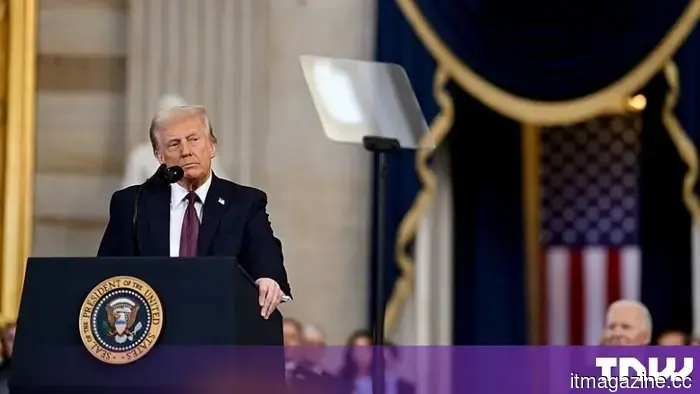
Trump's drone tariffs increase to 100%, while Europe is limited to a maximum of 15%.
Donald Trump signed the proclamation on August 13, titled "Adjusting Imports of Unmanned Aircraft Systems and Unmanned Aircraft Systems Components into the United States." This proclamation is based on Section 232 of the Trade Expansion Act of 1962, which pertains to national security, and Section 604 of the Trade Act of 1974.
Rates and definitions of sensitivity
Starting September 3, there are two tiers of tariffs. The 100% rate applies to drones with a maximum take-off weight exceeding 25 kg, drones equipped with thermal imaging, their docking stations, and a list of essential components. All other items are subject to a 25% tariff, which includes drones weighing 25 kg or less and the components listed in the annexes. The weight threshold significantly differentiates military-grade machines from those used by film crews and surveyors, establishing a clear tier distinction.
A third set is on the horizon. An additional group of components will incur a 25% tariff starting February 9, 2027, providing a 180-day grace period. The proclamation also allows for further tariffs on additional UAS components at the discretion of the Secretary of Commerce on an ongoing basis.
What Europe receives
For Europe, the relevant aspect is the allied cap. EU member states, along with Japan, South Korea, Taiwan, Switzerland, and Liechtenstein, will face a maximum tariff of 15%, while the United Kingdom faces a cap of 10%. This cap is conditional rather than automatic, applying only when “substantially all the critical components and technology are certified... as products of” the approved countries. This certification process is crucial; a drone assembled in Europe using Chinese components may not qualify.
The language is broad, encompassing technology and software in addition to the physical parts identifiable by customs officers. The proclamation explicitly notes the reliance of U.S. manufacturers on foreign sources for critical components such as motors and batteries.
The case presented in the document
The Secretary of Commerce conducted the Section 232 investigation and concluded that drones and their components “are being imported into the United States in such quantities… as to threaten to impair national security.” This conclusion is based on three arguments: the vital role of drones in military operations, the strategic vulnerabilities created by high import levels, and the inadequate domestic production capacity to meet national security requirements. A further point concerns data security, as foreign drones are deemed a risk by potentially transmitting information to foreign governments.
The accompanying fact sheet is titled "Securing American Drone Dominance," describing drones as a crucial technology in contemporary armed conflicts.
The exceptions that shape the policy
There are two measures that mitigate the impact for approved suppliers. Companies on the Department of Defense’s Blue UAS Cleared List, the Blue UAS Framework, or the FCC Conditional Approval List receive a 180-day delay before tariffs apply to their products. The second mechanism involves a program for onshoring; approved companies can import covered products without duties while establishing manufacturing facilities in the U.S. This process requires approval from the Department of Defense and Homeland Security, with compliance monitored. Failure to comply could result in the “rescission of tariff benefits.”
The FCC takes a similar approach
The definitions here closely resemble those in another proceeding. The FCC proposed retroactively banning DJI drones it had previously approved, classifying lidar and thermal cameras as military-grade. Its list includes thermal imaging, docking stations, swarming, aerosol dispersal, and drones weighing over 55 pounds, which aligns with the 25 kg threshold set by the proclamation.
The two measures are also interconnected. Being on the FCC Conditional Approval List provides a pathway to the 180-day delay.
Which European companies are impacted
Three companies are highlighted by Euronews: Parrot in France with its ANAFI range, Quantum Systems in Germany valued over €1 billion, and Tekever in Portugal valued above €1.1 billion. However, the primary target of the proclamation is Chinese supply, particularly DJI, which dominates the global market. European manufacturers will still be subject to tariffs of 15% or 10%, contingent on receiving certification. The desk has previously covered Quantum Systems in relation to drone swarms and its participation at the Berlin airshow.
Meanwhile, European investment continues, such as Cambridge Aerospace raising $300 million at a valuation of $3.4 billion for drone interceptors. The tariff affects these companies' calculations, as selling in the U.S. now incurs a duty, while setting up production there offers incentives.
Market reactions
American drone stocks saw a rise in premarket trading, with AeroVironment, Kratos Defense and Security, and Red Cat all experiencing gains, as reported by Forbes. Unusual Machines increased by 14% to $31.13, after Donald Trump Jr. joined its advisory board in November 2024 and received 200,000 shares, having previously bought 66,000 shares and 66,000 warrants in a private offering.
Other articles
 A judge has instructed Google to ease the installation of competing app stores.
The compliance order from Epic v Google allows Google one week to eliminate the additional taps and warning screens that hinder the installation of competing Android app stores.
A judge has instructed Google to ease the installation of competing app stores.
The compliance order from Epic v Google allows Google one week to eliminate the additional taps and warning screens that hinder the installation of competing Android app stores.
 SpaceX has finalized its $60 billion deal with Cursor, which made a purchase of a company just the day prior.
The acquisition of Cursor by SpaceX was finalized on 14 August. Cursor claims it now has access to the largest GPU fleet globally, along with more affordable models.
SpaceX has finalized its $60 billion deal with Cursor, which made a purchase of a company just the day prior.
The acquisition of Cursor by SpaceX was finalized on 14 August. Cursor claims it now has access to the largest GPU fleet globally, along with more affordable models.
 SpaceX has finalized its $60 billion deal with Cursor, which had acquired a company the day prior.
The acquisition of Cursor by SpaceX was finalized on 14 August. Cursor claims to now have access to the world's largest fleet of GPUs, along with more affordable models.
SpaceX has finalized its $60 billion deal with Cursor, which had acquired a company the day prior.
The acquisition of Cursor by SpaceX was finalized on 14 August. Cursor claims to now have access to the world's largest fleet of GPUs, along with more affordable models.
 Canva's supporters have reduced its valuation by $7.1 billion, while its internal valuator made an even larger cut.
Blackbird and Airtree reduced Canva's valuation to $34.9 billion, and Canva's internal assessment also dropped further, following a revenue downgrade due to AI expenses.
Canva's supporters have reduced its valuation by $7.1 billion, while its internal valuator made an even larger cut.
Blackbird and Airtree reduced Canva's valuation to $34.9 billion, and Canva's internal assessment also dropped further, following a revenue downgrade due to AI expenses.
 Tesla concluded Sweden's longest strike by purchasing out all of the remaining strikers.
The strike at Tesla Sweden concludes after 1,021 days. IF Metall reports that Tesla has bought out approximately 80 striking members, resulting in no one left to continue the strike.
Tesla concluded Sweden's longest strike by purchasing out all of the remaining strikers.
The strike at Tesla Sweden concludes after 1,021 days. IF Metall reports that Tesla has bought out approximately 80 striking members, resulting in no one left to continue the strike.
 The co-founder of Arm believes that AI will generate more value than any previous revolution and will be an exciting ride.
Hermann Hauser, a co-founder of Arm, states that AI will generate greater value than any previous revolution, but cautions that some valuations have become overly optimistic.
The co-founder of Arm believes that AI will generate more value than any previous revolution and will be an exciting ride.
Hermann Hauser, a co-founder of Arm, states that AI will generate greater value than any previous revolution, but cautions that some valuations have become overly optimistic.
Trump's drone tariffs increase to 100%, while Europe is limited to a maximum of 15%.
Tariffs on drones over 25kg and thermal imaging models imposed by Trump have increased to 100%. In contrast, the EU is limited to 15% and the UK to 10%, effective from September 3.