

The next big game might not originate from a million-dollar studio.
**TL;DR** The GDC 2026 survey reveals that 28% of game developers faced layoffs in the past two years, while 36% now utilize generative AI. Robert Brownstein, a former engineer from Boston Dynamics, leads Gnarled Helix, a small indie studio that leveraged AI-assisted development to quickly prototype a chess-resource-management game after years on a higher-budget project. He opts not to include AI-generated art in production but utilizes large language models for coding and idea generation and has created Taurus Tools, a free collaborative level editor.
The financial landscape of creating blockbuster games is becoming as challenging as the games themselves. Development timelines extend over several years, budgets skyrocket, and a single unsuccessful release can wipe out significant investments. Recent workforce data highlights this pressure, with 28% of respondents in the 2026 Game Developers Conference State of the Game Industry survey reporting layoffs in the last two years, and two-thirds of AAA companies having experienced similar staff reductions.
The issue is not only the escalating costs of game production; larger commitments can complicate experimentation. For example, Sony’s Concord, which reportedly took eight years to develop, was withdrawn from the market just two weeks after launch due to a lack of audience interest, showing how quickly extensive production timelines can clash with player expectations. This presents an uncomfortable realization for an industry that thrives on bold undertakings; greater scale amplifies both potential rewards and risks of miscalculation.
At the same time, the resources available to smaller developers are evolving rapidly. The 2026 GDC report shows that 36% of industry professionals now incorporate generative AI into their workflows, primarily for coding and prototyping. Yet, 52% feel that generative AI negatively impacts the industry, indicating ongoing uncertainty about the technology's role in game development.
This situation raises an important question for gaming: if smaller teams can validate and refine ideas quickly without the financial burdens of large productions, could originality prove to be a more significant competitive edge than production scale?
Robert Brownstein is confident that it can be. His experiences have offered him insight into the swiftly changing economics of development.
With a computer science degree earned in 2014, Brownstein worked as a full-stack developer at Boston Dynamics, where he contributed to software for the Spot quadruped robot. Later, he applied his engineering skills to Gnarled Helix LLC, a small studio he founded while still at Boston Dynamics. He emphasizes that transitioning from web development to game development shifted his perspective on product creation, particularly regarding the importance of testing ideas before making substantial commitments.
“Rapid prototypes are lower risk,” Brownstein states. “You can create something that you can confirm is enjoyable and valuable before investing heavily in art that might never be seen.” AI has accelerated this philosophy within his team. Using tools like large language models has allowed Gnarled Helix to focus more on ideation and prototyping, freeing engineers from getting bogged down in implementation details. He views AI as beneficial because human developers still oversee and assess its outputs.
“Everything we do, AI-wise, is moderated by a human. The real constraint lies in maintaining sufficient technical knowledge to understand what the tools produce,” he elaborates.
The increasing presence of AI in game development has reignited a longstanding industry debate: where does production efficiency end and creative authorship begin? As developers utilize AI for tasks like coding and prototyping, discussions intensify about which aspects of a game should remain distinctly human. Brownstein's method exemplifies one definition of that boundary. At Gnarled Helix, he asserts that AI-generated art does not enter the production pipeline, and game design, graphics, and writing are all managed by humans. His approach highlights a broader concern within the industry as it adapts to advancing tools while striving to ensure efficiency does not overshadow creative value.
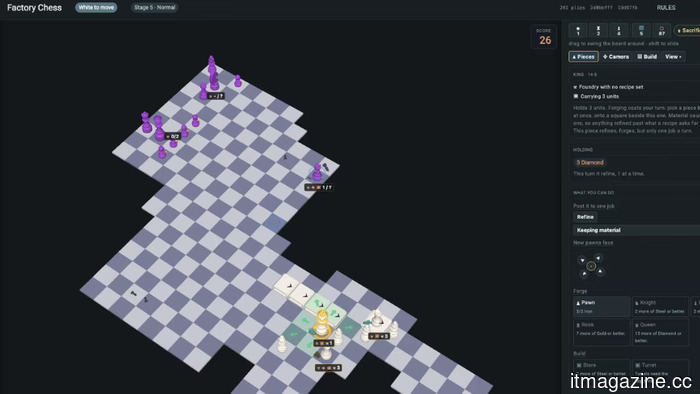
This careful stance is apparent in the studio’s upcoming chess project, which draws inspiration from Brownstein’s interest in chess and the game Satisfactory. The game transforms captured pieces into resources that players can extract, refine, and use to generate new pieces, embedding a familiar ruleset within a unique economic framework. Its single-player roguelike mode expands the game board through various waves and introduces different armies and economies, while another mode allows players to use the mechanics in a classic chessboard format.
Brownstein perceives a broader trend within the industry. He believes smaller teams can explore experimental concepts without subjecting each prototype to the risks that come with major publishers. Gnarled Helix's development timeline served as a practical lesson; the studio spent years on a high-budget programming-learning game but used AI-assisted development to create the new chess concept in just days.
Game development is also generating demand for tools that enhance production efficiency. Brownstein's Tauric Tools originated from his experience creating map-editing systems at various companies, enabling him to develop a free level editor that supports real-time collaboration and formats such as AutoCAD drawings, Tiled files,
Other articles
 Uber is developing a system that will allow 10-year-olds to travel alone.
The code in Uber's iOS application suggests the existence of a tween rides feature for kids aged 10 to 12. However, Uber clarifies that this is not currently an active service, though the engineering work has been done.
Uber is developing a system that will allow 10-year-olds to travel alone.
The code in Uber's iOS application suggests the existence of a tween rides feature for kids aged 10 to 12. However, Uber clarifies that this is not currently an active service, though the engineering work has been done.
 Google's latest Pixel Tag is more compact than an AirTag and more effective at locating your belongings.
Google's response to the AirTag is slimmer than both leading competitors and includes a Bluetooth enhancement that offers accurate tracking for Android devices.
Google's latest Pixel Tag is more compact than an AirTag and more effective at locating your belongings.
Google's response to the AirTag is slimmer than both leading competitors and includes a Bluetooth enhancement that offers accurate tracking for Android devices.
 Google's latest Tensor G6 introduces significant enhancements in performance, efficiency, and security for the Pixel 11 series.
Google's Tensor G6 introduces quicker camera processing, enhanced on-device AI, and new security features for the Pixel 11 series, along with upgrades in performance and efficiency.
Google's latest Tensor G6 introduces significant enhancements in performance, efficiency, and security for the Pixel 11 series.
Google's Tensor G6 introduces quicker camera processing, enhanced on-device AI, and new security features for the Pixel 11 series, along with upgrades in performance and efficiency.
 Google's latest Tensor G6 enhances performance, efficiency, and post-quantum security in the Pixel 11 series.
Google's Titan M3 incorporates NIST's post-quantum standards, positioning the Pixel 11 as the first Google phone designed for a future threat that has not yet emerged.
Google's latest Tensor G6 enhances performance, efficiency, and post-quantum security in the Pixel 11 series.
Google's Titan M3 incorporates NIST's post-quantum standards, positioning the Pixel 11 as the first Google phone designed for a future threat that has not yet emerged.
 Looking to purchase a vibrant Pixel 11? Google has the ideal case for it.
Google's official Pixel 11 cases complement the phones, ensuring that safeguarding your new Pixel does not obscure its character.
Looking to purchase a vibrant Pixel 11? Google has the ideal case for it.
Google's official Pixel 11 cases complement the phones, ensuring that safeguarding your new Pixel does not obscure its character.
 YouTube personality Cliff Tan has expressed his apologies to his 2.4 million followers after endorsing an AI design tool.
Cliff Tan issued an apology to his 2.4 million subscribers for a paid Dreamina advertisement, becoming the second YouTube creator in a week to distance themselves from an AI connection.
YouTube personality Cliff Tan has expressed his apologies to his 2.4 million followers after endorsing an AI design tool.
Cliff Tan issued an apology to his 2.4 million subscribers for a paid Dreamina advertisement, becoming the second YouTube creator in a week to distance themselves from an AI connection.
The next big game might not originate from a million-dollar studio.
AAA budgets are on the rise, yet 28% of game developers indicate that they have been laid off. Robert Brownstein, a former engineer at Boston Dynamics, contends that AI-assisted prototyping enables small teams to evaluate innovative mechanics in days rather than years.