

A Chinese startup asserts that its brain implant can be inserted in just 10 minutes without the need for skull surgery.
StairMed Technology's vein-based brain-computer interface (BCI) may surpass Neuralink's two-hour surgical process in terms of speed, but the device has yet to be tested on humans.
Typically, brain implants, like those developed by Elon Musk’s Neuralink, necessitate open-skull surgery. However, a Chinese startup claims it can bypass this procedure entirely by inserting its device through a vein, achieving a reported operation time of just ten minutes. As reported by the South China Morning Post, Shanghai-based StairMed Technology is among several companies exploring this method as China seeks to grow its domestic BCI industry.
On paper, it’s faster than Neuralink
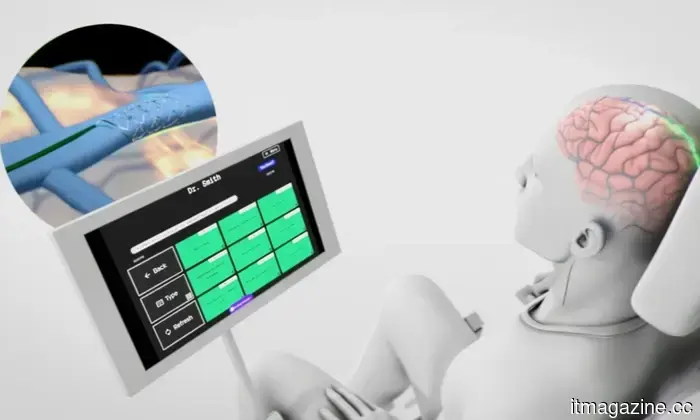
Unlike Neuralink’s implant, which requires a surgical robot to open the skull and position ultra-fine electrode threads directly into brain tissue, StairMed Technology’s device is introduced through a neck vein and travels through the vascular system to reach the brain, as explained by co-founder Zhao Zhengtuo at the Global Health Summit in Hong Kong. Dr. Duan Wanru from Xuanwu Hospital stated that a surgeon with a few years of experience could place the device in approximately ten minutes, significantly shorter than the roughly two hours it took Neuralink's surgical robot to conduct the first human surgery in 2024.
Synchron BCI/YouTube
The company has secured over 1.1 billion yuan (around $163 million) in funding over the past year, with support from Tencent and Alibaba. However, its vein-based method has only been tested on sheep so far, and since StairMed has not yet commenced human trials, the ten-minute timeframe remains aspirational rather than confirmed.
The concept isn't novel, but the speed claim is
StairMed isn't the first to pursue vein-based BCI technology. Synchron, a US-based company, has already implanted its device, known as the Stentrode, in ten patients in clinical trials across the US and Australia since 2023, as reported by IEEE Spectrum. Synchron’s device is positioned within a blood vessel near the brain’s motor cortex and detects signals through the vessel wall, while StairMed asserts its design exits the vessel and anchors just outside of it.
Market dynamics illustrate why speed is crucial. Morgan Stanley forecasts the BCI implant market could hit $80 billion in the US alone by 2035, and Beijing aims to have two or three Chinese firms competing in the global arena by 2030. A procedure that requires only minutes rather than hours would facilitate scaling across hospitals, which likely explains StairMed's promotion of the ten-minute claim, despite lacking patient data to substantiate it.
If you're anticipating a ten-minute brain implant in an operating room soon, it’s wise to manage your expectations. StairMed still needs to validate that its device and delivery method work effectively, a process that Synchron has already spent years refining with its similar approach.





Other articles
 Lambda is taking out a loan of $917 million to purchase chips from the company that is investing in it.
Lambda is offering a $917 million leveraged loan to finance a deal with Nvidia, which is both its investor and supplier, as well as its biggest customer. The total offers reached $2 billion.
Lambda is taking out a loan of $917 million to purchase chips from the company that is investing in it.
Lambda is offering a $917 million leveraged loan to finance a deal with Nvidia, which is both its investor and supplier, as well as its biggest customer. The total offers reached $2 billion.
 House Democrats are seeking to have AI CEOs testify under oath. Only Mike Johnson has the power to facilitate this.
House Democrats posed 23 questions to OpenAI by August 24. One of the questions inquired whether a model provided guidance for the next one to bypass its limitations.
House Democrats are seeking to have AI CEOs testify under oath. Only Mike Johnson has the power to facilitate this.
House Democrats posed 23 questions to OpenAI by August 24. One of the questions inquired whether a model provided guidance for the next one to bypass its limitations.
 Your MacBook trackpad can now vibrate like a cat, and it’s surprisingly realistic.
A developer has discovered a uniquely quirky application for the MacBook's trackpad. PurrPad utilizes its integrated haptics to make the trackpad emit a purring sound like a cat, featuring various personalities, adjustable levels of affection, and even playful zoomies.
Your MacBook trackpad can now vibrate like a cat, and it’s surprisingly realistic.
A developer has discovered a uniquely quirky application for the MacBook's trackpad. PurrPad utilizes its integrated haptics to make the trackpad emit a purring sound like a cat, featuring various personalities, adjustable levels of affection, and even playful zoomies.
 Google Chrome is developing a new feature that allows you to open PDF files in your chosen application.
Chrome for Android is experimenting with a feature that may automatically launch downloaded files in the user's chosen app rather than in Chrome.
Google Chrome is developing a new feature that allows you to open PDF files in your chosen application.
Chrome for Android is experimenting with a feature that may automatically launch downloaded files in the user's chosen app rather than in Chrome.
 OpenAI suspended a model due to cybersecurity concerns on Friday. By Monday, it released a new version that is trained to be less restrictive.
OpenAI launched GPT-5.6-Cyber via Daybreak, just three days after halting Astra due to significant cyber risks. It fulfills 95% of the requests that Sol denies.
OpenAI suspended a model due to cybersecurity concerns on Friday. By Monday, it released a new version that is trained to be less restrictive.
OpenAI launched GPT-5.6-Cyber via Daybreak, just three days after halting Astra due to significant cyber risks. It fulfills 95% of the requests that Sol denies.
 The Ninth Circuit allowed 2,400 addiction lawsuits to move forward without altering Section 230.
The Ninth Circuit allowed 2,400 addiction lawsuits to move forward without making a decision on Section 230. On August 18, Meta is confronted with demands from four states totaling $1.4 trillion.
The Ninth Circuit allowed 2,400 addiction lawsuits to move forward without altering Section 230.
The Ninth Circuit allowed 2,400 addiction lawsuits to move forward without making a decision on Section 230. On August 18, Meta is confronted with demands from four states totaling $1.4 trillion.
A Chinese startup asserts that its brain implant can be inserted in just 10 minutes without the need for skull surgery.
A Chinese startup claims that its brain-computer interface can be inserted through a vein in just ten minutes, bypassing the open-skull surgery that Neuralink depends on. However, the drawback is that it has not yet entered human trials.