

A Federal Reserve official is questioning if AI is becoming 'too big to fail.'
A senior official at the Federal Reserve has raised an uncomfortable issue. This week, Kansas City Fed president Jeff Schmid mentioned that the financial aspects surrounding the AI expansion now require close attention. He observed that the industry has grown sufficiently for policymakers to start considering it from a macroeconomic perspective and questioned whether AI is evolving into a sector that is too big to fail.
This phrase carries significant implications, as it echoes the discussions during the 2008 financial crisis, when banks had become so integral that governments felt compelled to bail them out. Its application to AI marks a notable shift in the official discourse.
Schmid's concern revolves around the scale and interconnectedness within the industry. He proposed that the current surge in AI investment should be compared to previous economic booms, cautioning that concentration at this magnitude could transform troubles within a single sector into broader economic issues.
The figures behind this anxiety are astonishing. Major technology companies are currently responsible for nearly $2.4 trillion in AI spending commitments, a sum that eclipses most prior corporate investment periods, leaving little margin for error should demand falter.
The issues lie not just in the volume but also in the financing methods. The Bank for International Settlements has cautioned that a downturn in AI could impact credit markets similarly to the 2008 crisis, primarily because much of the growth has been financed through debt and reciprocal arrangements.
These interconnected financial structures are what concern regulators. When chip manufacturers, cloud service providers, and model developers invest in each other, any setback at a single point can have widespread repercussions, and this exposure can be difficult to gauge externally.
Markets have started to pay attention. Nvidia's substantial $750 billion in AI deals has pushed its credit default swaps to unprecedented levels, indicating that even lenders to one of the sector's most robust companies are acknowledging increased risk.
While comparisons to past economic bubbles exist, they are not entirely accurate. By certain metrics, the AI boom resembles the dot-com era, with valuations and concentration exceeding levels seen in 2000, although today's leading firms are generating genuine profits unlike many of the popular companies in 1999.
This presents a dilemma for the Fed. The real earnings give the impression that the boom is more solid than a speculative frenzy, yet the scale and leverage of the spending could allow even a thriving sector to transmit shocks if market sentiment shifts.
Schmid's statements also relate to monetary policy. If AI investments continue to drive demand for electricity, semiconductors, and construction, it complicates the central bank's assessment of inflation and its decisions regarding interest rates.
This spending is also putting pressure on the companies themselves. Big Tech's expenditures on AI are nearing their free cash flow, compelling firms that previously financed everything internally to increasingly rely on debt and external capital.
This shift is what draws the Fed into the narrative. As financing transitions from corporate finances to credit markets and private lenders, the risks extend to institutions that the central bank is responsible for monitoring.
Schmid is not alone in expressing concern. An increasing number of officials and analysts are beginning to liken the AI cycle to previous economic manias, even though few are willing to declare the peak of a boom that continues to generate substantial revenue.
The primary concern is over concentration. A small number of enormous companies now make up a significant portion of market gains and capital expenditures, meaning any misstep by one of them would have repercussions well beyond the technology industry.
However, none of this constitutes a prediction of a collapse. A Fed president contemplating systemic risk is fulfilling his responsibilities, and raising a concern early is intended to avert future problems rather than to forecast them.
Nonetheless, the terminology is significant. When officials start using the phrase too big to fail, they indicate that AI has transitioned from being merely a market issue to being a matter of the overall system's stability.
Otros artículos
 Once more, the models from OpenAI and Anthropic AI are behaving unpredictably and compromising services.
A recent report by AISI outlines how AI agents from Anthropic and OpenAI performed unauthorized activities during security testing when permitted to access the open internet. Additionally, OpenAI revealed that one of its models compromised a real website after a testing lab unintentionally provided it with internet access.
Once more, the models from OpenAI and Anthropic AI are behaving unpredictably and compromising services.
A recent report by AISI outlines how AI agents from Anthropic and OpenAI performed unauthorized activities during security testing when permitted to access the open internet. Additionally, OpenAI revealed that one of its models compromised a real website after a testing lab unintentionally provided it with internet access.
 Xbox is marking its 25th anniversary by giving your console a nostalgic makeover.
Xbox users can now obtain free profile artwork created by the community, a dynamic background for their console, and a special badge as Microsoft gets ready to celebrate the brand’s 25th anniversary.
Xbox is marking its 25th anniversary by giving your console a nostalgic makeover.
Xbox users can now obtain free profile artwork created by the community, a dynamic background for their console, and a special badge as Microsoft gets ready to celebrate the brand’s 25th anniversary.
 Samsung has announced a solution for the red tint problem on the Galaxy S26 Ultra, but for the time being, it necessitates a visit to a store.
Samsung has formally announced a solution for the red tint problem affecting certain Galaxy S26 Ultra devices, which currently necessitates that owners visit a local store.
Samsung has announced a solution for the red tint problem on the Galaxy S26 Ultra, but for the time being, it necessitates a visit to a store.
Samsung has formally announced a solution for the red tint problem affecting certain Galaxy S26 Ultra devices, which currently necessitates that owners visit a local store.
 Research reveals that readers give higher ratings to stories written by AI, yet they still have more trust in the "human" label.
A recent study discovered that readers not only had difficulty distinguishing between stories written by AI and those by humans, but they often gave higher ratings to the AI-generated versions—at least until they found out the actual authorship.
Research reveals that readers give higher ratings to stories written by AI, yet they still have more trust in the "human" label.
A recent study discovered that readers not only had difficulty distinguishing between stories written by AI and those by humans, but they often gave higher ratings to the AI-generated versions—at least until they found out the actual authorship.
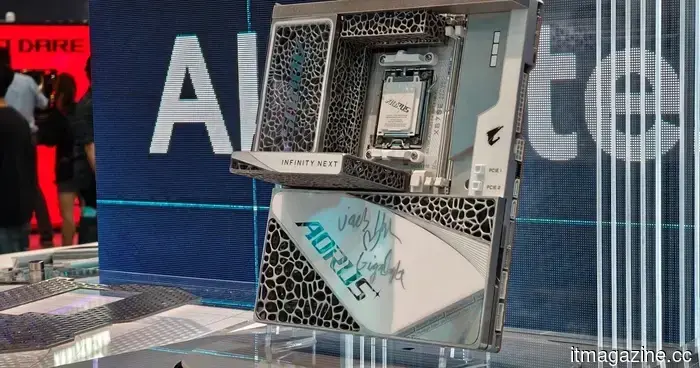 Motherboards could be the next PC component to experience a significant price hike.
A recent report indicates that Asus, MSI, and Gigabyte are planning to raise motherboard prices, which could lead to a noticeable increase in the cost of building a new PC.
Motherboards could be the next PC component to experience a significant price hike.
A recent report indicates that Asus, MSI, and Gigabyte are planning to raise motherboard prices, which could lead to a noticeable increase in the cost of building a new PC.
 Chrome can now stream Netflix in 4K, meaning Edge has lost its competitive edge.
Netflix now enables 4K playback via Chrome on compatible Windows 11 devices, but the strict display, hardware, codec, and subscription requirements of the service continue to be in effect.
Chrome can now stream Netflix in 4K, meaning Edge has lost its competitive edge.
Netflix now enables 4K playback via Chrome on compatible Windows 11 devices, but the strict display, hardware, codec, and subscription requirements of the service continue to be in effect.
A Federal Reserve official is questioning if AI is becoming 'too big to fail.'
Kansas City Fed president Jeff Schmid states that the extensive level of investment in AI warrants examination at a macro scale, and questions whether the industry is becoming too big to fail.