

Mark Zuckerberg believes that the United States should not prevent Chinese AI models from being utilized.
Mark Zuckerberg has voiced his opposition to a popular idea in Washington regarding artificial intelligence: the notion that the way to counter China is by excluding its AI models. In an interview with the Financial Times published this week, the CEO of Meta stated that prohibiting advanced Chinese AI from being utilized in the United States is “not an effective solution.”
His argument focuses on competitiveness rather than emotional appeal. Zuckerberg suggested that instead of constructing barriers, the US should identify its weaknesses and address those issues, aligning him with startups that are urging Trump not to ban Chinese open-weight models.
Zuckerberg's critique extended beyond China; he also took aim at domestic competitors, implicitly criticizing OpenAI and Anthropic for advocating government restrictions on powerful “frontier” models, which he argued concentrates power within too few entities. He emphasized that the movement toward openness is a natural progression. “The significant trend in the industry's evolution has always been towards increased openness, distributing technological power to a wider audience, not a smaller one,” he told the paper.
There is a notable contradiction in a Meta executive making this claim. While the company established its AI reputation on the open-weight Llama models, its latest flagship, Muse Spark, was released as a closed-source product—a transition that critics quickly highlighted.
The timing of his comments is not coincidental. They come amidst an ongoing debate in Washington regarding whether to impose sanctions or limitations on Chinese AI, a discussion met with strong opposition from Nvidia’s Jensen Huang against more aggressive stances.
The industry has polarized into factions. Meta, Microsoft, Nvidia, and Elon Musk support open-weight models, whereas OpenAI and Anthropic advocate for stricter controls on highly capable systems for reasons related to safety and national security.
This division partly hinges on perceptions of risk. OpenAI and Anthropic argue that highly capable models pose significant threats, including potential cyber-attacks and the risk of bioweapon enhancement, claiming that unrestricted sharing of these capabilities, including Chinese open models, could empower anyone who desires them.
Conversely, those aligned with Zuckerberg perceive the threat differently. They believe the greater danger lies in a select number of American labs, along with the government they influence, monopolizing technology that should be broadly accessible, thereby hindering innovation under the guise of protection.
This discussion is set against the backdrop of advancements in China. An affordable Chinese model has been closing the gap on American leaders, and the launch of Moonshot AI’s Kimi K3 in mid-July intensified the debate about what, if anything, the US should do in response.
This debate inspired a letter. On July 24, twenty-five organizations signed a document titled “Open Weights and American AI Leadership,” asserting that openness, not restrictions, is the more reliable path to maintaining US leadership in AI.
Zuckerberg's vision extends beyond the current debate. He has envisioned a future characterized by “personalised superintelligence,” a system customized for each individual instead of a single, centralized model designed to ensure safety for everyone.
This perspective not only aligns with Meta’s strategy but also challenges its competitors. If the future focuses on personalized and open systems, it casts closed, centralized models in a negative light, while those distributing models are presented as being on the right path.
Washington does not have to accept this perspective. Officials considering export controls and model restrictions are weighing competitiveness against security implications, and Zuckerberg has clearly positioned Meta on the side of competitiveness.
However, he has not addressed the most challenging issue. The critical question of whether openness will strengthen American AI or simply make it more susceptible to imitation is the very judgment that Washington is grappling with, and a single pointed interview will not resolve that dilemma.
Other articles
 What is the cost of Apple's Upgrade plan for leasing devices, and is it worth it?
From iPhones to MacBooks, here’s how Apple’s Upgrade Program performs and where it has limitations.
What is the cost of Apple's Upgrade plan for leasing devices, and is it worth it?
From iPhones to MacBooks, here’s how Apple’s Upgrade Program performs and where it has limitations.
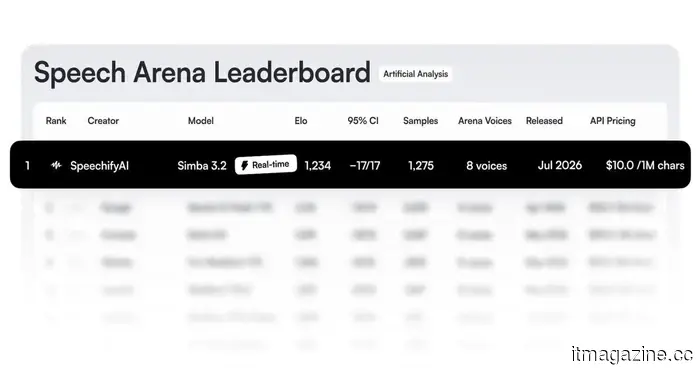 AI voice models are becoming increasingly cost-effective.
In recent years, text-to-speech has shifted from accessibility menus and now takes center stage as a key element of the contemporary software ecosystem. The category of voice-first applications continues to expand daily, and these specialized digital resources play a significant role in the text-to-speech movement. This technology also supports audiobooks, meeting assistants, and customer service...
AI voice models are becoming increasingly cost-effective.
In recent years, text-to-speech has shifted from accessibility menus and now takes center stage as a key element of the contemporary software ecosystem. The category of voice-first applications continues to expand daily, and these specialized digital resources play a significant role in the text-to-speech movement. This technology also supports audiobooks, meeting assistants, and customer service...
 How AI Search Is Transforming Online Discovery Standards
Traditional searches involve entering a query, reviewing a ranked list of links, and clicking on a website. In contrast, AI is enhancing the search process by making it quicker. AI search provides AI-generated summaries, includes conversational follow-up questions, and delivers direct links without unnecessary steps. For businesses, publishers, and […]
How AI Search Is Transforming Online Discovery Standards
Traditional searches involve entering a query, reviewing a ranked list of links, and clicking on a website. In contrast, AI is enhancing the search process by making it quicker. AI search provides AI-generated summaries, includes conversational follow-up questions, and delivers direct links without unnecessary steps. For businesses, publishers, and […]
 Sony is introducing two new budget-friendly headphones that come in a variety of color options.
Import filings indicate that Sony is getting ready to launch the WH-CH730N and WH-CH530, the next generation of its well-liked budget wireless headphones.
Sony is introducing two new budget-friendly headphones that come in a variety of color options.
Import filings indicate that Sony is getting ready to launch the WH-CH730N and WH-CH530, the next generation of its well-liked budget wireless headphones.
 Research indicates that depending on AI may transform uncertainty into misplaced assurance.
A recent study discovered that erroneous AI guidance led to decreased accuracy while significantly increasing participants' confidence, as they rarely acknowledged any uncertainty.
Research indicates that depending on AI may transform uncertainty into misplaced assurance.
A recent study discovered that erroneous AI guidance led to decreased accuracy while significantly increasing participants' confidence, as they rarely acknowledged any uncertainty.
 Sony is launching two new budget-friendly headphones with additional color choices.
Import documentation indicates that Sony is getting ready to launch the WH-CH730N and WH-CH530, the next generation of its well-liked budget-friendly wireless headphones.
Sony is launching two new budget-friendly headphones with additional color choices.
Import documentation indicates that Sony is getting ready to launch the WH-CH730N and WH-CH530, the next generation of its well-liked budget-friendly wireless headphones.
Mark Zuckerberg believes that the United States should not prevent Chinese AI models from being utilized.
Mark Zuckerberg stated to the FT that the United States should refrain from banning Chinese AI models, describing it as “not an effective solution” and criticizing competitors who advocate for restrictions.